
🚶 The Marathon Machine: China's Agibot A2 Sets a World Record for Humanoid Endurance
Inside the 106 km intercity trek: How the Agibot A2's feat of power efficiency and stability marks a revolutionary milestone for bipedal robotics.

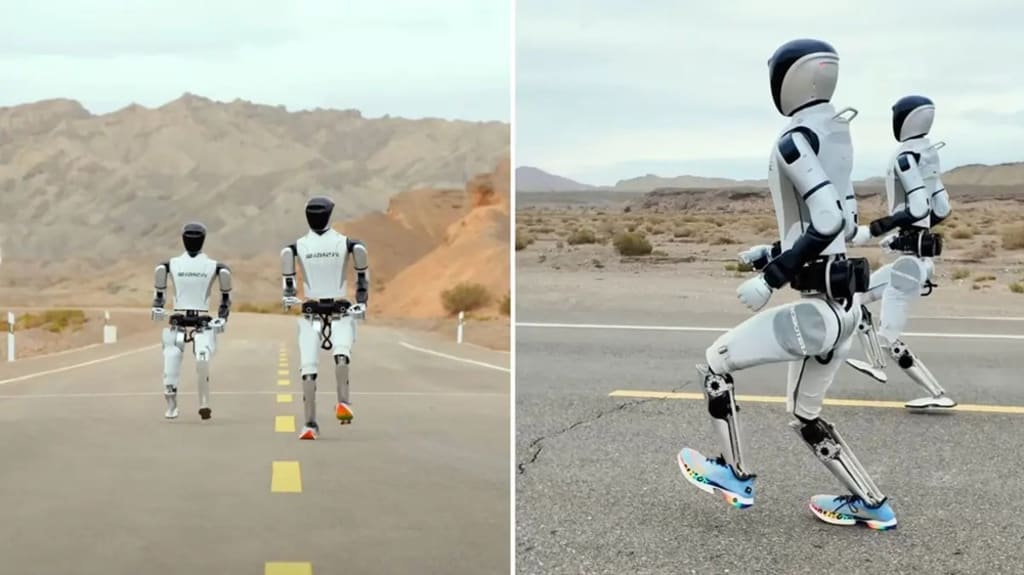
The development of humanoid robots often captures the public imagination with demonstrations of dexterity and complex manipulation. However, the true bottleneck for real-world deployment—whether in factories, disaster zones, or everyday life—is often something far more mundane: endurance and power efficiency.
This week, the Chinese robotics firm Agibot shattered all previous benchmarks by announcing that their humanoid robot, the A2, had successfully completed the "Longest Journey by a Humanoid Robot," covering an astonishing 106.286 kilometers without shutting down. The A2’s journey, which began in Suzhou on November 10th and concluded at the Shanghai Bund early on November 13th, is more than a Guinness World Record; it is a critical validation of the advancements being made in Chinese bipedal locomotion and energy management.
The Engineering Triumph: Efficiency over Speed
The journey itself—a staggering 106.286 km—is a testament to the A2’s engineering prowess, particularly in two areas where bipedal robots typically fail: stability in locomotion and power consumption.
1. The Challenge of Bipedal Walking (ZMP Control)
Walking is inherently energy-intensive and complex for a machine. Unlike wheeled robots, the A2 must constantly calculate and adjust its center of gravity to maintain stability—a principle known as the Zero Moment Point (ZMP) control. Successfully navigating over 100 kilometers of real-world, likely uneven, urban and intercity surfaces without a single fall or catastrophic system failure speaks volumes about the sophistication of Agibot’s proprietary gait algorithms. The ability to maintain sustained, energy-efficient walking for over two days is a massive leap forward from the short-duration demonstrations previously seen globally.
2. Power Management: The Quick-Swap Solution
The robot did not complete the journey on a single battery pack; the official record notes that it was powered by Agibot’s quick-swap battery system. This detail is crucial. It confirms that Agibot has engineered a system where the robot can seamlessly transition between power sources without powering down, maintaining continuous operation.
This efficiency is the real game-changer. For potential industrial partners, this means the robot’s utility is no longer limited by its battery life. A team of human operators can simply swap depleted battery packs for fresh ones, ensuring the robot can work non-stop, 24/7. This capability dramatically improves the Return on Investment (ROI) potential for the A2 in logistics or industrial settings.
The Psychological and Media Impact
The A2’s journey was highly publicized, culminating in the robot’s arrival at the iconic Shanghai Bund. The final quote attributed to the robot—describing the trip as an "unforgettable experience in its machine life" and humorously suggesting it "might need new shoes"—was a brilliant piece of anthropomorphic marketing.
This humanizing approach serves a dual purpose:
Public Acceptance: By giving the robot a voice and a sense of 'fatigue,' Agibot helps to bridge the psychological gap between complex machine and accessible companion, fostering positive public perception.
Demonstrating Learning: While the walk was physically demanding, the humor subtly emphasizes the underlying machine learning and large language model (LLM) integration that allows the robot to generate contextual, human-like responses, even post-feat.
Global Competition and the Robotics Race
The Agibot A2’s record should be viewed in the context of the intense global race in humanoid robotics, particularly against giants like Tesla’s Optimus and Figure AI (which recently retired its Figure 02 after factory work).
While Optimus and Figure focus heavily on complex manipulation and factory work, Agibot has placed a critical emphasis on locomotion and generalized mobility. The A2's endurance record is a direct challenge to the often-short, controlled demonstrations shown by competitors. It proves that Chinese robotics is now leading the field in the fundamental physics of bipedal travel over long distances—a core requirement for logistics and home service roles.
Conclusion: The Long March to General Autonomy
The 106-kilometer walk by the Agibot A2 is far more than a stunt; it is a scientific validation of power optimization and mechanical stability. It confirms that the limiting factor in deploying humanoid robots is rapidly shifting away from hardware capability and toward software and regulatory acceptance.
By solving the endurance puzzle through highly efficient walking and seamless quick-swap batteries, Agibot has effectively demonstrated that their robot is ready to transition from controlled lab environments to continuous, real-world deployment. The A2 has not just set a record for walking; it has set a new benchmark for sustained performance in the rapidly evolving world of humanoid robotics.
About the Creator
Tiles 101: A Practical Guide to Choosing the Right Tile for Your Space
Tile has remained one of the most versatile and reliable building materials used in homes and commercial spaces. From kitchens and bathrooms to entryways and patios, tiles offer a combination of durability, style, and easy maintenance that few flooring options can match. Understanding the different types of tile and how they perform in various environments can help homeowners and property managers make more informed decisions.
By Jillian Rowe2 days ago in Journal
TUS NUA - ch 53
TUS NUA – ch 53 New Beginnings – Mia and Midnight (*)(*)(*) Finola knew Ali’s brother-in-law needed to put his mind at rest. She fed her arm through his and led him outside. “We’ll sit here. If you like, I can put a block around us so our conversation will be private.”
By Margaret Brennan5 days ago in Fiction




Comments (1)
tks!