
The Invisible Network Powering Our Digital Lives
How fiber optics quietly drive the world’s digital economy
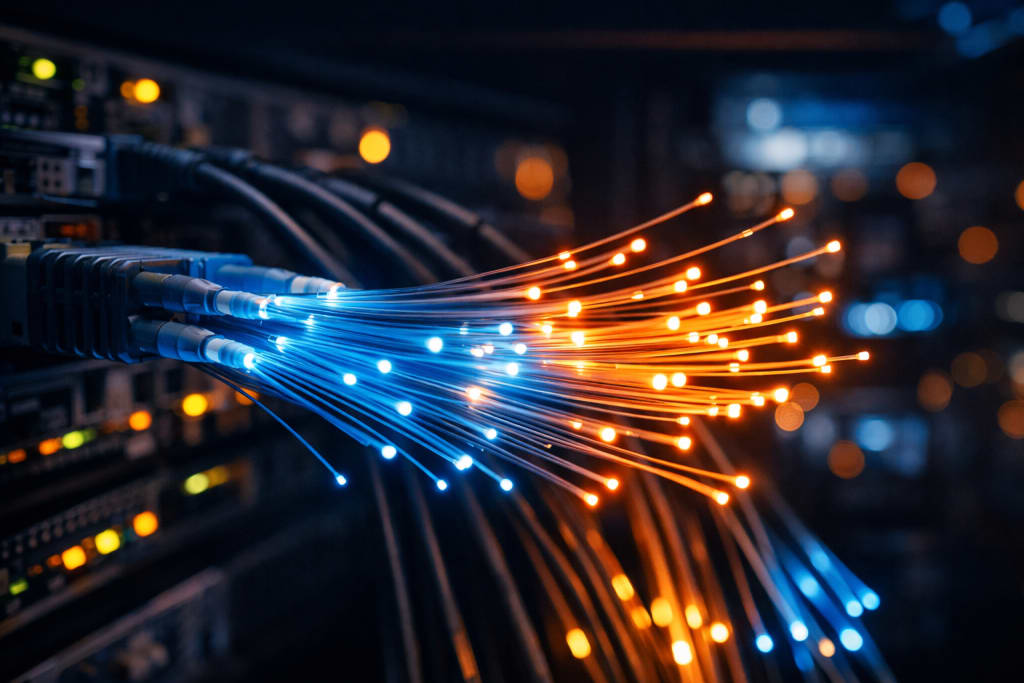
At any moment, billions of messages, videos, and transactions travel across the world in the form of light.
Not through satellites or wireless towers alone, but through hair-thin strands of glass buried underground and stretched across oceans. These fiber optic cables form the invisible highways of our digital lives, quietly carrying everything from streaming movies to AI-generated answers.
Behind this network lies a rapidly expanding fiber optic component industry, responsible for the transmitters, connectors, and optical modules that allow data to move at incredible speeds.
And the industry is growing fast.
According to Mordor Intelligence, the fiber optic component market size is expected to reach USD 38.81 billion in 2026, up from USD 35.42 billion in 2025, and projected to climb to USD 61.24 billion by 2031, expanding at a 9.56% CAGR between 2026 and 2031.
This steady rise highlights the increasing importance of optical technology in powering the modern internet.
The Backbone of the Digital World
Every time you send an email, join a video call, or stream a show, data travels across networks supported by optical infrastructure.
Inside these networks are specialized parts that make communication possible. Components like optical transmitters, receivers, amplifiers, and connectors convert electronic signals into light and back again. Together they form the core of the fiber optic component market.
Unlike traditional copper cables, fiber optics transmit data using light pulses, which allows for dramatically higher speeds and bandwidth. This capability is essential as digital activity continues to grow worldwide.
Modern technologies depend heavily on optical infrastructure, including:
- Cloud computing platforms
- Streaming and video services
- Artificial intelligence workloads
- Smart homes and IoT devices
- Enterprise data centers
As digital demand expands, so does the need for reliable fiber networks. This demand is a major driver of fiber optic component market growth across telecommunications and technology sectors.
The Data Explosion Driving Demand
Over the past decade, global internet usage has surged. Businesses rely on cloud services, individuals stream high-resolution media, and organizations exchange enormous volumes of information daily.
This explosion of digital activity is shaping the fiber optic component market trends seen across the industry.
Telecommunication providers are expanding fiber networks to support high-speed connectivity, while hyperscale data centers are deploying advanced optical interconnects to handle growing workloads. Artificial intelligence applications, in particular, require ultra-fast data transfers between processors and storage systems.
As a result, the fiber optic component market share is increasingly tied to companies capable of delivering high-performance optical technologies that meet these evolving requirements.
Another factor driving adoption is network reliability. Fiber optics are less susceptible to interference and signal loss compared to copper cables, making them ideal for long-distance communication and high-capacity infrastructure.
These advantages continue to strengthen the long-term fiber optic component market forecast.
Innovations Shaping the Industry
Technological progress within the fiber optic component industry is improving both efficiency and performance.
One major development is wavelength division multiplexing, a technology that allows multiple signals to travel through the same fiber using different wavelengths of light. This dramatically increases data capacity without requiring new cables.
Another advancement is the growth of coherent optical transmission, which improves long-distance data transport by reducing signal degradation.
Meanwhile, data centers are adopting more compact optical components designed to support dense computing environments while consuming less energy.
These innovations represent some of the most important fiber optic component market trends, helping networks scale to meet the demands of an increasingly digital world.
Why Fiber Infrastructure Matters
The future of connectivity depends on high-speed, reliable networks.
From smart cities and autonomous vehicles to advanced cloud services and global digital collaboration, nearly every emerging technology relies on fiber infrastructure.
Governments and private companies worldwide are investing heavily in expanding fiber networks to support economic growth and technological innovation.
Subsea cables linking continents, metropolitan fiber networks connecting cities, and high-capacity data centers all depend on the optical technologies driving the fiber optic component market growth.
As digital transformation accelerates, these networks will become even more critical to global communication.
The Light-Speed Future
The internet may feel invisible, but its foundation is very real — a vast system of cables and components carrying light across the planet.
Inside that system, the fiber optic component industry continues to evolve, enabling faster networks and greater connectivity for businesses and individuals alike.
With the fiber optic component market size expected to reach USD 61.24 billion by 2031, the role of optical technology in shaping the future of communication is only becoming more significant.
Your Thoughts
Fiber optics power nearly everything we do online, yet most people rarely think about them.
Do you think future technologies like AI, smart cities, and immersive digital worlds will push fiber infrastructure even further?
About the Creator
Keep reading
More stories from Andrew Hamilton and writers in Journal and other communities.
Why Ancient Goldsmithing Still Outperforms Modern Machines
In an age defined by automation and digital precision, it is easy to assume that machines have replaced traditional craftsmanship in nearly every industry. Jewellery, however, tells a different story. While 3D printers and computer-guided tools dominate headlines, one of the oldest techniques in metalworking continues to hold its ground: the lost-wax casting method.
By Md Mehedi Hasan Rifad2 days ago in Journal
Cassie and Johnny
I’m the kind of dame you notice. I’m no femme fatale, but you can’t ignore me, at least not until I warn you about what’s coming, then everybody ignores me. Hell, they usually blame me afterwards and give Johnny all the credit for saving the day, but my Johnny couldn’t save a seat at the movies without my help. Sure, he’s brawny, but brainy? Not so much. Like that time I asked him to spot me five bucks, and he said he didn’t see it anywhere on me, and believe you me, he looked but good.
By Harper Lewis7 days ago in Critique



Comments
There are no comments for this story
Be the first to respond and start the conversation.