
The Human Factor: Why AI Depends On Human Talent More Than Ever
Explore the vital role of human talent in AI. Learn why The Human Factor: Why AI Needs Human Talent More Than Ever is essential.

Key Highlights
- The integration of AI in the workplace is transforming job roles and creating new ones, requiring upskilling and reskilling.
- Human talent remains crucial for AI advancement, especially in areas requiring emotional intelligence, soft skills, and a human touch.
- The ethical dimension of AI integration necessitates careful consideration regarding transparency, accountability, and potential biases.
- Collaboration between AI and humans in creative industries enhances creativity, with AI serving as a tool to augment human intuition.
- Real-world applications highlight successful AI and human collaboration in healthcare, customer service, and other industries.
- Overcoming challenges like the skills gap and ensuring inclusivity in AI-driven workplaces are crucial for harnessing the full potential of AI.
Introduction
Artificial intelligence (AI) is rapidly changing the future of work, transforming industries and revolutionizing the way we work. While AI excels at automating tasks and analyzing vast amounts of data, it's becoming increasingly clear that human capabilities are more vital than ever. The key to unlocking the full potential of AI lies not in replacing humans but in fostering a symbiotic relationship where human talent complements and guides AI advancements.
Unveiling the Symbiosis: AI and Human Talent

Machine learning, a powerful subset of AI, enables systems to learn from data and improve their performance over time. While this has led to the development of sophisticated AI tools, these tools still require human oversight to ensure accuracy, ethical use, and alignment with organizational goals. Human intelligence provides the crucial judgment and context necessary to interpret AI-generated insights and make informed decisions.
This collaboration between AI and humans forms a powerful partnership, where AI automates repetitive tasks and provides data-driven insights, while humans focus on higher-level thinking, creativity, and strategic decision-making.
The Evolution of AI in the Workplace
The rise of AI is driving a massive digital transformation across industries, impacting job roles and reshaping the employment landscape. The integration of AI technologies in various sectors is automating routine tasks, augmenting human capabilities, and creating entirely new job categories.
While AI is undoubtedly transforming existing job roles, fears of mass unemployment are largely unfounded. Instead of replacing humans outright, AI is creating opportunities for workers to upskill and reskill, focusing on tasks that require uniquely human traits like creativity, critical thinking, and emotional intelligence.
This shift in job roles necessitates a change in how we approach education, training, and workforce development. As AI becomes more sophisticated, there's a growing need for professionals skilled in AI technologies, data analysis, and areas where human judgment remains critical.
Human Talent: The Irreplaceable Asset for AI Advancement
While AI excels at processing information and identifying patterns, it lacks the emotional intelligence and soft skills that are fundamental to human interaction and decision-making. Human intuition, empathy, and the ability to understand and respond to complex emotions are crucial for building trust, fostering collaboration, and navigating ethical considerations.
In an increasingly automated world, the human touch becomes even more valuable. Customers still crave personalized experiences, employees value interactions with empathetic leaders, and ethical considerations require a uniquely human perspective. These are areas where AI falls short, highlighting the irreplaceable role humans play in shaping and guiding AI development.
Therefore, organizations must prioritize the development of both technical skills and human-centered skills, creating a workforce capable of leveraging the power of AI while also retaining the empathy, creativity, and ethical judgment that are crucial for success in a human-centric world.
The Impact of AI on Job Roles and Skills
The integration of AI is reshaping career paths and requiring individuals to acquire new skills to remain competitive in the evolving workforce. Adaptability and a commitment to continuous learning are becoming essential for professionals as traditional roles are redefined and new opportunities emerge.
This shift presents both challenges and opportunities for workers. While some jobs may become automated, many others will transform, requiring individuals to develop new skill sets and embrace a growth mindset to navigate the changing employment landscape.
Transforming Job Descriptions: The AI Influence
The influence of AI is profoundly impacting the hiring process, from the way job descriptions are crafted to the strategic decisions HR professionals make. As AI tools automate tasks like resume screening and candidate sourcing, HR professionals are freed to focus on higher-level tasks like talent development, strategic workforce planning, and fostering a positive workplace culture.
This shift requires HR professionals to develop new skills in data analysis, AI literacy, and ethical AI oversight. Understanding how AI tools work, interpreting their output, and ensuring they are used fairly and ethically is paramount.
Moreover, the increasing integration of AI in the hiring process necessitates a deeper understanding of the limitations of these tools. While AI can efficiently process large amounts of data, human judgment remains crucial for assessing cultural fit, evaluating soft skills, and making final hiring decisions based on a holistic view of the candidate.
Upskilling: Bridging the Gap Between AI and Human Capability
The rapid advancement of AI has led to a growing skill gap, highlighting the need for continuous learning and adaptability in the workforce. To bridge this gap, individuals and organizations must prioritize upskilling and reskilling initiatives.
Here are key areas to focus on:
- Data Literacy: Understanding how to interpret and analyze data is becoming increasingly important as AI relies heavily on data-driven insights.
- AI Literacy: Basic knowledge of AI concepts, tools, and ethical considerations is crucial for working effectively with these technologies.
- Critical Thinking and Problem Solving: As AI automates routine tasks, the ability to think critically, solve complex problems, and approach challenges creatively is highly valued.
- Communication and Collaboration: Strong communication and collaboration skills are essential for success in AI-driven workplaces, where humans and machines work together.
By embracing lifelong learning and developing these in-demand skills, individuals can position themselves for success in the rapidly evolving world of work.
The Collaboration Between AI and Humans in Creative Industries

The collaboration between AI and humans in creative industries is redefining traditional art forms and pushing the boundaries of innovation. Generative AI tools, capable of generating novel content, are serving as collaborators for artists and designers, opening up new avenues for artistic exploration.
However, the human element remains critical in creative endeavors. AI tools, while capable of producing impressive output, lack the emotional depth, subjective experiences, and critical judgment that are fundamental to art. Human artists and designers provide the vision, direction, and emotional resonance that elevate AI-generated content from mere technical marvels to captivating works of art.
Enhancing Creativity: AI as a Tool, Not a Replacement
The integration of AI in creative fields is best viewed as an augmentation of human creativity, not a replacement for it. AI tools can assist with tasks like generating ideas, automating repetitive processes, and exploring new mediums, but they can't replicate the spark of human intuition or the ability to connect with audiences on an emotional level.
The true power of AI in creative endeavors lies in its capacity to free artists and designers from tedious tasks, allowing them to focus on higher-level creative problem-solving and conceptual development. By leveraging AI as a tool, creatives can push the boundaries of their imagination and explore new artistic frontiers.
The key to a successful partnership between AI and creatives lies in understanding the strengths and limitations of both. While AI excels at technical proficiency and efficiency, it's the human touch that infuses artwork with meaning, emotional depth, and the ability to connect with audiences on a profound level.
Case Studies: Successful Human-AI Collaborations in Art and Design
Numerous case studies highlight the exciting innovations emerging from the collaboration between humans and AI in creative industries. These partnerships demonstrate how AI can be leveraged as a powerful tool to enhance creativity, streamline workflows, and break new ground in artistic expression.
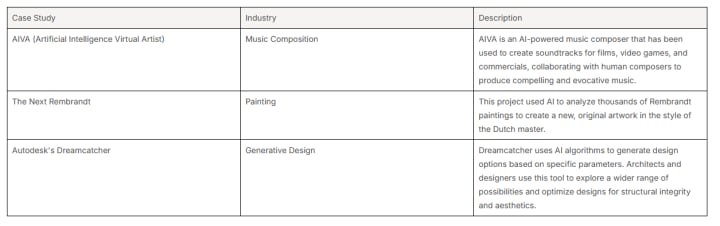
These examples underscore the potential for human-AI partnerships to drive innovation in creative industries, expanding artistic possibilities and challenging traditional notions of what constitutes art.
The Ethical Dimension of AI Integration
As AI becomes increasingly integrated into our lives, ethical considerations must be at the forefront of its development and deployment. Transparency, accountability, and fairness are crucial for ensuring AI is used responsibly and does not perpetuate or exacerbate existing societal biases.
Establishing clear ethical guidelines for AI development and use is essential for building trust in these systems. This includes addressing concerns about data privacy, algorithmic bias, and the potential impact of AI on employment. Promoting open dialogue and collaboration between technologists, ethicists, policymakers, and the public is essential for shaping the responsible development and application of AI.
Navigating the Ethical Minefield: AI Decisions and Human Oversight
The increasing automation of decision-making processes by AI systems raises concerns about fairness, transparency, and potential biases. It's crucial to ensure that AI systems are not perpetuating or amplifying existing societal biases, particularly in areas like hiring, lending, and criminal justice.
Human oversight is crucial for mitigating these risks. While AI can process information and identify patterns much faster than humans, it lacks the nuanced understanding of social context, ethical considerations, and potential consequences that are essential for making fair and just decisions.
To address these challenges, organizations must prioritize the development of AI systems that are transparent, explainable, and accountable. This includes implementing mechanisms for human review of AI-driven decisions, particularly in high-stakes situations, to ensure fairness and prevent unintended consequences.
Building Trust: Transparency and Accountability in AI Systems
Building trust in AI systems is essential for their widespread adoption and acceptance. This requires a multi-faceted approach that includes transparency, accountability, and a commitment to the ethical use of AI. Users need to understand how AI systems work, what data they are trained on, and how decisions are made to trust their output.
Transparency can be fostered through explainable AI (XAI) techniques, which provide insights into the reasoning behind AI-generated outputs. This allows humans to understand the factors that influenced a particular decision and identify potential biases or errors. Establishing clear lines of accountability for AI-driven outcomes is crucial. Organizations must take responsibility for the decisions made by their AI systems and be prepared to address any unintended consequences.
Building trust also requires ongoing monitoring and auditing of AI systems to ensure they are functioning as intended and not exhibiting biased or unethical behavior. This includes establishing mechanisms for feedback and redress, allowing individuals to challenge AI-driven decisions and seek remedies if necessary.
The Future of AI Development: Fostering Human-Centric AI
The future of AI development lies in creating human-centric AI systems that prioritize human values, well-being, and ethical considerations. This involves shifting the focus from purely technical advancements to a more holistic approach that considers the social and ethical implications of AI.
Human-centric AI emphasizes collaboration between humans and machines, leveraging the strengths of both to create systems that augment human capabilities, enhance decision-making, and promote societal good. This approach requires instilling AI systems with a deeper understanding of human emotions, motivations, and values, enabling them to interact with humans in a more empathetic and intuitive manner.
The Role of Emotional Intelligence in Shaping AI
Emotional intelligence (EQ) is increasingly recognized as a critical factor for success in the AI-driven workplace. While AI excels at processing information, it lacks the empathy and social skills needed to navigate complex human interactions. Building AI systems that can understand and respond to human emotions is essential for creating harmonious and productive human-machine collaborations.
Developing AI systems with high EQ requires a focus on areas like natural language processing (NLP), sentiment analysis, and computer vision. By training AI on vast datasets of human interactions, we can teach machines to recognize and interpret subtle emotional cues, such as facial expressions, tone of voice, and body language.
As AI literacy becomes increasingly important, individuals with high EQ will be better equipped to collaborate with these systems, interpret their outputs, and ensure they are used ethically and effectively. Emotional intelligence will be a key differentiator in the AI-driven workplace, allowing humans to excel in roles that require creativity, collaboration, and complex problem-solving.
Prioritizing Human Values in AI Development Strategies
As we continue to develop and integrate AI into various aspects of our lives, it's crucial to prioritize human values in our AI development strategies. This requires a shift from a purely technical mindset to a more holistic approach that considers the ethical, social, and human-centered implications of AI.
Core values such as fairness, transparency, accountability, and privacy should be embedded in the design and development of AI systems. This involves establishing clear guidelines for data collection, algorithmic design, and system deployment to ensure that AI is used responsibly and ethically. Strategic thinking is critical for anticipating the potential impacts of AI on society and proactively addressing any ethical concerns. This includes fostering open dialogue among stakeholders, including technologists, ethicists, policymakers, and the public, to ensure that AI development aligns with human values and societal goals.
Ultimately, human judgment should guide the development and deployment of AI, ensuring that these technologies serve humanity and contribute to a better future for all.
The Psychological Impact of AI on Workers
The rapid advancement of AI technologies and the prospect of automation can evoke a range of psychological responses in workers, from excitement to uncertainty and even anxiety. Some individuals worry about job displacement, while others feel overwhelmed by the pace of technological change. It's crucial to address these concerns proactively and foster a culture that embraces change while providing support for workers.
Building resilience and adaptability is essential for navigating the future of work. Developing a growth mindset, focusing on continuous learning, and embracing the opportunities presented by AI, rather than fearing them, will be crucial for thriving in this evolving job market.
Mitigating AI Anxiety: The Importance of Human Roles
To mitigate AI anxiety, it's essential to emphasize the critical role humans continue to play in the workplace. While AI excels at certain tasks, it cannot replicate human creativity, empathy, critical thinking, and complex problem-solving skills. These uniquely human traits will remain highly valued in the AI-driven workplace.
Organizations must create support systems for employees to adapt to the changing work environment. This includes providing opportunities for upskilling and reskilling, fostering open communication, and addressing fears about job displacement transparently. By investing in employee development and creating a culture of acceptance around technological advancements, organizations can help workers embrace the changes AI brings.
Furthermore, highlighting the collaborative nature of AI and human partnerships is crucial for alleviating anxiety. Framing AI as a tool that enhances human capabilities, rather than replacing human workers, can help employees view AI as an opportunity for growth and innovation rather than a threat.
Embracing Change: Preparing the Workforce for AI Partnerships
Preparing the workforce for the new world of AI partnerships requires a proactive approach to change management and workforce preparation. Educational institutions, businesses, and policymakers need to work collaboratively to equip individuals with the skills and knowledge necessary to thrive in the AI-driven economy.
This includes emphasizing STEM education, promoting digital literacy, and integrating AI concepts into curricula. Workforce training programs should focus on developing in-demand skills like data analysis, AI programming, and ethical AI oversight. Individuals should also focus on honing their soft skills, such as communication, collaboration, and critical thinking, which are crucial for success in any field.
By embracing change, fostering a culture of lifelong learning, and equipping the workforce with the necessary skills, we can navigate the transition to an AI-powered future with confidence and create a more inclusive and prosperous world for all.
Real-World Examples of AI and Human Collaboration
AI and human collaboration is already transforming industries worldwide, with real-world applications demonstrating the tangible benefits of this powerful partnership. In healthcare, AI is revolutionizing diagnostics, treatment planning, and drug discovery, while in customer service, AI-powered chatbots and virtual assistants are enhancing customer experiences.
These examples highlight how AI can automate routine tasks, augment human capabilities, and improve efficiency, allowing human professionals to focus on more complex and nuanced aspects of their work. As AI technology continues to advance, we can expect to see even more innovative and impactful applications of AI and human collaboration across various industries.
Healthcare: Diagnoses and Treatment Planning with AI Assistance
AI is revolutionizing healthcare by providing physicians with powerful diagnostic tools and assisting with personalized treatment planning. Machine learning algorithms can analyze vast amounts of patient data, including medical images, genetic information, and electronic health records, to identify patterns and make accurate diagnoses earlier and more effectively.
In addition to diagnostics, AI is playing an increasingly important role in treatment planning. For example, AI-powered systems can help oncologists develop personalized cancer treatment plans based on a patient's specific tumor characteristics and genetic profile. This level of customization improves treatment outcomes and minimizes side effects.
Furthermore, AI-driven robotic surgery is transforming operating rooms, allowing surgeons to perform complex procedures with enhanced precision and minimal invasiveness. The combination of AI and human expertise is improving patient care, accelerating medical breakthroughs, and creating a more efficient and effective healthcare system.
Customer Service: AI and Human Agents Working in Tandem
AI is transforming the customer service landscape, with AI-powered chatbots and virtual assistants providing instant support and personalized experiences. These intelligent systems can handle routine customer inquiries, provide 24/7 availability, and even offer personalized product recommendations based on a customer's browsing history and preferences.
The integration of AI in customer service doesn't eliminate the need for human agents. Instead, AI tools are freeing up human agents to focus on more complex and emotionally charged customer interactions. When a customer issue requires empathy, nuanced communication, or conflict resolution skills, human agents can step in and provide a human touch.
This collaboration between AI and human agents is resulting in faster response times, increased customer satisfaction, and a more efficient customer service experience. By leveraging the strengths of both humans and AI, businesses can enhance customer engagement, build loyalty, and create a more personalized and satisfying customer journey.
Overcoming the Challenges of AI Integration
While the benefits of AI are undeniable, widespread AI integration comes with challenges. Addressing the skills gap through education and upskilling initiatives is crucial. Furthermore, promoting inclusivity and diversity in AI development and deployment is essential to mitigate bias and ensure AI benefits all segments of society.
By addressing these challenges head-on, we can create a future where AI empowers individuals, enhances productivity, and drives innovation while upholding ethical considerations and fostering a more inclusive and equitable world.
Addressing the Skills Gap: Education and Continuous Learning
The rapid advancement of AI is creating a significant skills gap in the workforce. To bridge this gap, a multi-pronged approach that emphasizes education, lifelong learning, and continuous skills development is crucial. Educational institutions need to adapt their curricula to incorporate AI concepts, programming languages, and ethical considerations into STEM-related fields.
Businesses should invest in upskilling and reskilling programs to equip their existing workforce with the necessary AI literacy and technical skills. Furthermore, governments and policymakers play a vital role in incentivizing these initiatives and creating an environment that supports lifelong learning.
By fostering a culture of continuous learning and providing accessible pathways for skills development, we can empower individuals to adapt to the evolving job market and thrive in the AI-driven economy.
Ensuring Inclusivity and Diversity in AI-Driven Workplaces
As AI becomes increasingly integrated into workplaces, it's crucial to prioritize inclusivity and diversity in all aspects of AI development and deployment. This includes ensuring that AI systems are trained on diverse datasets to mitigate bias, promoting representation from underrepresented groups in AI-related fields, and fostering inclusive workplace cultures that value diverse perspectives.
Promoting diversity in AI development teams helps prevent bias in algorithms and ensures that AI systems are designed to benefit all members of society. When individuals from various backgrounds, cultures, and perspectives contribute to AI development, the resulting technologies are more likely to be fair, ethical, and reflective of the needs of a diverse user base.
Creating an inclusive workplace culture where everyone feels valued, respected, and empowered to contribute their unique talents is essential for leveraging the full potential of AI. This requires a commitment to fostering belonging, promoting mentorship opportunities, and addressing any systemic barriers that may hinder the advancement of underrepresented groups. By creating an environment where everyone can thrive, we can unlock the full potential of AI and drive innovation while upholding ethical considerations and promoting social good.
Conclusion
In conclusion, the synergy between AI and human talent is crucial for driving innovation and progress in the workplace. While AI revolutionizes job roles and skills, human creativity and emotional intelligence remain irreplaceable assets. Embracing AI as a tool rather than a replacement fosters collaboration, especially in creative industries where successful human-AI partnerships thrive. Upholding ethical standards, transparency, and accountability in AI development is paramount for building trust and navigating potential challenges. By prioritizing human-centric approaches and continuous upskilling, we can shape a future where AI complements human capabilities, leading to a more inclusive and diverse workforce.
Frequently Asked Questions
How can humans complement AI in the workplace?
Humans provide crucial human oversight in using AI tools, applying empathy in strategic decisions, and tackling complex problem-solving that requires intuition and creative thinking.
What are the key skills needed for the AI-driven future?
Thriving in the AI era requires a blend of technical expertise (data science, AI literacy) and essential soft skills (adaptability, communication, strategic thinking) to leverage AI effectively.
Can AI surpass human creativity and emotional intelligence?
While generative AI can mimic creativity, it lacks the depth of human intuition, emotional intelligence, and nuanced understanding that fuels true artistic expression and empathy-driven connection.
How do we ensure ethical use of AI in businesses?
Ethical AI hinges on transparency in data usage, accountability for AI's impact, human oversight to minimize biases, and a commitment to fairness in evaluating AI's outcomes.
What are the best practices for integrating AI and human talent?
Successful integration thrives on prioritizing human-centric AI design, fostering collaboration between humans and machines, promoting inclusivity in AI development, and encouraging continuous learning for both.
About the Creator
Nur Jahan Begum
Passionate blogger on Vocal Media, sharing engaging stories, insights & creativity across various topics. From personal experiences to trending topics, I craft content that informs, inspires & entertains. Join me on this journey of words!
Keep reading
More stories from Nur Jahan Begum and writers in Journal and other communities.
Big 12 is getting roasted for its 'assault to the eyes' basketball court
Key Highlights The Big 12's new basketball court design, featuring a repeating "XII" pattern, has sparked controversy for its unconventional aesthetic. Fans and critics have taken to social media to express their disapproval, with many deeming it distracting and unappealing. The design has drawn comparisons to other controversial courts in professional sports, raising questions about the future of court designs in college basketball. Big 12 Commissioner Brett Yormark defended the design, emphasizing its focus on student-athletes. While the visual impact has generated significant buzz, its effect on player performance remains a subject of debate.
By Nur Jahan Begum12 months ago in Gamers
War clouds in the Middle East — US, Israel and Iran face to face
oman: (special report)journalist malik sarfraz hussain awan. The Middle East is once again in the grip of severe military tension, where after joint air and missile attacks by the US and Israel on important military and strategic targets inside Iran, Iran retaliated vigorously, targeting not only Israel but also US military installations in the Gulf region. According to the initial military briefing, the Israel Defense Forces and the United States Armed Forces attacked various cities in Iran, including the capital Tehran, the industrial and defense center Isfahan, Qom, Kermanshah and other sensitive locations. According to the Israeli position, this operation was carried out to limit Iran’s growing missile and drone capabilities, while US officials called it a preemptive measure to defend their allies and stabilize the region. According to Iranian media, some military installations were damaged in the attacks and a few personnel were killed and injured, but the full damage estimate is still underway. Iran responded immediately by launching ballistic missiles and drones towards Israel through the Islamic Revolutionary Guard Corps and also attempted to target US bases in the Gulf countries. According to reports, alarm sirens were sounded and air defense systems were activated near the Al-Udeid Air Base in Qatar, the US Navy Fifth Fleet headquarters in Bahrain, and some military installations in Kuwait and the United Arab Emirates. Several missiles were claimed to have been destroyed in the air, while reports of limited material damage were also received. Israel said its defense system was largely effective, but explosions were heard in a few places. Iran has warned that if its territory is attacked again, the response will be more severe and widespread. The most immediate and significant impact of this military exchange was on the airspace of the entire region, where Iran completely closed its airspace and suspended all international and domestic flights. Israel also temporarily closed its airspace and stopped civilian flights as a precautionary measure. Iraq has been warned of becoming a potential missile passageway. Due to the fear, it immediately closed its airspace and dozens of flights were canceled. Jordan closed its airspace for a few hours as a precaution and later allowed limited flights. Qatar increased air surveillance, suspended some routes and issued special instructions to pilots. Bahrain announced restrictions on air traffic in view of the security situation. Kuwait diverted several international flights. The United Arab Emirates tightened surveillance in its northern airspace and instructed many aircraft to take alternative routes. Saudi Arabia did not announce a complete closure, but it imposed additional surveillance in the eastern sector and temporarily suspended some flights. Lebanon and Syria also issued alerts, while Turkey increased security measures in its eastern airspace. As a result of these extensive closures, flights from Europe to the Gulf and Asia had to take longer routes, which increased fuel costs and travel times. International airlines made urgent changes to schedules and canceled or postponed several flights, keeping in mind the safety of passengers. This extraordinary closure has practically turned the region into a military zone where defense systems are active 24 hours a day and radars are on full alert. Security is on high alert on the ground as well. An emergency has been declared in hospitals and civil defense agencies are mobilized. Oil prices fluctuated in global markets while investors adopted a cautious attitude. Activities on the diplomatic front have intensified and the United Nations Security Council has called an emergency meeting and appealed to the parties for an immediate ceasefire, restraint and diplomatic negotiations. In the Security Council meeting, some countries expressed concern over unilateral military actions, while others questioned Iran's missile program and regional role. The statement issued after the meeting said that the continuation of tensions in the region could pose a serious threat to global peace and security and that all relevant parties should abide by international law and the UN Charter. The UN Secretary-General also stressed that the civilian population and civilian aviation should be protected at all costs. Experts say that if these clashes are not limited, Lebanon, Syria, Iraq and the Gulf states could also be directly or indirectly involved in the conflict. According to military analysts, the two sides are currently sending each other messages through limited but symbolic use of force. However, in the event of any miscalculation or additional attacks, the situation could quickly turn into a full-scale war. The biggest question in the current situation is whether behind-the-scenes diplomatic efforts will succeed in reducing tensions or whether this crisis will take the form of a long and destructive regional conflict. The region is currently in a state of uncertainty, airspace closures remain partially in place, military preparations are increasing, and the eyes of the international community are focused on the next few days, which will determine the future of this crisis.
By Malik Sarfraz Hussain Awan6 days ago in Journal
Review of 'Man on the Run'
My wife and I saw Man on the Run, a nearly 2-hour documentary on Amazon Prime, about Wings, Paul McCartney's group that flew around the world from shortly after The Beatles broke up in early 1970 to shortly after John Lennon was murdered at the end of 1980, making a Beatles reunion forever impossible.
By Paul Levinson5 days ago in Beat


Comments (1)
I love human talent! Great work!