
☄️ The Great Lakes Fireball: Analyzing the Comet Fragment That Lit Up the Sky
Decoding the spectacular streak: Why the 100,000 mph meteor blazed bright green and the scientific significance of high-velocity atmospheric entries.

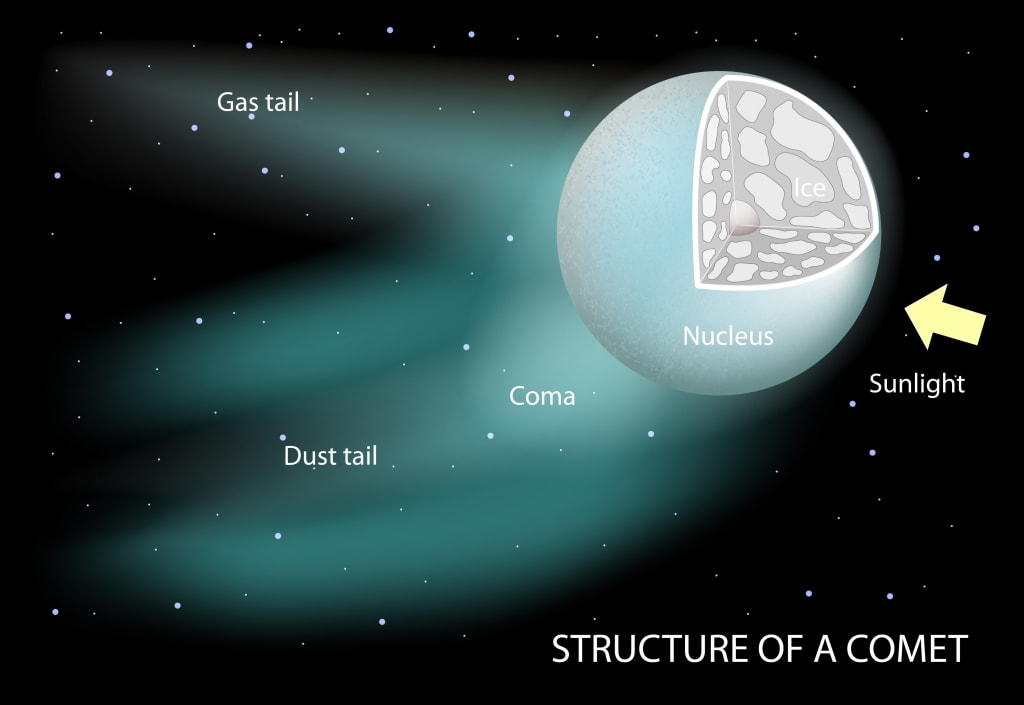
he night sky over the Great Lakes region recently hosted a spectacular, albeit brief, astronomical show. On November 23rd, 2025, a brilliant meteor, likely a fragment of a comet, streaked across the atmosphere, illuminating the landscape with an intense, vibrant green light. Footage captured by organizations like the Michigan Storm Chasers and subsequent reports documented the fiery phenomenon, which was visible from states as far afield as Michigan, Wisconsin, Indiana, and even up to 550 kilometers away in Lancaster, Ohio.
This event was a stark reminder of the dynamic, chaotic nature of our solar system and the constant cosmic debris entering Earth’s atmosphere. More than just a dazzling display, the characteristics of this meteor—its extraordinary velocity and distinct color—offer valuable insights into its origin and composition.
The Speed and Source: Comet Fragment vs. Asteroid
The meteor’s observed characteristics strongly suggest it was a fragment of a comet, rather than a piece of a rocky asteroid, based primarily on its speed.
Extreme Velocity: The object was estimated to be traveling at speeds up to 160,000 km/h (approximately 100,000 mph) upon atmospheric entry. Asteroids typically orbit the Sun in the inner solar system and enter Earth’s atmosphere at slower, though still high, speeds. Comets, originating from the icy, distant regions of the Kuiper Belt or Oort Cloud, travel on highly eccentric, faster orbits. Their fragments often enter the atmosphere at much higher relative velocities, matching the speed observed in the Great Lakes event.
Compositional Clues (The Green Glow): The distinct blue-green light emitted by the fireball provides a direct clue about the element vaporizing in the atmosphere. The spectacular green glow is often attributed to the heating and ionization of magnesium within the meteoroid's composition. While asteroids also contain magnesium, the specific intensity and color signature often found in these high-speed events are consistent with the more volatile, icy debris shed by comets.
Shutterstock
The Physics of the Fireball
When a meteoroid—even a small fragment—strikes the atmosphere at such extreme velocities, the process is one of rapid compression, intense friction, and plasma creation.
Atmospheric Compression: The object compresses the air in front of it, rapidly heating the atmosphere. This intense heat causes the meteoroid's outer layers to vaporize almost instantly.
Creating the Plasma Trail: The vaporized material and the superheated air become a glowing plasma, creating the visible fireball or bolide. The incredible speed of 160,000 km/h means the object spent mere seconds crossing hundreds of kilometers of the sky, maximizing the drama of the visible event.
The fact that the meteor was sighted over such a vast area (up to 550 km away) suggests it was a particularly large and bright specimen. The brightness of a meteor is measured on the astronomical magnitude scale; a fireball visible over such distances likely reached magnitudes comparable to the Moon or even the Sun for a brief moment.
Scientific Significance: Tracking Cosmic Debris
Events like the Great Lakes fireball are vital for planetary scientists, even if the object entirely vaporizes before reaching the ground.
Orbital Mechanics: By triangulating the trajectory of the fireball from multiple witness reports (like those collected by the American Meteor Society, AMS), scientists can back-track the object's original path. This helps them confirm its orbital characteristics and whether it genuinely belonged to a known comet stream or represented a fragment from a new, previously untracked body.
Atmospheric Entry Data: The speed and location data gathered from videos and witness reports are fed into models that study atmospheric entry dynamics. This data is critical for refining models used to track and predict the entry of potentially hazardous near-Earth objects.
Conclusion: A Reminder of the Cosmic Connection
The fiery plunge of the comet fragment over the Great Lakes was a vivid, ephemeral demonstration of the constant cosmic connection between Earth and the distant solar system. It confirms that the space around us is not empty, but filled with fast-moving remnants of ancient comets, occasionally providing us with a spectacular, harmless light show. While the object itself has dissolved into atmospheric dust, the event underscores the scientific value of amateur observations and the persistent beauty of astronomical phenomena.
About the Creator
Author’s Advice
If you would’ve asked me 20 years ago did I know I’d become a writer and an author, I would’ve said “nope, ain’t happening”. As fate would have it I did become an author and I can honestly say I’m loving it so far. It really does feel good to be a writer. I’ve learned a lot on this journey and I feel like with even me being as new to this world as I am, there’s some wisdom I need to share with every other aspiring author.
By Joe Patterson4 days ago in Journal
7 Signals the wireless connectivity market Is Entering a New Era
The invisible threads holding the modern world together aren’t made of steel or fiber—they travel through the air. From the moment your alarm syncs with the cloud to the instant a self-driving car updates its navigation data, wireless signals quietly power the rhythm of modern life. What once began as simple radio communication has evolved into an ecosystem connecting billions of devices, satellites, sensors, and cities.
By Andrew Hamilton7 days ago in Journal




Comments (1)
tks