
The Gospel of the Disabled Body
When Holiness Walks Differently, Thinks Differently, and Leads Us Home

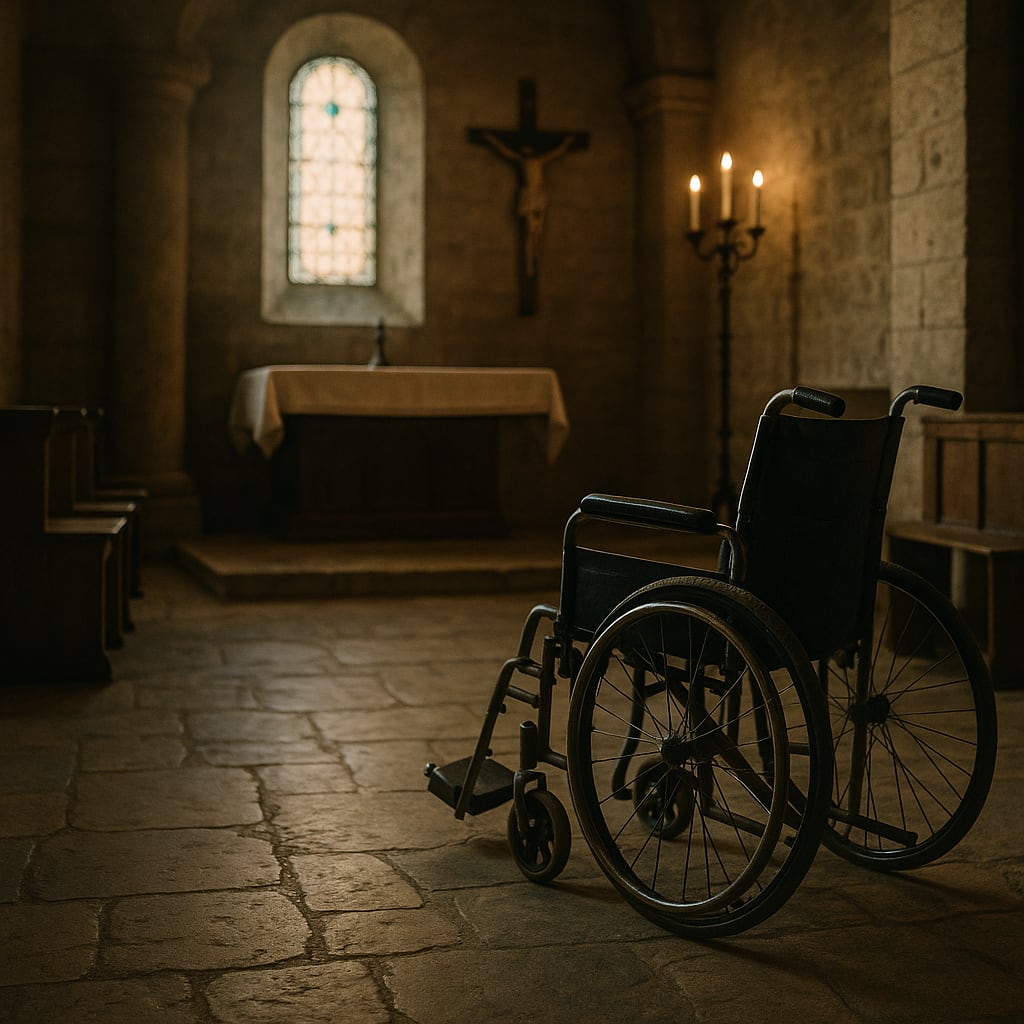
Beloved,
To the one whose body moves in rhythms unfamiliar to others
To the one whose mind fogs when the room is too bright
To the one who cannot remember names or whose speech breaks apart mid-sentence
To the one who panics in crowds or gets lost in spirals of thought
To the one whose limbs don’t always obey
You are not a distraction.
You are not broken.
You are not behind.
You are not silent.
The kingdom does not march.
It limps.
It stutters.
It cries out from beds, from wheelchairs, from locked rooms where the mind battles storms no one else can see.
There are wounds that bleed.
And there are wounds that whisper in silence
misfiring neurons, sensory overloads, depressive spirals, and manic highs.
Still, there is holiness there.
Still, you are seen.
Scripture doesn’t just offer a place at the table; it calls you first to come. (Luke 14)
These are not the seats of consolation. They are thrones of witness.
Let me tell you what the Spirit has never forgotten:
She does not hover only over the unscarred.
She descends upon the weary joints.
She moves through wheelchairs and tremors and twitching muscles.
She groans in autistic speech, in bent spines, in phantom limbs.
She is not repulsed by wounds.
She broods over them.
Because the Spirit knows, every malady is an annunciation.
That the works of God may be displayed in you. (John 9:3)
I know the world can feel like a race run on someone else’s track.
And every sermon feels like an echo from a pulpit you cannot climb.
I know the ache of reading theology that hurts your head,
and the sting of silence when you stumble over “holy words.”
I know how you sought presence over pity.
But your presence is prophecy.
You are the sermon
Your story is the Gospel.
And if they have ever made you feel like the only way to belong in the sanctuary
was to be healed first,
they have not known the Gospel.
Because the Gospel was never about erasing your limp.
It was about walking with it, all the way to resurrection.
Somewhere along the way, we confused healing with perfection.
We thought faith meant being strong.
That holiness must look like health.
That Jesus only touched bodies to restore them to some "ideal" state.
But that’s not the Gospel.
That’s marketing.
Saint John Paul II spoke of our bodies, no matter how wounded, as temples of the Spirit.
Mother Teresa said God often dwells in the weakest bodies,
because those bodies hold the greatest need for love.
In the crumbs of your imperfection, Christ reveals Himself.
You are not broken glass waiting to be fixed.
You are stained glass, already telling the Gospel.
Not in spite of your condition,
but because your body and mind are sacred texts that we have too often refused to read.
We have not just denied you a seat.
Many times, we’ve refused to notice your limp,
your trembling hands, your anxious breath.
I have to say it clearly:
The Church has not made enough room.
We built ramps for stairs, but not for pews.
We put out large-print bulletins,
but still use language that dances too fast for those who think or learn or focus differently.
We say, “come as you are.”
But preach in metaphors that require a seminary degree.
We do not pause.
We do not wait.
We ask the disabled to adapt to us,
but we rarely ask what it would mean to be converted by them.
We built buildings with entrances…
but ignored hearts who couldn’t follow the sermon.
We wrapped our words in complexity…
and injured minds built for simplicity.
We structured worship for volume…
and neglected rooms meant for silence.
We made participation optional…
but never asked what participation means for those who think differently.
Yet Christ Himself stopped the sermon
to heal a man’s ears in the synagogue (Mark 7).
He made a feast for the blind Bartimaeus (Mark 10).
He called the invited, yes—but then the poor, the crippled, the blind, and the lame (Luke 14).
These weren’t extras.
They were a cause of astonishment.
And so:
You are not just welcome.
You are essential.
You are not the object of charity.
You are the bearer of revelation.
Never once did He rush them.
Never once did He say, “Come back when you understand.”
So why do we?
Why do we make fluency in Scripture a requirement for belonging?
Why do we assume that neurodivergent is irreverent?
Why do we dress up theology in inaccessible words and call that reverence?
What if holiness sounded like fewer syllables?
What if it looked like a break in the middle of a sermon, just to breathe?
The Church should not be a lecture hall.
It should be a home.
And homes have couches for those who need to lie down.
They have soft lighting for those who are overstimulated.
They have silence, not just sound.
And they have questions, not just answers.
Look around next Sunday:
Who receives Communion with hands that shake?
Who kneels with a body that trembles?
Who listens with rapt attention where others fidget?
They are not edge cases. They are signposts.
When the slowest hands break the bread,
the veil tears again,
and God is seen without disguise.
Not in spite of them, but through them.
When a mind whispers a simple prayer,
it may open a door we’ve never even knocked on.
This is not feeling sorry.
It’s seeing differently.
It’s learning that grace is not given equally…
but manifested uniquely.
To die is to be born to ourselves.
Consider that your disability—visible or invisible—is not death.
It is a beginning.
A beginning in which you become the dwelling-place of God’s manifest glory.
Just as Christ’s wounds were the marks of victory,
your wounds are signs of Eucharistic sufficiency.
So come
Bring your wheelchair.
Bring your notecards.
Bring your stutter, your fogged mind, and your wobbly limbs.
Bring all of it.
Because there is no healing more powerful
than being seen, understood, cherished, and invited to serve.
You do not have to climb stairs to hold the Gospel in your hands.
All He asks is that you hold fast to it.
To the Church I say:
Stop wondering what to do with those who think and move differently.
Start learning from them.
Celebrate their gifting.
Let them pray over altars.
Let them teach us, not just endure us.
Let the liturgy slow down,
until the slowest soul is not left behind.
For the Church is a body.
And every member—hand, foot, mind, heart
is needed to live the Gospel fully.
So take your seat at the Table.
It was set for you.
Not in spite of your limp.
But because the One who hosts it still walks with one too.
And we follow Him best
not by leaping,
but by limping together.
Peace to your pace.
Grace for your fatigue.
Joy that swells in your presence.
And the Word-turned-Flesh
Who kneels in solidarity with those the world forgets.
Till soon.
A broken voice in the desert.
About the Creator
Joe Sebeh
Friend, Brother, and Son to all. I invite you without fear to a sacred world of wonder, to stories and poems that transport you to new worlds, and above all, to encounter God's presence in the broken, the holy, and all that lies in between.
Author’s Advice
If you would’ve asked me 20 years ago did I know I’d become a writer and an author, I would’ve said “nope, ain’t happening”. As fate would have it I did become an author and I can honestly say I’m loving it so far. It really does feel good to be a writer. I’ve learned a lot on this journey and I feel like with even me being as new to this world as I am, there’s some wisdom I need to share with every other aspiring author.
By Joe Patterson2 days ago in Journal
Inspection Drones Market Enabling Safer and Smarter Infrastructure Monitoring
The Flying Inspector Above Critical Infrastructure Across industries such as energy, utilities, construction, and transportation, infrastructure inspection is essential for safety and operational efficiency. Traditionally, inspections required manual labor, scaffolding, helicopters, or technicians working in hazardous environments.
By james robert3 days ago in Journal
TUS NUA - ch 53
TUS NUA – ch 53 New Beginnings – Mia and Midnight (*)(*)(*) Finola knew Ali’s brother-in-law needed to put his mind at rest. She fed her arm through his and led him outside. “We’ll sit here. If you like, I can put a block around us so our conversation will be private.”
By Margaret Brennan5 days ago in Fiction




Comments
There are no comments for this story
Be the first to respond and start the conversation.