

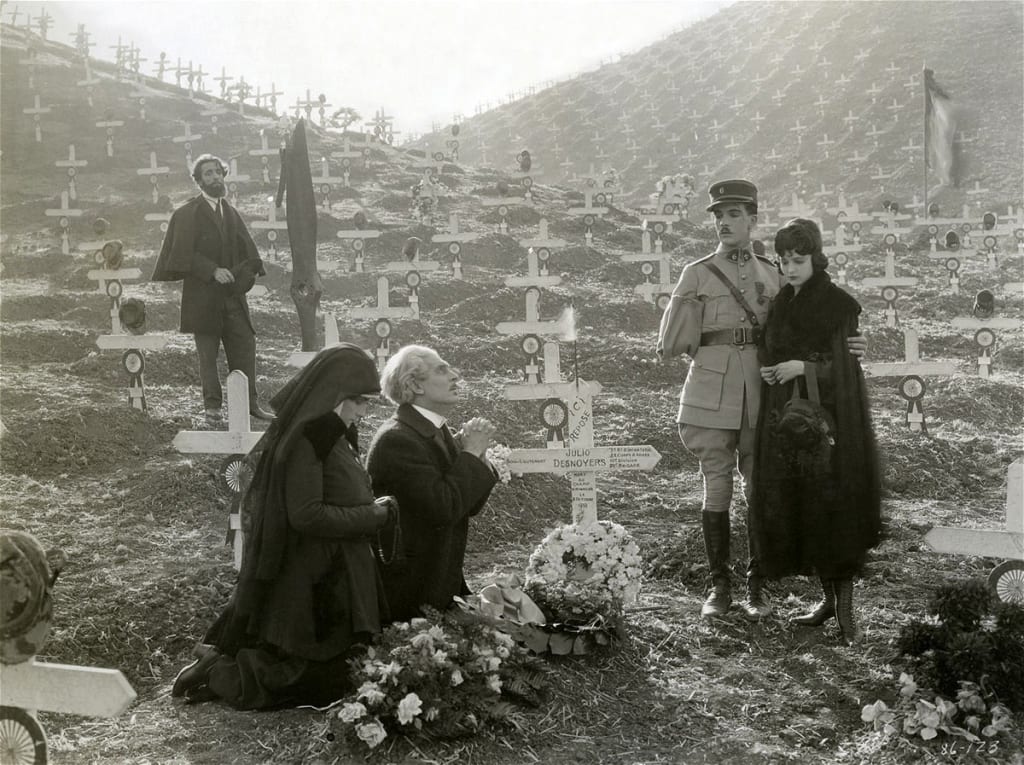
Many may question the logic of reviewing a film that has transcended "entertainment" due to its age, now standing as an antique document—a historical relic. However, as the world drowns in blood and World War III seems all but imminent, it is important to revisit a document as old and arcane as The Four Horsemen of the Apocalypse. As the epigraph in the 1991 film JFK stated, "What is past is prologue."
The film survives in a very dark and grainy state, clearly showing the signs of its age. It was one of the highest-grossing silent films, even surpassing Chaplin’s The Kid in 1921, and it set Rudolph Valentino on the path to becoming the iconic cinematic "Latin Lover." Alas, poor Rudy’s fate would be as tragic as that of the character he portrays here; unlike his on-screen counterpart, Valentino would die young from a tubercular lung, much like fellow silent film star Mabel "Madcap Mabel" Normand.
The Four Horsemen of the Apocalypse presents stark, fantastical, and horrific imagery pulled directly from the Bible—its Beast of the Apocalypse and the titular Four Horsemen are depicted as literal wraiths astride the Earth. Meanwhile, what unfolds beneath the dark, troubled skies is the simple tale of Madariaga (Pomeroy Cannon), a.k.a. "The Centaur," a Spanish gaucho turned prosperous landowner. He has two sons-in-law: a German, Hartrott (Alan Hale), whom he does not care for, and a Frenchman, Marcello (Joseph Swickard), whom he favors. His German grandson, Julio (Valentino), is already an accomplished rake at a young age. He and his grandfather hustle women in local taverns, while Julio has an affair with Ettienne’s wife, dancing the tango and setting the pattern for a wasted life.
All is well until the coming of war, the Apocalypse foretold, following Madariaga’s death. His sons-in-law return to their respective homelands, taking up the cause of their fellow countrymen against their cousins. Julio Desnoyers continues his hedonistic ways, becoming a sensation with the ladies. His former lover, Marguerite (Alice Terry), leaves to become a war nurse, tending to the sick and dying at Lourdes. She eventually returns to her husband, Ettienne (John St. Polis), who has been blinded in the war, to care for him.
Meanwhile, Marcello Desnoyers’ castle-estate is taken over by German troops, who wreak havoc as marauding "Dirty Huns." Marcello becomes involved in an altercation with a German soldier over a woman and is condemned to execution.
Four years later, Julio finally decides to do his part in the war, becoming a fine soldier. He meets Marguerite again, but they know they can never be together. Each is, in their own way, a prisoner of circumstance as much as they are prisoners of love.
The final denouement has Julio meeting his last surviving German cousin on the battlefield. The film concludes with Tchernoff (Nigel De Brulier), a seemingly prophetic figure, lifting his arms and declaring:
"Peace has come—but the Four Horsemen will still ravage humanity—stirring unrest in the world—until all hatred is dead and only love reigns in the heart of mankind."
The film ends on a somber note in a military cemetery, with row upon row of white crosses stretching up the dark slopes. There is a resigned acknowledgment of the roles that War, Famine, Pestilence, and Death will continue to play in humanity’s future. As we can see after more than a century, the pessimism of the filmmakers was, perhaps, well-founded. Fin.
The Four Horsemen of the Apocalypse | 1921 | starring Rudolph Valentino | directed by Rex Ingram
***
Connect with me on Facebook
My book: Cult Films and Midnight Movies: "From High Art to Low Trash, Volume 1"
About the Creator
Tom Baker
Author of Haunted Indianapolis, Indiana Ghost Folklore, Midwest Maniacs, Midwest UFOs and Beyond, Scary Urban Legends, 50 Famous Fables and Folk Tales, and Notorious Crimes of the Upper Midwest.: http://tombakerbooks.weebly.com
Reader insights
Outstanding
Excellent work. Looking forward to reading more!
Top insights
Compelling and original writing
Creative use of language & vocab
Expert insights and opinions
Arguments were carefully researched and presented
Eye opening
Niche topic & fresh perspectives
On-point and relevant
Writing reflected the title & theme
The goals I did not achieve
Every writing goal I made for the year is a wash. It has been this way for a while, but I think it's important to be open about my failures and the reality of how life can get in the way. This is especially true considering the several times I have posted on Vocal about my writing goals, how I was changing my approach, and where I was hoping to be for the upcoming year. I will probably do that again in a couple months, but for now, it is time to acknowledge where I am today.
By Kay Husnick24 days ago in Journal
The Invisible Hand That Rules
In the heart of the city, there’s a building that no one notices. Its glass walls reflect the sun, its elevators glide silently, and its corridors smell of polished ambition. Decisions are made here that shape millions of lives, yet outside, the city breathes, unaware. The air hums with traffic, the chatter of cafes, the distant wail of sirens, and life moves on as though the building’s influence is nothing more than an echo.
By Jhon smith6 days ago in Journal


Comments (1)
That was amazing, I did not know about this film. I really loved this, I think I may watch this film. I'm currently reading, "Behold! A Pale Horse," by Milton William Cooper, so these concepts sure are on my mind. Great read