
The Death of Silicon: How a Rainbow Crystal Could Rewrite the Future of Technology
Inside the discovery of a silicon-free chip that could make your computer 100 times faster—and mark the dawn of a new era in computing.
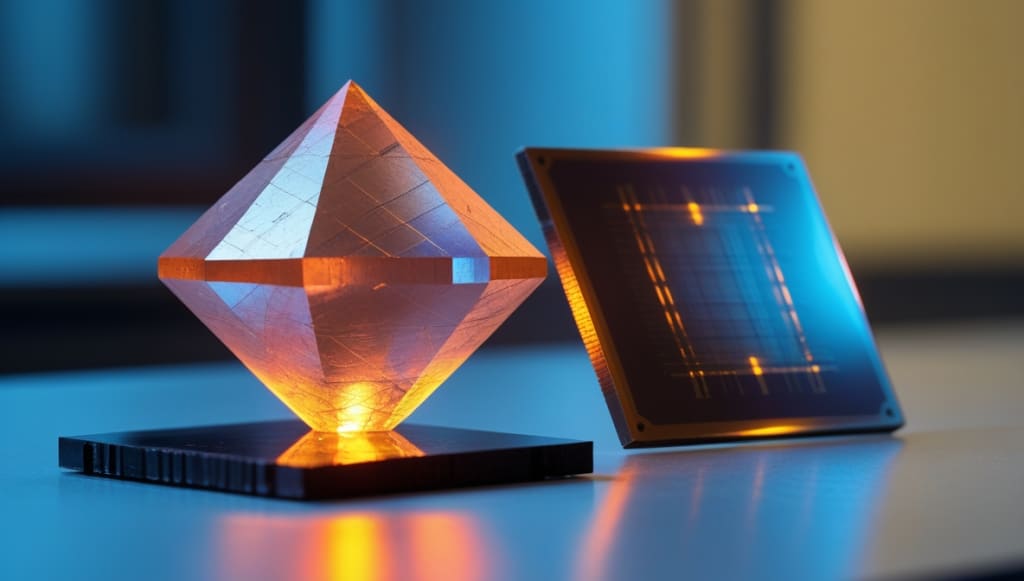
Silicon has been the invisible center of modern civilization for almost a century. Every computer, smartphone, satellite, and even modern refrigerators depend on this component. Silicon turned sand into fast technology, sparking a digital revolution that has shaped our life.
But, like all epic stories, silicon's preeminence has limits; it seems we have at last gotten close to those boundaries.
Emerging into fame is bismuth, a magnificent crystal with rainbow colors. Should scientific principles hold true, it has the potential to completely change how we view computers.
Conclusion of Silicon's Speed Path
Engineers have worked tirelessly for years to develop quicker, more compact, and efficient chips. From those measured in nanometers—so small that billions may be housed on a single processor—we have advanced from big transistors like in size to a fingernail.
Still, the scene gets more and more strange as we strive for smaller dimensions.
At around 2 nanometers, we come across what scientists call the quantum barrier. Here, the fundamental rules of physics begin to diverge. Like air flowing across a sealed door, electrons behave strangely—they tunnel through impediments that should be impenetrable.
This "quantum tunneling" occurrence causes information to be corrupted, signals to escape, and general performance to drop inside microchips: Whatever our engineers might be, the natural world has drawn a border.
This line could indicate the end of silicon's story.
Enter the Crystal That Glows Like Art
Bismuth seems more like a work of art than like technology. Its surface sparkles with a rainbow of hues, more like something seen in a fantasy film than in a physics-focused lab. Still, beyond its trippy appearance resides a feature transforming the field of semiconductors.
Bismuth displays a property called strong spin-orbit coupling, as opposed to silicon. This basically means that the spin and orbit of its electrons are really strongly connected. Bismuth may affect electrons' quantum spin, whereas silicon just modifies their electrical charge.
This difference is revolutionary
It makes quantum-level computations possible, where knowledge is not only present as on or off but also as something in between. Faster. Smarter. More Energy-efficient.
The Odd Chip That Achieved Success
For many years, researchers thought bismuth too erratic for use in chips. It lacked a band gap, a fundamental property enabling materials to flip between insulating and conducting states. Bismuth acted as a metal without this characteristic, unable to halt the electrical current's flow.
This situation, meanwhile, shifted in 2025.
Chinese researchers found a technique to change the atomic structure of bismuth at Peking University. They merged it with tellurium to produce an extremely thin, layered substance acting like a real semiconductor.
The first silicon-free chip in the world was made as such.
Faster Than Any Built Before
This was much beyond a passing lab test. It was a working model that established fresh standards.
The novel chip based on bismuth moved at speeds exceeding 500 GHz, nearly 100 times faster than the top silicon chips made by Intel, Apple, or Samsung. It changed 40% more swiftly than any other available choice and used three times fewer energy.
Engineers coupled the transistors produced of bismuth with graphene—an extremely thin layer of carbon that conducts electricity practically without opposition—to achieve this. Combining these substances produced a structure 0.5 nanometers thick, thinner than a single silicon atom.
The final result?
A chip that went beyond the physical limitations of silicon was not just faster but also more efficient.
A New Race for the Future
If this strikes you as the start of a technological revolution, it really is.
Leading this industry, China has over 70% of the world's bismuth reserves under its control. The country's researchers' significant results were published in the renowned magazine Nature, and other worldwide players are paying attention.
Using bismuth, National Taiwan University, MIT, and TSMC have started their own research investigating its possible application in the creation of next-generation transistors.
This represents scientific advancement and a shift in global relations. The future generation of computers may be under the power of anyone who can successfully use this new substance.
The barriers one must overcome
Revolutions, as one would anticipate, do not happen overnight.
Created under nearly flawless laboratory settings, the bismuth chip is now merely a prototype. Mass manufacturing conversion of it presents a big difficulty. Because there are already established plants, equipment, supply lines, and world standards based on silicon, it has a 60-year lead.
To make bismuth chips on a commercial basis would need wholly new production techniques. Preserving purity across millions of chips, guaranteeing ideal graphene layer alignment, and layering materials at the atomic scale all present challenges that even the most important technology businesses are still trying to fix.
Early on, though, silicon faced the same problems.
Invented in 1947, the first transistor was little more than a paperclip. Few could have foreseen that it would result in autonomous vehicles, artificial intelligence, or smartphones. History shows that as scientific advancements take place, civilization eventually corrects itself and grows.
The Post-Silicon Era Begins
The great shift in viewpoint it brings is what makes the finding of bismuth amazing, not only its fast speed.
For many years, miniaturization has been the main focus of computing. Alternatives are now center focus.
By controlling the spin and charge of electrons, scientists are clearing the ground for breakthroughs in quantum computers, spintronics, and perhaps artificial intelligence (hardware. Learning similarly to the human brain, that can heal itself.
Hardware and intelligence are starting to blur.
Hence, we are in the post-silicon era when crystals, carbon sheets, and quantum mechanics theories are scheduled to define our daily instruments.
A future founded on code and hue
The future of silicon will be shaped by the coming ten years. Though its power in the field of computers is already waning, it could go on to be the foundation for simple electronics.
Driven by chemicals that previously remained undetected in a chemistry lab, the future could be vivid and quantum rather than gray and metallic.
One undeniable fact is that the bismuth age has started, no matter which of China, Taiwan, or the United States first makes this breakthrough.
We will consider this point—the one we waited for the next generation of processors working at previously unheard-of speeds with little energy consumption. end of silicon: as the starting point for the future digital revolution.
About the Creator
Keep reading
More stories from Shahjahan Kabir Khan and writers in Journal and other communities.
The Dawn of Samsung’s Smart Shades: Could the Ray-Ban Killer Arrive in 2026?
Smart glasses constitute the next major advance in the ever changing world of wearable technology. Integrating cameras, voice assistants, and artificial intelligence capability, Meta's Ray-Ban smart glasses have already drawn notice for fusing form with function. But the emphasis might soon change. Unproven sources suggest that Samsung is secretly creating a rival, perhaps a Ray-Ban killer that would change our view, record, and interaction with our environment. If the news is correct, we might see its launch sooner rather than later.
By Shahjahan Kabir Khan3 months ago in Journal
The goals I did not achieve
Every writing goal I made for the year is a wash. It has been this way for a while, but I think it's important to be open about my failures and the reality of how life can get in the way. This is especially true considering the several times I have posted on Vocal about my writing goals, how I was changing my approach, and where I was hoping to be for the upcoming year. I will probably do that again in a couple months, but for now, it is time to acknowledge where I am today.
By Kay Husnick23 days ago in Journal
Catholic Social Teaching and Modern Life
Catholic Social Teaching is a rich tradition that provides moral guidance on how to live out faith in society. Rooted in Scripture and the teachings of the Church, it addresses issues of human dignity, justice, care for the poor, and responsible stewardship of the world. Understanding Catholic Social Teaching helps believers apply their faith to modern challenges while staying true to God’s call for love, compassion, and justice.
By Sound and Spirit5 days ago in Journal



Comments
There are no comments for this story
Be the first to respond and start the conversation.