
The Current Politics of Bangladesh and the Insecurity Faced by Buddhist Monks
The Current Politics of Bangladesh and the Insecurity Faced by Buddhist Monks


The Current Politics of Bangladesh and the Insecurity Faced by Buddhist Monks
– A Terrible Fact Bangladesh is a multi-religious and multicultural country. While the majority of its population is Muslim, Hindus, Buddhists, and Christians have also been living here for centuries. After the country's independence, communal harmony was largely maintained. However, this coexistence has been severely disrupted in recent years by political instability and the rise of extremist ideologies. Among the most affected are the Buddhist community and the Buddhist monks, who now find themselves in a state of deep
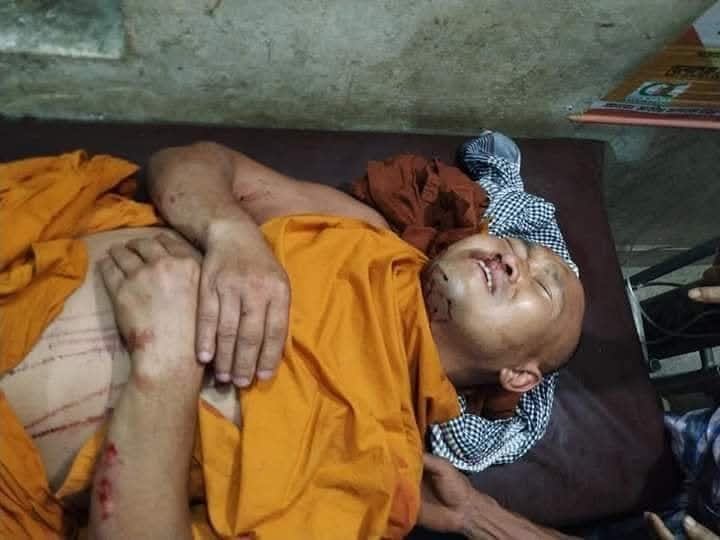
Religion and politics: a dangerous combination In today’s Bangladesh, politics is increasingly being conducted under the shadow of religion. Religious minorities frequently become political instruments as elections get closer. Sometimes they are courted for votes, while at other times, they are targeted for strategic advantage. This political game takes a heavy toll on ordinary people, especially the peace-loving Buddhist community.
There have been numerous instances where attacks on Buddhist villages occurred simply because they were perceived to support or oppose a particular political party. Monks have been targeted in the hill tracts due to ideological differences. Some have even been branded as "political agents" and subjected to social defamation. Given that Buddhism fundamentally promotes peace, nonviolence, and tolerance, this is especially troubling. Targeting Monks for Their Neutrality

Most Buddhist monks in Bangladesh deliberately stay away from politics. Their primary focus lies in spiritual practice, social service, and humanitarian efforts. However, in recent years, some political factions have developed into intolerable opponents of even this neutrality. They want every individual, even religious figures, to take a political stance. Thus, monks remaining silent or neutral is perceived as an offense.
There have been numerous instances of harassment against monks: Spreading misinformation and propaganda on social media
Obstructing religious events and ceremonies
Taking possessions from monasteries and vandalizing them Forcing monks to flee due to threats and lack of safety
These incidents not only harm individuals but also place immense psychological pressure on the entire Buddhist community.
The Hill Tracts Are in a Crisis of a Different Level The situation in the Chittagong Hill Tracts is even more complex. Here, religion, ethnicity, and politics are deeply intertwined. A volatile environment has been created by the influence of various political groups, military presence, and ethnic tensions. Often, Buddhist monks face obstacles in conducting even basic religious activities.
It is often said, “Monks don’t engage in politics”—yet the reality is that even monks residing in the hills are being drawn into political turmoil. If a monk speaks out on any issue, they are accused of political involvement. If they don't speak up, rumors about their alleged support for a particular group spread. The Politics of Social Media and Misinformation
In today’s digital age, social media has become a battleground of political propaganda. To spread false information, some political activists and religious extremists purposefully distort statements, videos, or images of Buddhist monks. The public is misled by such propaganda, which hurts the monks' image. This is especially dangerous for the younger generation, who largely rely on social media for information. They occasionally succumb to these distorted narratives and acquire erroneous perceptions. As a result, divisions within society increase, fueling communal tension.
The Role of the State and the Need for Action
The Constitution of Bangladesh guarantees religious freedom and security for all citizens. However, in reality, these promises are frequently broken. Ensuring the safety of Buddhist monks is not just a moral obligation—it is a constitutional duty of the state. Moreover, proper investigations and justice for attacks on minority communities are crucial for building public trust.
If the state truly desires to uphold secularism, it must take active steps to eliminate fear from the minds of minority communities, ensure social security, and curb the use of religious hatred in politics.

The Buddhist community in Bangladesh is peace-loving by nature. The monks who serve as their spiritual leaders are committed to serving humanity rather than political ambitions. Yet, in this era of political polarization, even they are feeling unsafe, dishonored, and in some cases, fear for their lives.
This reality is shameful for us as a nation. The time has come for self-reflection. We must build a society of coexistence where Buddhist monks can live safely, be respected, and carry out their religious responsibilities without fear by encouraging religious tolerance, mutual respect, and fundamental human values.
About the Creator
Keep reading
More stories from Manson Chakma and writers in Journal and other communities.
Humanitarian Aid from Barkal and Jurachari Sangha and Lay Community for Myanmar Earthquake Victims
The Bhikkhu Sangha's and Barkal and Jurachhari Donors' Humanitarian Initiative to Help the Burmese Earthquake Victims Untold numbers of people suffered greatly when a devastating and destructive earthquake struck Myanmar recently. In this moment of crisis, the Bhikkhu Sangha and various Vihara committees and donors from the Barkal and Jurachhari regions of Bangladesh's Chittagong Hill Tracts extended their humanitarian assistance. The Bhikkhu Sangha's eminent monks made a total of 29 contributions to this humanitarian endeavor. Each monk provided financial aid according to their capacity, with notable contributions from Venerables Dharmashree Thero, Ratnasar Bhikkhu, Pragnadarshi Bhikkhu, and Mahipal Bhikkhu, among others, each gave more than 2,000 taka. In addition, monks such as Venerable Karmapal Thero, Venerable Kalyanashree Mahathero, and Venerable Bipulananda Mahathero participated in this noble endeavor. Additionally, Barkal and Jurachhari Upojela's various Vihara committees and donors collectively contributed financial assistance. Noteworthy contributions include: Barkal Sadar Vihara Committee and Donors: 12,155 Taka 7,620 taka from the Kusumchhari Monoram Vihara Committee and donors and 5,100 taka from the Bilchhara Vihara Committee and donors Additionally, contributions came from various Vihara committees and initiatives. For this worthy cause, 123,395 taka were collected all together. On 5/4/25, 75,000 taka were sent, and on 6/4/25, 48,390 taka were sent. This money was handed over to Venerable Buddha Jyoti Thero, the Secretary of the Parbatty Bhikkhu Sangha Bangladesh Office, to ensure it reaches the victims in Myanmar in due time. This humanitarian assistance exemplifies the Buddha's teachings of compassion, empathy, and mutual friendship and is without a doubt a shining example of the charitable tradition. All monks, donors, and committees who participated in this timely and noble initiative deserve our respect and gratitude.
By Manson Chakma10 months ago in Writers
How New Avionics Systems Improve Pilot Efficiency and Safety
In the ever evolving world of aviation, advancements in avionics systems play a crucial role in enhancing pilot efficiency and ensuring the safety of both aircraft and passengers. Modern avionics are transforming the way pilots interact with their aircraft, making operations smoother, safer, and more intuitive. From flight management systems (FMS) to heads-up displays (HUDs), the innovations in avionics are setting new standards in aviation.
By Beckett Dowhan4 days ago in Journal


Comments
There are no comments for this story
Be the first to respond and start the conversation.