
The Book of Household Management
by Mrs.Beeton

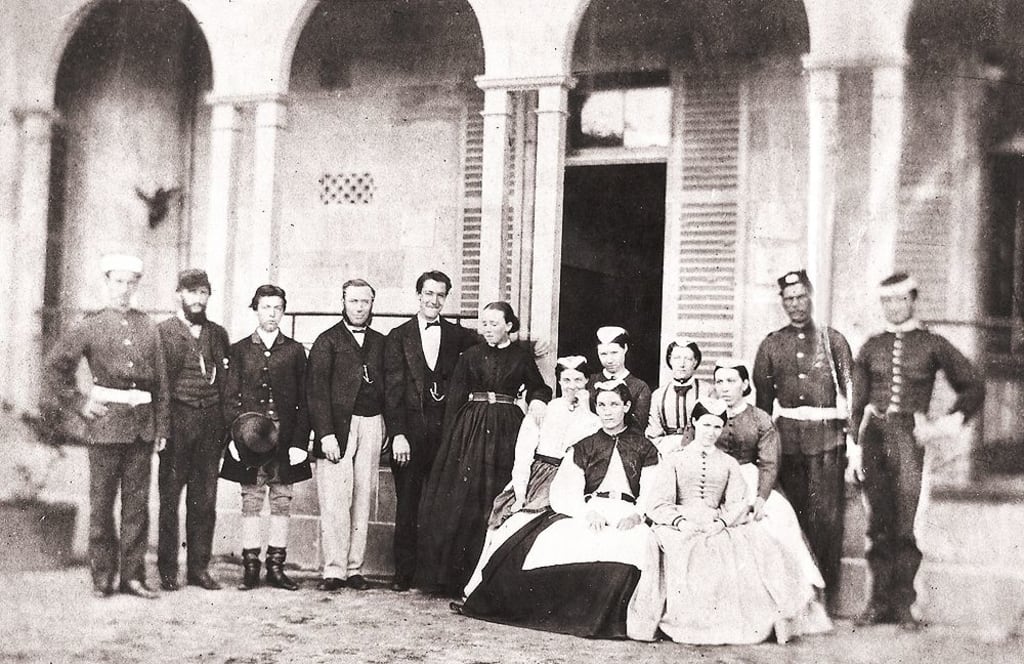
One subject that a lot of people are interested in is “Domestic Service”. We seem to be fascinated with the whole “Upstairs, Downstairs” world as it crosses over from the Victorian to the Edwardian Eras. My own grandmother was a maid in a ‘big house’, and I love the (only) photo of her in her maid’s uniform, and she does look in her early teens! It was such a different world that people actually lived their in whole lives, and I think this is why we are so interested in “It”.
During my many hours of research (and, I’ve got to be honest, I can’t get my nose out of a book), there is one book that is constantly popping up. Recently, I managed to get hold of this book and am making quite a study of it. Yes, I am finding it fascinating! It has “everything” in it for running a household of any size. It is the book “The Book of Household Management” by Mrs.Beeton.
The book itself was first published in 1861. It was first published in ‘parts’ in a series of guide-books by Mr.Beeton, written by Mrs.Beeton. Isabella Beeton was 21 years of age when she first started writing this book, and it was initially serialized in 24 monthly installments, in The Englishwoman’s Domestic Magazine published by her husband. In October, 1861, the installments were collected into one volume called “The Book of Household Management”. The information was invaluable for the new, young wife or “Mistress”.
“I must frankly own, that if I had known, beforehand, that this book would have cost me the labor which it has, I should never have been courageous enough to commence it. What moved me, in the first instance, to attempt a work like this, was the discomfort and suffering which I had seen brought upon men and women by household mismanagement. I have always thought that there is no more fruitful source of family discontent than a housewife’s badly-cooked dinners and untidy ways”. This was written by Isabella Beeton in the preface of the book.
The information written in this book is priceless and ‘nothing’ is left out! There is ‘instruction’ for: the mistress / housekeeper / cook / kitchen maid / butler / footman / coachman / valet / upper and under house-maids / Lady’s-maid / maid-of-all-work / laundry-maid / nurse and nurse-maid / monthly wet and sick nurses — it seems that no domestic servant is left out. Plus, she goes into detail about sanitary, medical and legal information, with a great deal of history of the origins, properties and “uses of all things connected with home life and comfort”. I’m not sure if there is a modern day equivalent?

Lucy Smiles, who was Isabella’s half-sister, remembers: “Different people gave their recipes for the book. No recipe went into the book without a successful trial, and the home at Pinner was the scene of many experiments and some failures”.
The book was an immediate success, selling 60,000 copies in its first year, with 2 million sold by 1868. A revised edition was issued in 1863. Revisions to the book have continued to the present day, keeping the Beeton name in the public eye for over 125 years. By 1906, the book had 2,056 pages (“exclusive of advertising”), with 3,931 recipes. Since Mrs.Beeton’s death in 1865, the book has been extended to 74 chapters — the first edition had 44 chapters. The book ‘offers’ an emphasis on thrift and economy.
Now, to the book itself. I have found it interesting that what is common sense to us today, was ‘spelled out’ to the reader back then. “Early rising is one of the most essential qualities which enter into good Household Management”, something that is still encouraged today because so much more can be accomplished during the day, using every hour in a ‘profitable’ way.
“Cleanliness is also indispensable to health”. At a time when there was no running water (as such) and the kitchen and bathrooms were so different to our own today, this is not such an unusual thing to read. Even today, with this latest pandemic, we are constantly being encouraged to wash our hands thoroughly and more often.
“Frugality and economy are home virtues”. Let’s face it, even today we need a good budget to be able to manage our finances.
“Charity and benevolence are duties which a mistress owes to herself as well as to her fellow-creatures”. How many of us give our time freely to help a charity which is close to our hearts? With the terrible ‘troubles’ in the Ukraine, many of us are helping in any way we can.
A great deal of advice is given to the task of “Engaging domestics”. “Interviewing” the former mistress of the servant seeking a job is advised, “by this means you will be assisted in your decision of the suitableness of the servant for your place, from the appearance of the lady and the state of her house”. Sounds very much like a reference but ‘in person’.

Every servant is given instruction on their duties, mainly for the mistress to know so that she can keep ‘control’ of the domestics. From the scullery maid to the housekeeper and the boot boy to the butler and house steward. No-one is left out!
As mentioned before, there are over 3,000 recipes, each one tried and tested too. A point I found of particular interest is that several pages are devoted to foods in season, something today we don’t really think about because we can get most foods at any time of the year. Certain meats, vegetables and fish at certain months of the year. It is fascinating. The cook with this reference book would have no excuses — providing, of course, he or she can read themselves.
I have never seen a reference book like this. Nothing is left out to help the young, newly married mistress to have a happy and successful home. Even advice on visiting, receiving visitors and how to dress is included.
If you are interested in all things to do with Domestic Service, have a look at this book because it gives such an insight into how the servants lived and the kind of jobs they were expected to do, as well as what their employers (the mistress and master) were expected to know and do themselves. It is an old book but a treasure, giving us a look into another world and time.
If you found this article interesting, go over to https://sarah-s-story-book.webnode.co.uk/history/ for more articles on Domestic Service.
About the Creator
Ruth Elizabeth Stiff
History and knowledge, especially about the Earth, are my passions. I enjoy putting my thoughts to paper and I always try to encourage self-motivation and love for life. LIVE AND LOVE LIFE!
Keep reading
More stories from Ruth Elizabeth Stiff and writers in Journal and other communities.
Going Into Domestic Service
Very few have them today, whereas in the 19th Century, one and a half million people worked as them (1 in 4 worked as one). I am talking about “Servants.” Today, we seem fascinated about this subject = how the maid lived? How old was the kitchen maid? What did the footman actually do? I personally have always been interested because my grandmother worked as a maid “in a big house” and I remember her trying to teach me how to serve dinner: “always serve on the left and pick up on the right.”
By Ruth Elizabeth Stiff5 years ago in Journal
Has the North Korean Embassy in Tehran Been Destroyed by an Israeli Missile?
Introduction The ongoing conflict involving Iran, Israel, and the United States has created intense global tension and a flood of breaking news and rumors. In recent days, social media posts and unverified reports have claimed that an Israeli missile strike destroyed the North Korean embassy in Tehran. These claims quickly spread online and raised concerns about whether North Korea could become directly involved in the growing regional conflict. However, examining credible information and verified reports is essential before drawing conclusions about such a serious event.
By shaoor afridia day ago in Journal
Silken Chains
Silhouettes of the female form were given flesh and bone. Silken skin glistened under the spotlight. Dry ice rose around our Icons as they danced atop their podiums in the Square. Heralded for their beauty, their movements were slight, powerful, and sensual.
By Paul Stewart6 days ago in Fiction




Comments
There are no comments for this story
Be the first to respond and start the conversation.