
The Blue Peak Hiding in Plain Sight
Most people believe white light is neutral.

Most people believe white light is neutral.
If it looks white, it must be safe.
If it feels bright, it must be effective.
If it saves energy, it must be better.
But inside most modern LED lighting, there is something very specific happening — and it’s not visible to the naked eye.
A spike.
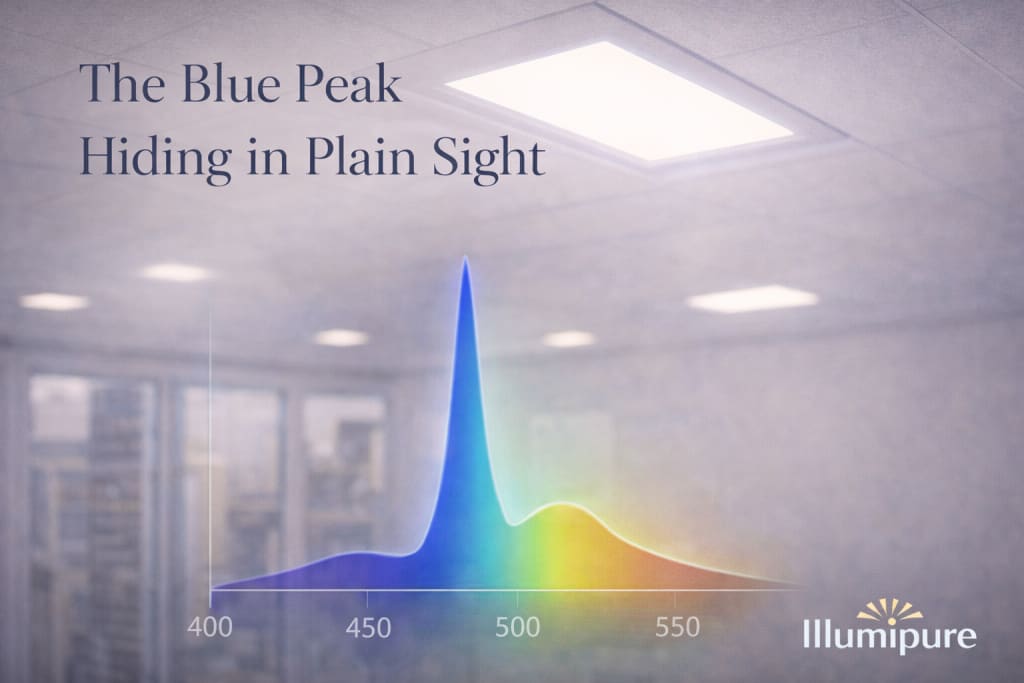
Around 450 nanometers.
And it has quietly reshaped the way we experience indoor environments.
Why That Peak Exists
Traditional LEDs were engineered for efficiency first.
The simplest way to create bright white light with low energy consumption was to start with a strong blue diode — typically around 450nm — and coat it with phosphor to shift the output into something that appears white.
From an energy standpoint, this was brilliant.
From a biological standpoint, the conversation had barely begun.
That 450nm region sits inside what scientists call High-Energy Visible (HEV) blue light — roughly 420–500nm, with the highest biological sensitivity between 440–455nm.
This is not just a color.
It is a wavelength range that interacts deeply with the human eye and brain.
What Makes It Different
Unlike other wavelengths, high-energy blue light penetrates further into the retina.
It scatters more aggressively inside the eye.
It stimulates alertness pathways in the brain.
In moderate, natural exposure — like morning sunlight — that stimulation is useful.
But modern indoor life is not moderate.
We spend nearly 90% of our time indoors.
We sit beneath artificial ceiling light.
We look into screens for hours each day.
The result is cumulative exposure to the same spectral peak, over and over again.
And most of the time, we don’t even realize it.
Why It Feels Subtle
Blue light does not announce itself.
It doesn’t flicker.
It doesn’t buzz.
It doesn’t change color dramatically.
It simply sharpens the environment slightly.
Makes edges feel crisper.
Keeps the brain in a mild state of stimulation.
Over time, this can translate into:
• Eye strain
• Low-grade headaches
• Circadian rhythm disruption
• A feeling of being alert but not fully at ease
It is not dramatic.
It is accumulative.
And that is why it hides in plain sight.
Not All White Light Is the Same
Two rooms can both be labeled 4000K.
Both can look white.
Both can measure the same brightness in lumens.
Yet their Spectral Power Distribution — the actual energy output at each wavelength — can be dramatically different.
One may carry a strong 450nm spike.
Another may be engineered differently, shifting the spectral peak toward safer regions while still producing clean white illumination.
The label on the box does not tell the whole story.
The spectrum does.
The Larger Question
Lighting used to be about illumination.
Then it became about efficiency.
Now, the next question is about biology.
If light influences circadian rhythm, retinal health, alertness, and comfort…
Shouldn’t we care about the exact wavelengths being delivered into our eyes every day?
The blue peak is not inherently evil.
But when it becomes the dominant feature of modern indoor life, it deserves closer attention.
Because what we cannot see
can still shape how we feel.
And sometimes the most important details
are the ones quietly embedded inside the spectrum.
About the Creator
illumipure
Sharing insights on indoor air quality, sustainable lighting, and healthier built environments. Here to help people understand the science behind cleaner indoor spaces.
Keep reading
More stories from illumipure and writers in Journal and other communities.
Why Comfort Was Not the Same as Relief
For a long time, I thought comfort was enough. If the chair was soft, the temperature moderate, the lighting bright enough to see clearly, I considered the space comfortable. I wasn’t in pain. I wasn’t shivering or squinting. Nothing felt obviously wrong.
By illumipure3 days ago in Journal
SpongeBob Review
From the moment the episode’s opening riff swells, “Squidward the Unfriendly Ghost” plunges viewers into a delightfully eerie, yet unmistakably Bikini Bottom‑centric, ambience that feels both nostalgic and freshly inventive. The water‑logged streets, tinged with an uncanny violet hue, pulse with a low‑key hum that mimics the thrum of an old‑school haunted house, while the familiar pastel houses take on a shadowy glow that suggests something mischievously supernatural is afoot. The animation team masterfully layers subtle visual cues—dripping kelp, flickering lantern‑like coral, and the occasional translucent wisp curling around the reef—to heighten the sense of otherworldly intrigue without abandoning the bright, cartoonish charm that defines the series. This atmospheric groundwork is not merely decorative; it deftly primes the audience for the episode’s thematic blend of comedy and gentle spookiness, making the ensuing ghostly escapades feel both plausibly spooky and comfortably absurd.
By Forest Green5 days ago in Journal
A Knight of the Seven Kingdoms Series Review (Season 1)
As one of the biggest properties in fantasy, A Song of Ice and Fire remains immensely popular with audiences. After reaching far into the past with House of the Dragon, a second spin-off was on the cards. A Knight of the Seven Kingdoms serves up a bite-sized slice of action and drama, but it still claims a spot among the best small-screen titles.
By Robert Cain3 days ago in Geeks




Comments
There are no comments for this story
Be the first to respond and start the conversation.