
The Abandons: Review & Ending Explained
Why Netflix’s New Western Misses the Mark!

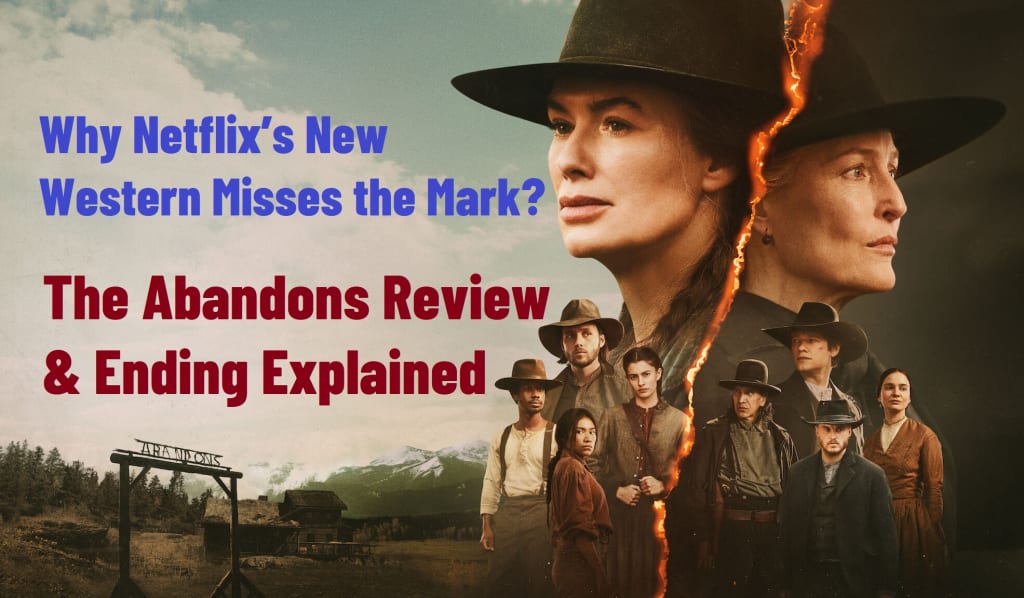
Netflix has been steadily expanding its frontier-era catalog, and after the success of American Primeval, many viewers—myself included—were curious to see whether The Abandons could stand alongside the powerhouse storytelling of Taylor Sheridan’s 1883 or 1884. Western dramas are my comfort genre, so I went into this with high hopes. But did the series deliver? Let’s talk about it.
⚠️ Full spoilers ahead.
My Review of The Abandons
A promising start… and a strong finish… but everything in between missed the target
If I’m being honest, I didn’t enjoy The Abandons as much as I hoped I would.
The first episode had a strong, intriguing setup, and the final episode delivered genuine tension and emotional payoff. But the middle of the series? It dragged badly. The pacing was choppy, the storylines often meandered, and I found myself not caring much about the characters at all.
A world that never felt real
What Sheridan achieves in shows like 1883 and what American Primeval succeeded at earlier this year is immersion. Those series transport you to another era through:
- authentic dialogue
- gritty, lived-in costumes
- grounded set design
- naturalistic performances
The Abandons felt more like an imitation of that rather than an authentic entry in the genre.
The world never felt fully inhabited, and the characters’ mannerisms and dialogue often felt too modern for the period. The signature “Netflix gloss” didn’t help—the cinematography never embraced the rawness that a Western needs.
Characters I struggled to connect with
For a story centered on two feuding families, I surprisingly felt little attachment to either the Fiona O’Keeffe clan or the Vaness family. Maybe it was the short seven-episode run. Maybe it was the lack of character development. Or maybe it was that the show tried to juggle too many arcs at once—Elias, Dalia, Lilith, Albert—without giving any of them room to breathe.
Even Fiona’s backstory, which should have been central, felt thin.
And Constance’s husband? Mentioned enough to matter—but we learn virtually nothing.
Casting that didn’t quite land
Lena Headey, who gave us one of television’s most iconic performances as Cersei Lannister, delivered a surprisingly flat performance here. Her expression rarely changed throughout the series, and it genuinely shocked me that this came from such a talented actress.
Some characters, like Garrett and Elias, simply didn’t feel believable—too modern, too clean, too stiff. Garrett in particular often felt like a sulky teen rather than a young man fighting for pride and purpose.
Missed opportunities for action
The opening scene teased a brutal, action-packed Western. But then the show seemed to forget it was a Western at all. Episodes passed without any meaningful confrontation, chase, or gunfight.
The finale was the first time in several episodes that real tension and excitement returned. But by then, it felt a little too late.
What did work?
Despite my criticisms, the show isn’t without merit.
The core theme—the lengths people go to for family—did come through clearly:
- Constance justifies her cruelty as protection of legacy and bloodline.
- Fiona holds onto land out of a promise to her late partner, not just out of stubbornness.
- Both women use “family” as a shield for vengeance, pride, and rage.
There were moments when those emotional motivations felt powerful, especially in the final episode.
The Ending Explained
The ending ties back poetically to the very beginning:
The Vaness family started a fire on Fiona’s land, and Fiona’s family ends the season by burning down the Vaness home.
Here’s the breakdown:
Constance’s Obsession
Constance wanted control of the Hollow, a shared piece of land crucial to her mining expansion plans. When the families living there refused to sell, she tried to drive them out—and eventually escalated matters with manipulation, intimidation, and planned violence.
She was fueled by:
- greed
- fear of losing her influence
- and the need to secure the Vaness legacy
All while pretending her actions were about “family.”
William’s death and the cover-up
William’s assault on Dalia set off the first major spark. Dalia retaliated, Fiona later killed him, and the families covered it up. When the body was found, Constance wasn’t devastated—she was strategic. She even passed off Grady Mitchell’s body as her son’s when it suited her agenda.
War with the Caillou
To maintain her deal with Mr. Vanderbilt, Constance attempted to provoke a war with the Caillou tribe, hoping to create enough chaos to seize the Hollow. Her greed was relentless and increasingly unhinged.
Dalia’s capture → Fiona’s turning point
When Constance took Dalia, it pushed Fiona and her family into launching the final attack—leading to the inferno that destroyed the Vaness estate.
The Final Showdown
The burning house showdown between Fiona and Constance was one of the season’s most intense scenes. Someone emerges from the flames at the end—but the show cuts to black before revealing who.
My take?
It’s probably Fiona. Her resilience is baked into her character, and narratively, it makes more sense for her story to continue. But honestly?
I don’t feel strongly about it either way—and that says a lot about my emotional investment at this point.
Trisha’s Internal Conflict
Trisha never felt like she belonged in the Vaness family. She lacked her mother’s cruelty and longed to simply exist as a normal citizen. Even after learning about Elias’s involvement in William’s death, she wore his jacket—symbolizing her emotional alignment with the townspeople rather than her own bloodline.
Season 2?
There’s no official confirmation yet, but the show was clearly written with a Season 2 in mind. A new season could explore:
- Adam Winston’s mysterious past
- Xavier Roach and the Redmas Bandits
- The Caillou tribe’s response to one of their own being killed
- The fallout of the Vaness family collapse
If Constance survives, she may still pursue the Hollow—or she may finally experience what life is like stripped of power.
Final Thoughts
The Abandons had potential, but for me, it fell short.
Beautiful themes, a strong finale, and some compelling ideas got buried under weak characterization, pacing issues, and a lack of immersion.
I love Western dramas—but this one left me surprisingly indifferent.
About the Creator
Bella Anderson
I love talking about what I do every day, about earning money online, etc. Follow me if you want to learn how to make easy money.
Keep reading
More stories from Bella Anderson and writers in Journal and other communities.
Did David Harbour Attend Millie Bobby Brown Wedding?
The Surprising 'Stranger Things' Wedding Guest List Reveal More Than Who Showed Up! For years, fans watched Jim Hopper and Eleven's unconventional, yet deeply moving, father-daughter relationship unfold on screen in Stranger Things. The bond between actors David Harbour and Millie Bobby Brown seemed just as strong off-camera, making the question of his presence at her recent wedding to Jake Bongiovi one of the summer's biggest celebrity mysteries: Did David Harbour attend Millie Bobby Brown's wedding?
By Bella Anderson4 months ago in Journal
Israel Renews Strikes on Tehran as Iran Vows Revenge for Supreme Leader’s Death
Escalation After the Killing of Ayatollah Ali Khamenei Tensions in the Middle East have sharply intensified following the confirmed death of Iran’s long-time Supreme Leader, Ali Khamenei, in joint U.S.–Israeli strikes. The development marks one of the most dramatic turning points in regional geopolitics in decades, triggering immediate retaliation from Iran and raising fears of a broader war.
By Daily Motivationabout 3 hours ago in Journal




Comments
There are no comments for this story
Be the first to respond and start the conversation.