
Tell Me More
My new therapist asked if I had experienced trauma in my life. I told her about the time a man bought me a drink in the Cheers bar in Boston while I was in 12th grade and visiting with my family. My brother was playing football for Dartmouth, and earlier that day they beat Harvard 14-7. Somehow, I snuck a few drinks from the bartender; my twenty-three-year-old cousin facilitated the Ouzo shots for me most likely. The man at the bar coerced me to exit into the alley with him, where he pulled me closer, kissed me violently, and put one hand around my neck while twisting my nipple with the other. I was not safe.
I got away and ended up back inside with my family none the wiser. I have no idea who he was nor whom he ended up hurting badly. But I know this experience traumatized me since I still think about it, still cringe when I remember the pain in my chest, picture the dark alley where no one would have heard my cries for help.
My therapist just nodded. “Tell me more.”
Tonight, I take a break from lesson planning Into the Wild and Brave New World to drink some Jack Daniels and write this story. My nineteen-year-old daughter just got home for Christmas. She entered the house with a vendetta. Apparently, her father and I have not been emotionally available to her, and she has no problem mixing weed with Prozac. We take note. Our cats tear up all the paper they can find, zeroing in on empty Christmas card envelopes.
I don’t tell my therapist about the car accident five months ago, saving it for the next session. I run it through my mind until I feel ready to share it with her, ready to tear up the paper of that memory during our telehealth meeting. This is how I imagine sharing the story with her:
The washing machine wasn’t connected to the water line yet, and the dryer was not gas ready, so we had to visit Peanut’s Laundry on Wrightsboro Road. I dropped the husband and son off at our new school to work out and then fumbled with two garbage bags full of clothes to make my grand entrance into Peanut’s. Once I figured out how to start the machines and weighed the likelihood of losing our wardrobe to theft, I left and went to Publix for groceries. The text message from my oldest daughter read there’s a Doberman mixed with great Dane in Beaufort SC and he’s soooo cute. Can we go adopt him today pls?
Two hours later and we were on our way. I texted with Titan’s owner as we headed 114 miles Southeast.
Hi Candice, it’s Mari. Titan is ok with cats. I also have 3 cats lol he never chased them or anything, he pretty much ignores them. She sent a picture of him in his camo harness and BEST FRIEND label stitched across the front. His eyes were grey and kind. What I needed most at that time was kindness. Passing the Savanna River Site, we contemplated names.
Then we hit the low country of Port Royal Island and felt the loneliness that only a Southeastern Atlantic coast can bring. The saltwater bluffs, marshes, and intercoastal iciness showed cracks under its surface from a permeating military presence. The Marine Corps Air Station populated the town with grit, rank, and purpose. And a hint of rage. Somewhere between the U-Haul dealer and the Urgent Care we found a strip mall Mexican restaurant. We had time to kill before picking up the dog, so Rancho Grande seemed the perfect diversion. Sitting in the Kia Sorento, eating our lunch, the sky hinted at an approaching storm. The Marines coming out of Publix in their DCUs, kids in tow, were unphased. I wonder if that’s the prevailing mood of nature this close to Parris Island, as if the air is still grieving.
We had just left Los Angeles, where we lived for close to thirty years. The Kia had served us well over a five-day drive from California to Georgia, and here it sat on the opposite coast. We’d been in the South for only two weeks, and it just felt right to christen our move with a new dog. We decided on Boone because it sounded the most Southern.
“Tell me more,” I imagine my therapist urging.
My mind wanders to the California plates still on the Kia as we sat in that parking lot. The carefree, cursive red script of California struck me— this car shuttled our family from soccer games to schools to the beach and back thousands of times, and now it will shuttle a new dog into the eye of our CA-SC-GA Charybdis.
Titan lived up to the cliché of his name; he was huge. As we pulled up to Mari’s house, three children ran out to tell us He likes to fight other dogs! And he bit my brother’s head once! And finally, why do you want a mean dog? Washed over with the anticipation from a two-hour drive and the wagging of his tail, we didn’t know how to receive these tiny voices.
I felt like a mysterious barn owl emerging from the cavities of an abandoned rural church to slope down toward tiny rodents. Crouching to their level, I said, “Tell me more.”
But Mari interceded. “Oh, they just love their dog so much, they are trying to trick you into not taking him. They don’t want him to leave.” And she ordered the kids back inside the house. Within minutes I had Venmoed her the $150, and we were barreling down Route 21 with a hyperactive, ninety-five-pound Doberdane to the sound of high-pitched squeaks from the toy squirrel lodged between his terrifying jaws. Each squeak seemed to celebrate his transition from Titan to Boone.
By this time, the sun had set. The two-lane rural highway offered an occasional Dollar General or Pizza Hut, but mostly we met headlights and train tracks.
And a drunk driver.
The impact threw Boone’s head into mine and the Kia into a telephone pole. Everyone was fine, but the car seemed totaled. It was all so jolting. I still feel the splash of iced tea on my arms and face as Boone’s paws slushed into the cup holders leaving a trail of Styrofoam and fur. I still hear the twisting of metal harmonizing with our screams and Boone’s barks. I still see the neon lights of the New Hong Kong restaurant blurring with the police strobes like some warped lighthouse beaconing us to safety.
As if we weren’t disoriented enough, an elderly woman walking her white poodle approached our car to see if we were okay. Like a Teiresias, she appeared out of nowhere and began prophesying that the other car would have no insurance. At the sight of her dog, Boone became more agitated, drowning me in his weight. I became the vole burrowing into the snow drifts to avoid the warm talons of a nocturnal predator.
“I was just walking beside the train tracks and heard the crash,” she told us through our cracked window, unmoved by the thrashing of our oversized dog. After a long drag on her cigarette, she walked into the fog of night. I imagine her still walking those train tracks, an eternal, flawed witness of late-night accidents. Perhaps like me, she too ascribed to the Joan Didion approach to suffering— if you keep the snake in your eye line, the snake isn’t going to bite you. She believed in confronting pain, knowing where it is.
It turns out her prophecy was accurate. The teenage driver had no car insurance. But he had an aunt who came quickly to clean everything up the best she could. Looking back, I wish she had been the police officer instead of the man who declared our car was safe to drive the remaining 100 miles home in the dark on country roads. I imagine she would have known better and wouldn’t have abandoned us in the empty parking lot late at night in an unfamiliar town of twenty-five hundred.
The Kia limped its best toward the road and finally refused to go any farther. We were prisoners of Hampton, South Carolina now. USAA refused to send a tow truck that far, AAA refused to service such a remote location, and no mechanics were open that time of night. Boone would make it difficult to find a willing Uber even if we could find one. We contemplated walking to the first motel we could find, spending the night, and then dealing with the disaster in the light of day, but I insisted we call Officer Jenkins back to the scene of the accident. There had to be something he could do for us.
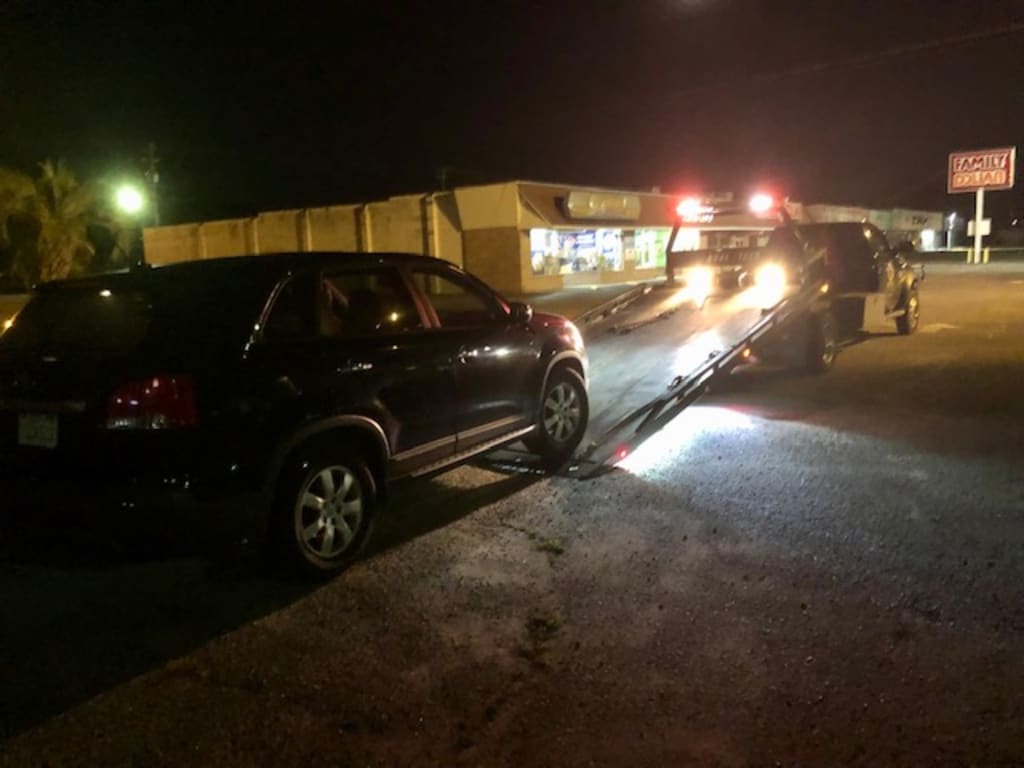
When he arrived again, he offered to call his friend who operated a tow truck but was off duty at the time. Carl arrived and realized how vulnerable we were. He offered to tow the car with Boone in his giant crate while cramming the three of us into his cab; if we paid him six-hundred dollars under the table, he’d deliver us to our house in Augusta. Overwhelmed by his generosity and kindness, I accepted. Desperation breeds danger, and danger breeds fear. Two hours of fear while knee to knee with a strange man who is suddenly in control of your car, your dog, your family breeds trauma.
Soon we learned Carl has wrestled many alligators, some on the front porch of his house, where he lives with his wife who has top secret clearance with the U.S Government. We also heard about his daring exploits on the Alaskan oil fields after earning a Congressional Medal of Honor for his service in Iraq. In his free time, he built a recreation center for the at-risk teens in his county, whom he counsels and tutors. His son is a nationally ranked monster truck driver and is the youngest EMT in the Southeast. After explaining what alligator tastes like, he taught us how to assemble explosives from everyday items. I stared at the dry skin on his hands, the red knuckles of delusion driving our vulnerability into the endless and unfamiliar. One turn after another, and I imagined we would end up captives on his family land.
Only when I saw the familiar roads of North Augusta did I feel somewhat confident that all would be well.
“Pull in here,” I directed him toward the Wells Fargo, so I could withdraw the obscene fee I promised to pay him. As the ATM spit out the bills, I remembered our neighbors are husband and wife sheriffs. I quickly texted them our situation and begged them to meet us outside in five minutes; I also attached the picture of Carl’s license plate.
It was 2:00 am now. I handed him the cash and thanked him again. He drove us the final miles to our home and unloaded our dog-filled Kia as our neighbors greeted us with a wave, leaning on their his-and-hers Richmond County Sheriff cars. Carl took note. And he took off, a tired and delusional but nonetheless richer man.
Three weeks later we had to surrender Boone to a Doberman rescue. Two months later, we received the Kia back from the body shop with its Georgia plates. Three months later the CT scan reveals three pinched nerves in my neck. The man in the bar thirty-three years ago is still with me. Carl is sitting next to him. I keep them both in my site line.
The young man who caused the accident also remained with me. I grappled with how to forgive him. Late one night I wrote this poem:
If Forgiveness
is a true barn owl,
I am the vole burrowing under the snow,
the trickiest of prey.
The yellow of her eyes
belies her night
vision
and topographic memory.
She hears my mutterings,
sees my midnight
retreats, has blueprints of my secret
plans and stalks
me with biblical talons.
Forgiveness never falters
from atop the church steeple
a silver launching
and falling with purpose. I come
to the terror
of her aerial agility, her ability
to thrust – vortices
like lungs inhaling Arctic skuas.
She conquers
my frozen tundra anger
of time-lapse hurt,
my inability to soften
like sunlight through the fog
of an aubade river bank. I rest
in her gentle wingbeat
whispers
in the tall grass of my wounds. I succumb
and soar caught—
“That’s all our time for tonight,” I imagine my therapist whispering. As I close the laptop, I hear the train like an iron ghost in my feathered chest.
About the Creator
Reader insights
Outstanding
Excellent work. Looking forward to reading more!
Top insights
Compelling and original writing
Creative use of language & vocab
Excellent storytelling
Original narrative & well developed characters
Heartfelt and relatable
The story invoked strong personal emotions
Keep reading
More stories from writers in Journal and other communities.
Author’s Advice
If you would’ve asked me 20 years ago did I know I’d become a writer and an author, I would’ve said “nope, ain’t happening”. As fate would have it I did become an author and I can honestly say I’m loving it so far. It really does feel good to be a writer. I’ve learned a lot on this journey and I feel like with even me being as new to this world as I am, there’s some wisdom I need to share with every other aspiring author.
By Joe Patterson2 days ago in Journal
Inspection Drones Market Enabling Safer and Smarter Infrastructure Monitoring
The Flying Inspector Above Critical Infrastructure Across industries such as energy, utilities, construction, and transportation, infrastructure inspection is essential for safety and operational efficiency. Traditionally, inspections required manual labor, scaffolding, helicopters, or technicians working in hazardous environments.
By james robert2 days ago in Journal
TUS NUA - ch 53
TUS NUA – ch 53 New Beginnings – Mia and Midnight (*)(*)(*) Finola knew Ali’s brother-in-law needed to put his mind at rest. She fed her arm through his and led him outside. “We’ll sit here. If you like, I can put a block around us so our conversation will be private.”
By Margaret Brennan5 days ago in Fiction



Comments
There are no comments for this story
Be the first to respond and start the conversation.