
Stolen Childhoods: The Hidden Crisis of Bangladeshi Girls Trafficked to India
The Hidden Journey of Trafficked Girls

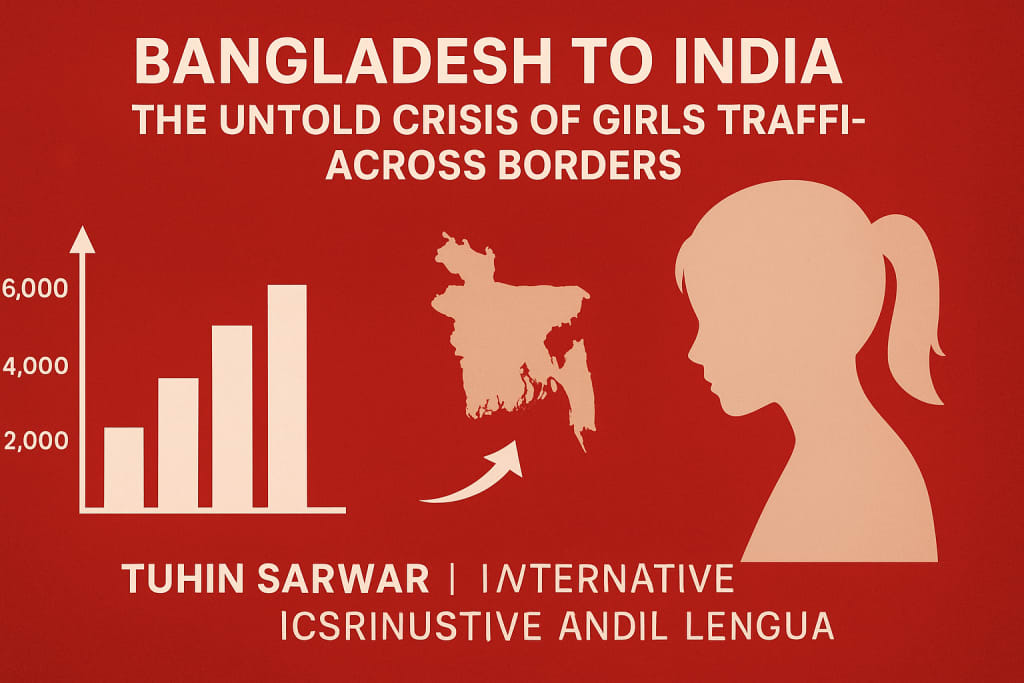
By Tuhin Sarwar
Bangladesh’s densely populated border regions, where poverty and hopelessness are stark realities, witness thousands of young girls each year being swept away into an invisible current, carried into India’s shadowy red-light districts. This cross-border trafficking is not merely a statistic but a deeply human tragedy, one that shatters lives and leaves families in anguish. According to the BMET Annual Report 2023
, thousands of minors are lured under false promises of employment or education, only to find themselves entrapped in the trafficking networks that span South Asia. Experts argue that entrenched socio-economic inequalities, lack of education, and systemic vulnerabilities make these girls prime targets for traffickers.
Prof. Zakir Hossain, a human rights researcher at Dhaka University, notes, Traffickers exploit the desperation of impoverished families, offering promises that are never kept. The journey these girls take is often irreversible, and many never see their homes again (UNODC South Asia Report
). This human cost is rarely quantified in official records, yet survivor testimonies paint a grim picture of exploitation, coercion, and abuse.
Consider the case of Safa, a 16-year-old from the Kurigram district, who was persuaded by a neighbor to move to India for work. Within days, Safa found herself trapped in a brothel in Kolkata. “I thought I would work as a maid, but I was forced into things I couldn’t imagine,” she recounts. Her story mirrors thousands of others, where promises of livelihood are replaced with brutality. Reports by Amnesty International 2022–24
highlight that trafficked girls face extreme physical, emotional, and psychological trauma, often living in conditions that violate every basic human right.
The mechanisms of trafficking are complex and highly organized. Middlemen, often familiar to the families of victims, play a critical role in recruitment. These agents exploit local poverty, ensuring that the economic desperation of households is leveraged against the well-being of children. Studies by Human Rights Watch 2023
show that traffickers charge between USD 200–500 per girl, and these networks are deeply entrenched in local and cross-border economies.
Legal frameworks exist, both in Bangladesh and India, to combat trafficking, yet enforcement remains weak. Corruption, inadequate resources, and limited cross-border coordination often allow traffickers to operate with impunity. According to UNODC
, only a fraction of traffickers are prosecuted, and victims seldom receive adequate protection or rehabilitation.
The social and economic drivers behind trafficking are equally important. Rural poverty, unemployment, and lack of education create environments where families, desperate for income, are susceptible to deception. The global demand for cheap labor and sexual exploitation compounds the problem, turning vulnerable girls into commodities. OXFAM South Asia Research
emphasizes that without addressing these root causes, enforcement alone cannot halt the trafficking crisis.
Survivor accounts provide invaluable insight into the scale and brutality of this exploitation. Rina, another survivor, describes being forced to work under the constant threat of violence. “I would cry every night for my family, but no one heard me,” she recalls. NGOs such as Praxis Bangladesh
and Shishu Polli
have documented dozens of such cases, providing rehabilitation and support, but resources are limited compared to the magnitude of need.
Public awareness and international pressure can play pivotal roles. Stories documented by journalists, combined with academic research, reveal systemic failures and highlight actionable solutions. Experts recommend multi-layered strategies, including community education, improved border monitoring, legal reforms, and survivor-centric rehabilitation programs. The integration of survivor voices into policy development ensures that interventions address real needs rather than theoretical solutions.
The psychological toll on trafficked girls cannot be overstated. Trauma manifests in long-term mental health issues, including depression, anxiety, and PTSD. WHO reports
stress the urgent need for trauma-informed care, highlighting that recovery is possible only when social support, therapy, and empowerment programs are accessible. Vocational training, education, and safe reintegration into society are critical to breaking the cycle of exploitation.
Collaboration between governments, NGOs, and international agencies remains essential. Programs by UNICEF Bangladesh
and Save the Children
have demonstrated success in both prevention and rehabilitation, though scalability remains a challenge. Awareness campaigns targeting families, schools, and communities have been instrumental in preventing recruitment, emphasizing the role of education and community vigilance in protecting vulnerable children.
Economic empowerment programs targeting at-risk families show promise. By providing sustainable livelihoods and microfinance support, these initiatives reduce the financial desperation that traffickers exploit. According to World Bank Reports
, income-generation initiatives combined with education significantly reduce vulnerability to trafficking.
The narrative of cross-border trafficking also intersects with migration and gender dynamics. Women and girls remain disproportionately affected, and societal stigma further marginalizes survivors. Addressing these structural inequalities is essential not only for rehabilitation but also for prevention. Policies must incorporate gender-sensitive frameworks, community engagement, and enforcement accountability to create a lasting impact.
International cooperation is key. Bilateral agreements between Bangladesh and India must ensure cross-border surveillance, victim repatriation, and judicial cooperation. The South Asia Initiative
emphasizes harmonized regional strategies to tackle trafficking networks that operate across porous borders. These frameworks, however, require sustained political will and adequate funding to be effective.
Voices of survivors serve as powerful catalysts for change. By sharing their stories in safe and supportive environments, they inform policy, raise awareness, and inspire community action. Survivor-led advocacy provides authenticity, ensuring interventions are grounded in lived experience rather than abstract statistics.
In conclusion, trafficking of Bangladeshi girls into India remains an urgent humanitarian and social crisis. It thrives on systemic poverty, weak enforcement, and the exploitation of vulnerability. Yet, hope persists through the tireless work of NGOs, international agencies, and survivor advocates. Comprehensive strategies encompassing prevention, protection, prosecution, and partnership are essential. Ensuring safe rehabilitation, education, and opportunities for survivors like Safa and Rina can transform lives and disrupt the networks that perpetuate exploitation. Society’s responsibility extends beyond awareness to actionable support, compelling governments and international organizations to prioritize the protection of these vulnerable girls.
Call-to-Action (CTA):
Support organizations working to end human trafficking: Amnesty International
, UNODC
, Praxis Bangladesh
, Shishu Polli
. Share this story to raise awareness and contribute to change.
By Tuhin Sarwar | International Investigative Journalist
About the Creator
Tuhin sarwar
Tuhin Sarwar is a Bangladeshi investigative journalist and author, reporting on human rights, the Rohingya crisis, and civic issues. He founded Article Insight to drive data-driven storytelling. 🌐 tuhinsarwar.com
Keep reading
More stories from Tuhin sarwar and writers in Journal and other communities.
Rising Influence of Islamist Student Groups in Bangladesh: Youth Politics Ahead of 2026 Elections
Introduction: A Shifting Political Landscape in Bangladesh In the 2024 student council elections at Dhaka University (DU) and Jahangirnagar University (JU), Islamist student organizations have gained unprecedented support. The United Students Alliance, backed by Islami Chhatra Shibir, won 23 out of 28 seats at DU, including leadership positions such as vice president, general secretary, and assistant general secretary. At Jahangirnagar University, Shibir secured 20 out of 25 seats, signaling a broader political shift.
By Tuhin sarwar3 months ago in Journal
The goals I did not achieve
Every writing goal I made for the year is a wash. It has been this way for a while, but I think it's important to be open about my failures and the reality of how life can get in the way. This is especially true considering the several times I have posted on Vocal about my writing goals, how I was changing my approach, and where I was hoping to be for the upcoming year. I will probably do that again in a couple months, but for now, it is time to acknowledge where I am today.
By Kay Husnick16 days ago in Journal
Bruce Lee and The God of War: Kuan Ti
It starts with love.. The Power to the God Of War and Wealth Walk into a Chinese restaurant (even in Oklahoma, USA), a Chinese police station, a kung fu martial arts studio or even a Chinese temple and you often see a red faced warrior holding a heavy quan-do (spear like weapon).
By WILD WAYNE : The Dragon King4 days ago in Chapters


Comments
There are no comments for this story
Be the first to respond and start the conversation.