
Staticky Oracles & The Book of Lists
Childhood lessons resolve into adult attitudes in a world that can no longer be abided.

To Whom it May Concern,
I first began to suspect that life was a limited-time-offer, rife with terms and conditions to which I was not privy, when I was three years old and Dude the cat disappeared, never to return. Further confirmation arose at age four when I awoke to find my mother crying on the morning of her birthday. She responded to my concerned inquiries by explaining that Nana Haas had died. Unsure of what that truly meant, I was simply told we wouldn’t be seeing her any more, just like Dude.
Gradually, I pieced together the evidence. The mysterious absence of pets and people we just didn’t see anymore meshed, somehow, with the occasional tragedy of finding a fish floating, belly-up, in the tank. The other aquarium denizens would carry on with their fish lives, unaware or uncaring of what hung at the surface of the water, at that demarcation between their comfortably wet world and an inhospitable alien hell beyond their gasping comprehension. My family did their best to protect me from the knowledge of death. Evidently, for every expired fish I discovered, there had been several frantic, rushed trips to the pet store in search of finny doppelgängers.
The babysitter was less kind. Her glowing, cathode-ray-tube face presented fictions and truths that most adults dared not engage with. She is an oracle. Movies are fake, but She, in Her multitudes, simulates some version of reality. A chaperone is always present at the theater, but the television is always there, even when I’m alone. Late at night She sings the National anthem before exposing the screaming static of Her true face.
The TeeVee is a hypnotic drug, tantalizing with cartoon inanity, violence, and flesh. There are soft-focus soap operas, vice squad gunfights and phasers set on kill. The news, filled with talking heads rambling about politics and economics, is boring, but also offers raw footage of crashes, war, blood, and death. It’s hard to know what’s real and not sometimes, but I grow to understand that the key is paying attention to how people talk. The TeeVee showed us The Challenger explode in a plume one day during class. Who could look away after that?
The TeeVee enthralls. She provides my first true taste of grief that I now recognize as the dopamine crash of expectation unrealized. I was five when Manimal was “cancelled.” My father’s explanation floored me, triggering a full-blown tantrum, filled as I was with such visceral loss. The idea that not just pets and grandparents are subject to being taken suddenly away, seemingly anything, even television shows, could be swept up and away in Time’s scouring tide.
Despite Her hold on me, the screen is merely an infatuation. My true love is books, which surround me, and allow for conjuring of magics that expose the television for the vulgarian She is. Here is the dreamy knowledge, osmotically percolating into the mind’s eye, solidifying into understanding in a way that should make all screens everywhere jealous. With Her bright colors and quick cuts, She is blind to Her inadequacies, merely a receiver and transmitter of electromagnetic frequencies. Books, however, are doorways leading to deeper truths.
I endlessly pore over a huge astronomy book and a textbook of Greek mythology. The TeeVee may have taught me certain valuable lessons, but these tomes point to things greater. Herein are hints of the vastness of experience and the unknowable quantities that flit and float through lives I am just starting to understand can be cut short or run out their course to some final end that represents, if nothing else, an unignorable absence of something that once was.
The media I consumed programmed an admittedly annoying skepticism into me at a young age. I began a persistent search for clarification: Why was Jesus real, but Zeus was not? I had been taught that there were no stupid questions, but it began to come clear that certain inquiries existed which adults were simply not prepared or equipped to answer satisfactorily.
Much discussion these days revolves around which books are appropriate for what libraries. People think that certain ideas are dangerous for children, or for anybody to be exposed to. Various issues have led to outrage and even book burning. The idea that libraries have been recently infiltrated with unsavory knowledge is being pushed aggressively, leading to accusations of agendas on all sides.
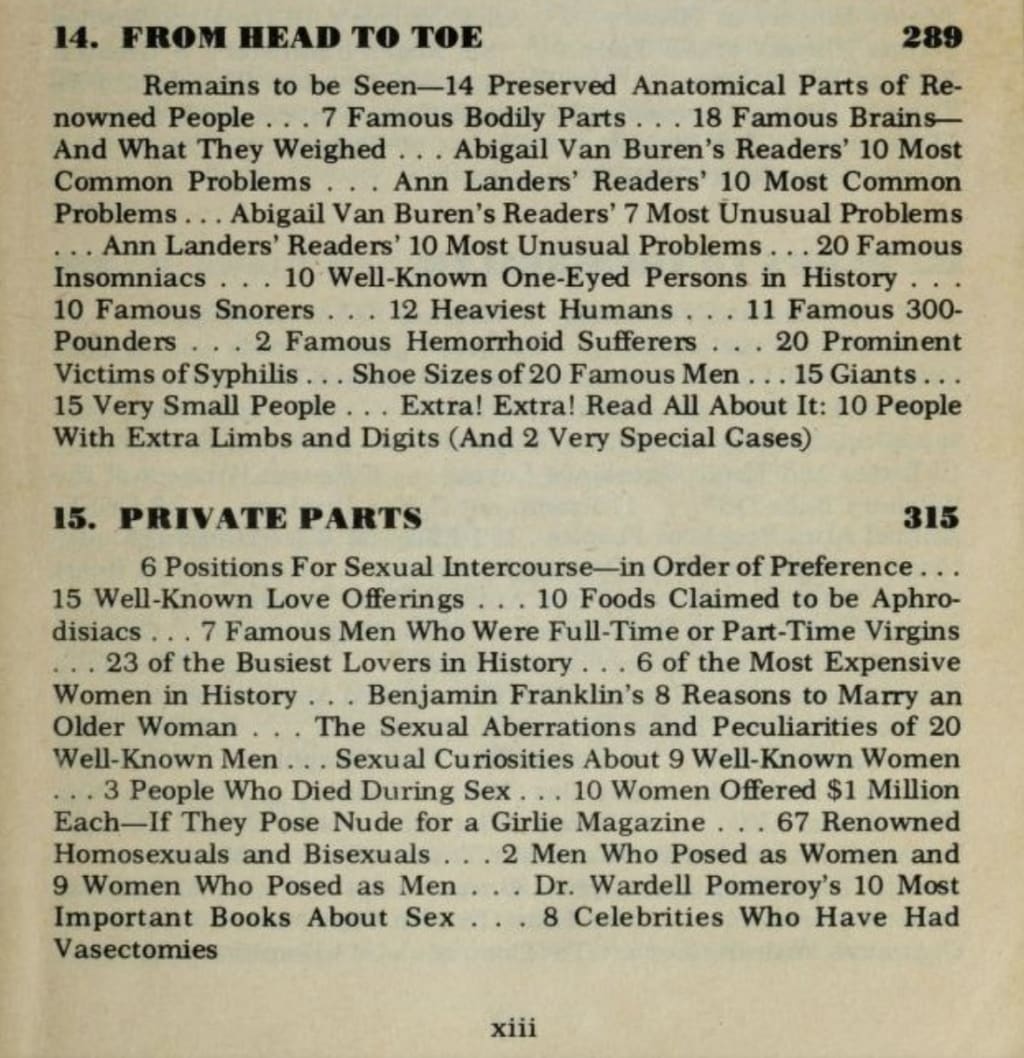
The reference section of my elementary school library contained The Book of Lists, a 1977 compilation of gems such as “10 Possible Victims of 10 ‘Jack the Rippers,’” “The 10 Worst Famines,” and “15 Most Dangerous Airlines.” There were boring lists such as: “6 Nations That Receive Military Aid from China, the U.S.S.R, and the U.K and U.S.” and “Top 10 American Arabs—or Didn’t You Know?” as well as titillating ones like: 6 Positions for Sexual Intercourse—In Order of Preference” and “Sexual Curiosities About 9 Well Known Women.”
This book, which I had checked out of my elementary school library a dozen times, was in my hand when I encountered my father emerging from the bathroom. “What is rape?” I asked him. He seemed taken aback, but my hippie parents tended toward earnestness. “It’s, uh, when sexual intercourse is forced on someone who is, uh, unwilling,” he replied with his New York City accent, “Where did you hear that?” Looking back, I can see how my next question took him off guard, but at the time I only wondered if I was going to get some bullshit brush-off explanation or if my horrendous suspicions were about to be confirmed.
“So, what does ‘raped by trained dogs’ mean?” I asked. He blanched and asked where I’d heard that and I showed him The Book of Lists. “10 Countries That Still Use Torture Today.” Number 10 on the list read:
URUGUAY
National police and Armed Forces Ministry of Defense use water torture, electric shock, rape with trained dogs, and beatings on suspected Tupamaro terrorists and political dissidents. Documented cases since 1965.
My father looked at the list and at the book. We had a contentious relationship for most of my life, but he imparted some wisdom on rare occasions, like “always stand with your back to the wall on subway platforms, so no one can push you in front of the train.” On this day, he explained to me what “propaganda” is, and how sometimes the powers that be make things up so we’ll think less of others. He told me that it can be hard to know what’s true, and that simply accepting someone’s word can be dangerous, and that it’s critical to consider the sources of information, as most people harbor agendas.
It has been forty years since that day, and my father is dead, relegated to the vastness beyond along with Dude, Nana Haas, and Manimal. I take this opportunity to resign. I resolve to quit being a fish in a tank, mindless of the specter of death hanging above my head. I quit being complacent. I quit holding my tongue as time speeds my existence into a future of obscene excess for oligarchical puppetmasters while the rest of us scramble desperately, distracted by a new generation of lying oracles. I quit believing that the better angels of their nature will eventually reveal themselves, understanding that absolute power corrupts absolutely. I quit doing “good enough” and will do “better,” regardless of the obstacles set before me.
The world is full of dangerous ideas with opportunities for exposure to them more available than at any time in history. It is time to understand that, considering the inevitabilities this scenario predicts, how we respond to these ideas and infohazards is of critical importance. Solutions are available to all of our problems if we carefully choose how to respond, but first we must reevaluate how we relate to the oracles with which we are provided, and refuse to be complacent with the limited time that we have.
About the Creator
J. Otis Haas
Space Case
Keep reading
More stories from J. Otis Haas and writers in Journal and other communities.
Engro Holdings Profit Jumps to Rs. 107 Billion in 2025
Engro Holdings has reported a remarkable profit of Rs. 107 billion for the year 2025, marking one of the strongest financial performances in the company’s history. The impressive results reflect robust growth across its diversified portfolio, disciplined cost management, and strategic investments that continue to strengthen its position as one of the most influential conglomerates in Pakistan.
By Sajida Sikandar3 days ago in Journal


Comments (1)
Wooohooooo congratulations on your honourable mention! 🎉💖🎊🎉💖🎊