
Solar Panel Cost UK in 2025: Real Prices, Payback & Savings
Solar Panel Cost UK in 2025

Intro
Thinking about going solar but unsure what a fair quote looks like? You’re not alone. Prices vary with system size, roof access, equipment choice and whether you add a battery. Below we break down realistic solar panels UK cost 2025 ranges, the main cost drivers, where the savings come from, and how to compare quotes without getting lost in the jargon. We’re Evergreen Power UK — installing solar PV and batteries since 2013 — so you’re getting the practical version, not just the brochure talk.
What UK homeowners are actually paying in 2025
There’s no single “right” price because every roof and spec is different. That said, recent reference points help you sanity-check quotes:
• The Energy Saving Trust’s guidance remains a reliable start for understanding how domestic solar works and where the savings come from; use its calculator to test assumptions for your postcode and tariff.
• Consumer cost round-ups in 2025 frequently cite circa £9,800 for a 4.5 kW system including a small battery as a mid-market example (actual quotes may be below or above once scaffolding, access and brand choices are factored in).
• For systems without batteries, many UK homeowners still see quotes in a broad £5,000–£9,000 band for 3.5–5 kWp arrays, depending on module efficiency, inverter choice and install complexity (use third-party calculators to cross-check the savings).
Tip: When comparing prices, check you’re looking at like-for-like specs — panel wattage and count, inverter type, mounting system, scaffolding, monitoring, and any extras (diverter, EV integration, bird-proofing).
The big cost drivers (and how to keep them under control)
1) System size & panel efficiency
Higher-efficiency modules can reduce panel count for the same kWp, helpful on compact or chimneied roofs. On larger, simple roofs, standard panels may be the better value.
2 Inverter architecture
A single string inverter is cost-effective for simple, unshaded roofs. If you’ve got multiple pitches, dormers or trees, optimisers or microinverters may lift yield — worth the premium in the right scenario.
3 Scaffolding & access
Terraced streets, three-storey townhouses or tricky spans push costs up. Good survey photos and accurate access notes keep quotes realistic.
4 Optional extras
Battery storage, immersion diverters, EV charger integration and monitoring upgrades add cost but can improve savings or comfort. Batteries also benefit from 0% VAT in Great Britain until 31 March 2027, as does solar supply-and-install.
5- VAT
The government’s zero-rate policy for energy-saving materials applies in Great Britain until 31 March 2027; installers show this at 0% VAT on the invoice. (Different rules apply in Northern Ireland.)
What savings look like (and how to estimate yours)
Savings come from using your own generation in real time and selling any surplus via the Smart Export Guarantee (SEG). SEG is a supplier-led scheme: each licensee sets its export rate and terms, but the rate must be above zero and payments are based on metered export.
To estimate your savings:
1. Pull your annual kWh usage from bills.
2. Use the Energy Saving Trust solar calculator to model a system size for your postcode and roof orientation; adjust self-consumption assumptions if you’re often at home in the day.
3. Check SEG rates with suppliers or comparison round-ups; note that some top rates require you to also buy your import electricity from them.
4. Consider a battery if evenings are your peak usage, you plan to use time-of-use tariffs, or you want resilience for price spikes. Battery costs and benefits are covered later.
Payback: the honest version
Payback periods depend on your usage profile, tariff, system size, local irradiance and whether you add storage. A south-facing ~4–5 kWp array on a typical semi can trim a meaningful chunk off bills, with extra income from SEG for the surplus. Use local modelling via the EST calculator and compare two or three supplier SEG offers to avoid under-selling your export.
Planning permission & regs — any hurdles?
For most UK homes, rooftop solar is permitted development, so you don’t need planning permission provided you meet certain limits (e.g., panel projection and siting rules). Listed buildings, flats and some conservation areas differ — always check the detail or ask us to confirm for your address.
Batteries: headline costs & when they stack up

Battery systems vary widely by capacity and brand. A widely-cited benchmark is around £4,600 for a 5 kWh system, with overall ranges between £1,500 and £10,000 depending on size and spec. Bundling storage with a new PV install can reduce total labour and integration costs.
Adding a battery can shorten payback if you have evening demand, a time-of-use tariff or frequent daytime surplus. If you work from home and use most electricity in daylight, pure PV might already deliver strong savings without storage; if you’re out all day, a solar panel battery often makes more sense.
What a trustworthy quote includes
• A measured or digital roof survey with shading notes.
• A design showing panel layout, inverter type and estimated annual yield.
• Full kit list (module model and warranty, inverter, mounting system, monitoring).
• Scaffolding, AC/DC works, DNO paperwork, MCS certification, commissioning and handover.
• Clear info on warranties (panel performance, product, inverter, workmanship).
• Export readiness (SEG guidance, smart meter requirements).
FAQs
Do I need a smart meter for SEG?
You need export metering; suppliers typically use a smart meter configured for export.
How long do panels last?
Many modules have 25-year performance warranties; inverters typically 5–12 years with extension options. Check your quote for specifics.
Will I need planning permission?
Usually not — most houses are covered by permitted development, with caveats for listed buildings and conservation areas.
What affects price most?
System size, roof access, inverter architecture and whether you add a battery. Use trusted calculators to stress-test savings.
Is SEG available in Northern Ireland?
SEG is a Great Britain scheme; NI has different arrangements.
About the Creator
Evergreen power
We specialize in Solar panels UK and other renewable energy solutions
Keep reading
More stories from Evergreen power and writers in Journal and other communities.
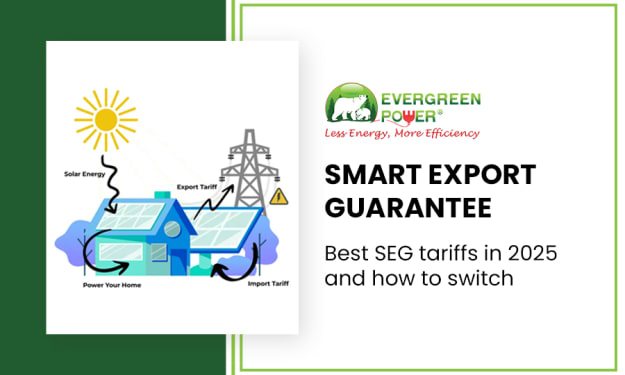
Smart Export Guarantee: best SEG tariffs in 2025 and how to switch
If you export any solar you don’t use, Smart Export Guarantee (SEG) payments help the numbers stack up. The trick is picking a tariff that matches your generation and usage profile — especially if you have a battery. Below you’ll find a brisk refresher on how SEG works, what to compare, and a step-by-step that makes switching painless.
By Evergreen power5 months ago in Journal
Yoan Iglev Reveals the Influence of Classical Art in Contemporary Murals
Public art has the ability to change how people experience a city. Large murals on walls can turn simple buildings into meaningful cultural spaces. One artist who has contributed to this form of art is Yoan Iglev, a Bulgarian painter known for creating monumental murals and artistic mosaics.
By Mark Walker7 days ago in Journal



Comments
There are no comments for this story
Be the first to respond and start the conversation.