
Smart Pricing: When and How to Reduce the Price Without Hurting Your Brand
Learn smart ways to reduce the price without losing value. Discover low-cost pricing strategies, legal rules, and tips to lower prices strategically.


You might be facing slow sales or fierce competitors offering lower prices. Cutting your own price feels like a quick win, but it can also damage profits and long-term brand value. The key is to reduce the price with a clear purpose and strategy, not emotion.
In this guide, I’ll explain when and how to lower prices effectively, and how to make each price move strengthen – not weaken – our business. After reading, you’ll have a clear plan to adjust prices and maintain your brand's competitiveness.
When Reducing Prices Makes Sense
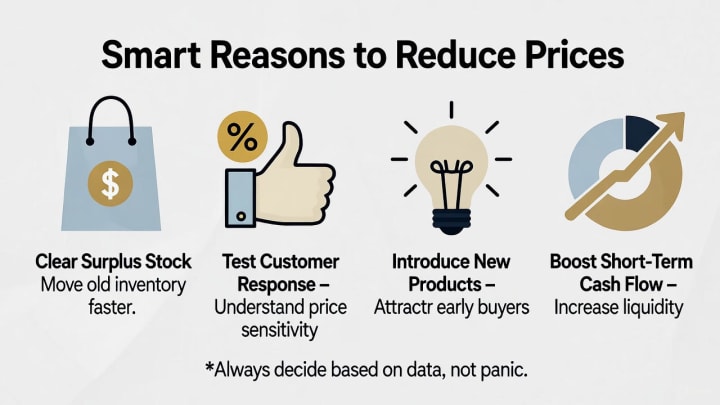
Price reduction is best done as a result of a specific business purpose and not in panic. It may be intelligent when you need to clear some surplus inventory, to test customer reaction, or to introduce a new product. A price cut that is controlled will boost the volume of sales and customer loyalty without killing brand positioning.
As an illustration, a lifestyle brand can conduct a small-scale promotion of new, lower prices on old stock and still charge high prices on new collections. This enables the flow of money without undermining the whole brand.
Nevertheless, data should always determine the decision to lower the price regardless of the competition panic. Examine product margins, demand trends, and lifetime customer value, and then act.
Legal and Ethical Realities
Pricing regulations define distinct limits of what should be done. Prices can be reduced at will, but not misleadingly or collusively. It is strictly regulated in the US, wherein resale price maintenance and misleading price advertisement are closely monitored. The EU has agreements among sellers fixing prices that violate the competition law.
Also, always retain evidence for any promotional claim. Openness is a source of trust and is a safety net against sanctions.
Planning a Strategic Price Cut
Price reduction is not a mere number reduction but one of the communications. Begin with an objective: are you attempting to empty stocks, enhance cash flow, or increase trial purchases? After determining the purpose, the appropriate pricing structure is selected.
Experiment with a reduced price to small customer groups first. Monitor rates of conversion and profitability. Gradually scale in case the results warrant it. Digital A/B tests are also employed by many retailers before the lower-cost offers are applied to all channels.
Always support discounts with a strong product presentation. Even during sales, your packaging quality, such as using tuck top mailer boxes, should stay consistent. This ensures customers perceive value despite the lower price.
Common Low-Cost Pricing Approaches
The low-cost strategy pricing relies on volume rather than high margins. It works best with brands that have the capacity to dictate the production expenses and logistics. Nevertheless, it helps make them the lowest price, but it is only possible to such an extent that the efficiency and quality are kept in balance.
Some brands apply a low to high price structure to attract budget-conscious buyers first and then introduce premium lines once loyalty grows. Others use a tiered pricing system where entry-level products attract new customers, while premium variants maintain profitability.
Checklist Before Lowering Prices
- Define why you’re reducing the price (clear stock, boost sales, compete).
- Calculate the margin impact before any reduction in price.
- Confirm compliance with advertising laws in your market.
- Communicate discounts honestly and clearly.
- Set a time limit to avoid long-term brand erosion.
- Track sales performance and adjust the offer if needed.
Advertising and Communication
The manner in which you deliver the lower price determines how the customers view it. Avoid shouting “cheap!” Rather, convey vision and significance. An announcement such as “Seasonal Clearance” and “Limited Stock” is dignified, whereas the announcement “Massive Price Drop” sounds desperate.
In case you are reducing prices to win over competition, do it selectively. The company has to compete only on the major products where the differentiation is minimal. Add value instead of reducing prices with bundles or loyalty programs.
Highlight “new lower prices” in digital ads, but balance with service benefits like fast shipping, easy returns, or extended warranty to sustain perceived worth.
Retail Reality: When Competitors Lower Prices
You are not the only one when the market changes. When companies reduce their prices in difficult times, other firms would respond. Do not follow at the very moment; examine the actual products that are sensitive to price. More trust may be held by just staying the same and providing better service or packaging.

For instance, a fashion brand might keep its main collection prices stable while applying lower-cost pricing to accessories. Adding detail through premium packaging, like personalized apparel boxes, can make even discounted products feel special and maintain brand consistency.
Avoiding Common Pitfalls
Avoid permanent price cuts. The number becomes easily adjusted by the customers, and the future increases are resisted. Do not lower the price on all your products in your entire line-up, but on a few selected SKUs. And do not compete to the bottom; not all the victories come at a reduced price.
Other times, an improved path can be the provision of extra value: delivery free service, reward loyalty, or service upgrades. These can outperform uncooked discount in the long-term brand equity.
Can you sell at a lower retail price than the manufacturer’s suggested price?
Yes, in most cases. However, when there is a Minimum Advertised Price (MAP) policy in a contract, you can not advertise amounts that are lower than that number publicly. You may, however, sell low-end in-store or by personal offers.
What’s the best time to announce a price reduction?
Seasonal clearance or before the introduction of a new inventory. Credibility is preserved by offering discounts to consumers at that time.
How can small businesses compete with companies that lower prices?
Compete on quality, speed, and trust. Use packaging, personalization, and local service as differentiators instead of cutting too deeply.
How to recover after a price cut?
Rebuild pricing gradually by adding value like new features, bundles, or premium presentation. Communicate improvements clearly so the higher price feels justified.
Final Thoughts
Risky but powerful price cuts can be achieved without a strategy. The smartest brands think, trial and error, and achieve this by communicating. Always set your price strategically- supported by statistics, brand aspirations, and legislation. By positioning it well to counter competition, reducing price may draw the eye, and reputation may not be spoiled.
Be open, maintain quality, resort to design, packaging, and service to maintain perceived value. That is what makes a low-cost pricing strategy more of a brand-building tool than a panhandling tool.
About the Creator
Cristina Baker
I’m Cristina Baker, a business and market expert with 8+ years of experience helping brands and entrepreneurs grow. I share insights, strategies, and ideas that inspire growth, spark curiosity, and turn challenges into actionable results.
Keep reading
More stories from Cristina Baker and writers in Journal and other communities.
Graphic Cigarette Packaging: How Warning Labels Change US Smokers’ Minds
Packs with small text warnings are always visible on store shelves. Many US smokers underestimate risk and delay quitting. Clear, graphic cigarette packaging forces a pause. It raises risk perception, sparks quit attempts, and supports tobacco control. So, warning labels always play a crucial role in changing smokers’ minds.
By Cristina Baker3 months ago in Journal
The goals I did not achieve
Every writing goal I made for the year is a wash. It has been this way for a while, but I think it's important to be open about my failures and the reality of how life can get in the way. This is especially true considering the several times I have posted on Vocal about my writing goals, how I was changing my approach, and where I was hoping to be for the upcoming year. I will probably do that again in a couple months, but for now, it is time to acknowledge where I am today.
By Kay Husnick22 days ago in Journal
Apostolic Succession Explained in Plain Language
One of the most misunderstood aspects of Catholic Church structure is the concept of apostolic succession. Simply put, apostolic succession is the unbroken line of spiritual authority handed down from the apostles, who were personally chosen by Jesus Christ, to the bishops and priests of the Church today. Understanding this concept is essential to grasping why the Catholic Church claims to preserve authentic teaching, sacramental authority, and continuity with Christ Himself.
By Sound and Spirit4 days ago in Journal




Comments
There are no comments for this story
Be the first to respond and start the conversation.