
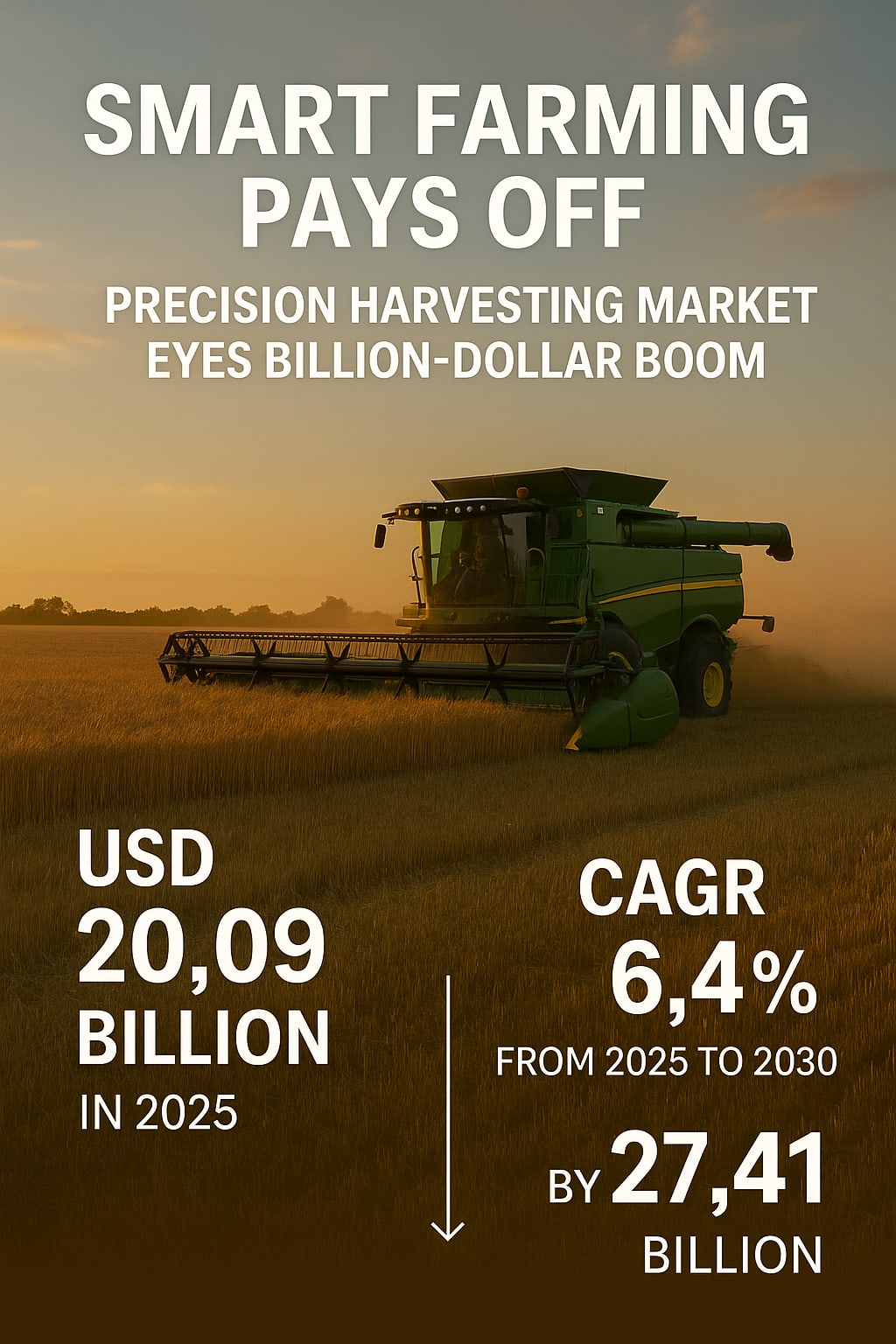
Smart Farming Pays Off: Precision Harvesting Market Eyes Billion-Dollar Boom
Market predictions show that the global precision harvesting industry will expand from USD 20.09 billion in 2025 to surpass USD 27.41 billion by 2030 while maintaining a strong CAGR of 6.4%.

Modern agriculture depends heavily on efficiency and sustainability which makes precision harvesting a revolutionary development in the field. The advanced technology segment of smart farming is revolutionizing crop collection through automated systems that utilize data analytics and GPS guidance to boost yields and reduce waste. As the world faces growing food needs alongside increased climate challenges, the precision harvesting industry experiences strong growth and is set to reach a billion-dollar valuation.
The Rise of Precision Harvesting
Precision harvesting market utilizes cutting-edge technologies including drones, sensors, autonomous combines, satellite imaging and AI-driven software to establish the best timing and techniques for harvesting crops. The advanced precision harvesting techniques produce higher operational efficiency and better crop quality while decreasing reliance on human labor and minimizing environmental impact.
The rapid expansion of the global precision harvesting market demonstrates growing use of advanced farming technologies among commercial farms of all sizes seeking competitive advantage.
What’s Driving the Market?
1. Global Food Security and Demand
The future global population expected to reach 9.7 billion people by 2050 makes efficient food production extremely important. Precision harvesting guarantees crops are gathered at their optimal stage of readiness which leads to increased food production and reduced wastage.
2. Labor Shortages and Rising Costs
Developed nations are experiencing agricultural labor shortages which drive the accelerated implementation of automated harvesting technologies. Robotics and artificial intelligence provide reliable performance without the possibility of fatigue or mistakes.
3. Sustainability and Environmental Impact
Smart harvesting systems cut down both fuel consumption and excessive harvesting while preventing unnecessary soil compaction. Farmers can implement sustainable farming methods and meet environmental standards through the use of precision technology.
4. Integration of IoT and AI
Precision farming depends on the combined capabilities of IoT technology and artificial intelligence. The combination of real-time crop monitoring with data analysis and predictive algorithms enables farms to make decisions quickly and with greater intelligence.
Key Technologies Powering Growth
• Autonomous Harvesters: AI-enabled autonomous harvesters use machine vision to determine fruit ripeness while optimizing harvest routes for maximum efficiency.
• Crop Sensors and Drones: These devices perform field scans to monitor moisture content along with nutrient levels and plant health status while delivering data that supports accurate scheduling of harvest activities.
• GIS and GPS Mapping: Geolocation tools provide the ability to conduct site-specific harvesting which facilitates targeted collection while minimizing field damage.
• Cloud-Based Analytics Platforms: Centralized data systems assist farmers to analyze information and modify their tactics instantly.
Regional Momentum
• North America: Agri-tech market leadership stems from significant investment efforts in North America with a strong focus on the U.S. and Canada. Large agribusiness companies along with government support programs are speeding up deployment efforts.
• Europe: The EU Green Deal together with the Common Agricultural Policy's sustainability initiatives promote the uptake of precision harvesting techniques.
• Asia-Pacific: China, India, and Japan have begun quickly implementing smart farming technologies to meet their food security needs and overcome labor shortages in rural areas.
Challenges to Watch
Even though precision harvesting is advancing rapidly the market still confronts numerous challenges.
• High Initial Investment: The high cost of advanced machinery and software creates financial barriers for small-scale farmers to access precision harvesting technology.
• Data Integration Issues: Bringing together numerous technologies under one unified platform requires complex integration processes.
• Lack of Technical Expertise: Farming communities need education and resources to deploy smart systems successfully.
The Future of Harvesting
Precision harvesting technology will become a vital element in creating intelligent and sustainable food production systems as digital agriculture develops. Robotic and AI developments combined with data science progress promise to make farming both more profitable and environmentally sustainable in the future.
Smart farming is now an essential requirement for modern agricultural practices. The availability and affordability of precision harvesting tools is leading to global farming benefits. The market crossing the billion-dollar threshold indicates both industry expansion and shows how technology transforms agricultural practices.
About the Creator
Paxton Templeton
I’m a storyteller at heart with a passion for turning data into compelling narratives. With a focus on industry trends, market insights, and growth statistics, I bring clarity to complexity
Keep reading
More stories from Paxton Templeton and writers in Journal and other communities.
Charging Ahead: Electric Trucks Market Accelerates into Billion-Dollar Territory
The worldwide effort to adopt sustainable transportation methods is transforming the commercial vehicle industry while electric trucks play a pivotal role in this change. Electric trucks have moved from being futuristic concepts to becoming essential and practical options for worldwide freight and logistics operations. The electric trucks market has moved beyond gaining traction to reach billion-dollar sales figures which are transforming transportation methods throughout cities and across entire continents.
By Paxton Templeton8 months ago in Journal
The goals I did not achieve
Every writing goal I made for the year is a wash. It has been this way for a while, but I think it's important to be open about my failures and the reality of how life can get in the way. This is especially true considering the several times I have posted on Vocal about my writing goals, how I was changing my approach, and where I was hoping to be for the upcoming year. I will probably do that again in a couple months, but for now, it is time to acknowledge where I am today.
By Kay Husnick23 days ago in Journal
Inside a Policy Limit Investigation: Process, Purpose, and Pitfalls
Insurance claims can be complex, especially when the potential damages approach or exceed the policy limits. In such cases, insurers often initiate a policy limit investigation, a critical process designed to determine whether a claim should be settled within the policy limits or if additional considerations, including litigation risk, must be addressed.
By Addison Jons3 days ago in Journal


Comments
There are no comments for this story
Be the first to respond and start the conversation.