
Simple Predictive Algorithms and Techniques for Business Users
Business Users CAN Leverage Predictive Analytics Algorithms

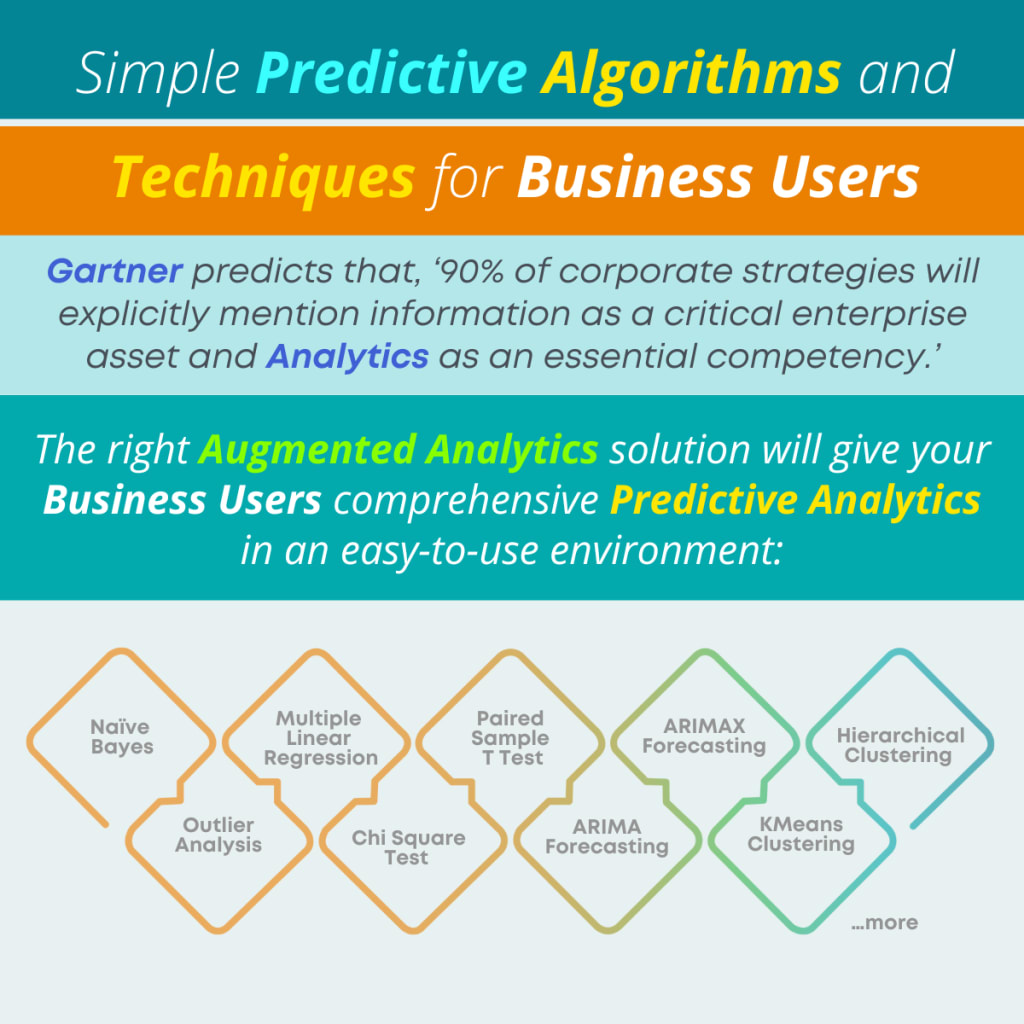
It is often difficult for an organization to imagine its business users engaged in analytics but, there is no doubt that a competitive market landscape and the constant need for up-to-date, accurate information is necessary to your business success. When you consider the complex, sophisticated topic of advanced analytics, you want to select an analytics solution that is easy for your team to use, one that provides algorithms and techniques for analysis in an easy-to-use environment, so users can select the right technique and perform analytics with confidence.
Gartner research analysts predict that, ‘90% of corporate strategies will explicitly mention information as a critical enterprise asset and analytics as an essential competency.’
In order to get the most out of a self-serve analytical solution, your team members will leverage many types of tools. One of the most important analytical processes your users will employ is predictive analytics for planning and forecasting.
‘The right augmented analytics tool provides auto-suggestions to select the techniques or algorithms that will best suit the purpose of the analysis and allows users to gather and analyze the data with intuitive navigation, designed to guide the team member through the analytical process.’
A comprehensive augmented analytics solution should include a full suite of assisted predictive analytics tools. Let’s consider some of the predictive analytics techniques your users will need:
Naïve Bayes Multiple Linear Regression Paired Sample T Test
ARIMAX Forecasting Hierarchical Clustering Outlier Analysis
Chi Square Test ARIMA Forecasting KMeans Clustering
Holt-Winters Forecasting Gradient Boosting Isotonic Regression
Spearman’s Rank Correlation Random Sampling and Stratified Random Sampling KNN Classification
Independent Sample T Test Simple Linear Regression Karl Pearson Correlation
SVM Classification Decision Tree Analysis FP Growth Analysis
Descriptive Statistics Trends and Patterns Multinomial Logistic Regression Classification
Random Forest Regression Binary Logistic Regression Classification Multilayer Perceptron Classifier
Generalized Linear Regression
Each of these techniques is designed to address a different type of data and a different issue or purpose. These techniques can be used to identify the root cause of problems, to clearly understand challenges and opportunities and to strategize and share data. The most important consideration here is to provide this capability in a self-serve environment that is easy enough for business users with average technical skills.
The right augmented analytics tool provides auto-suggestions to select the techniques or algorithms that will best suit the purpose of the analysis and allows users to gather and analyze the data with intuitive navigation, designed to guide the team member through the analytical process.
‘The right augmented analytics solution should include a full suite of assisted predictive analytics tools.’
The secret to user adoption of augmented analytics is to provide tools that your users will want to embrace, tools that make it easy for them to employ sophisticated analytics without data scientist, IT or analyst skills. Your business can defeat user perception of the complexity of augmented analytics and optimize the true value of integrating analytics into the day-to-day workflow.
Give Your Team Assisted Predictive Analytics with Easy-to-Use Algorithms and Techniques
If you want your business users to adopt your augmented analytics solution, give them tools and predictive analytics features that are comprehensive and sophisticated AND easy-to-use. Auto-suggestions and guidance provide a path to choose the right algorithm or technique for analysis of the data selected.
To get the most out of self-serve analytics, your team will employ predictive analytics for planning and forecasting. Each technique is designed to address a different type of data, issue or purpose and can identify the root cause of problems, to clearly understand challenges and opportunities and to strategize and share data. It is important to provide a self-serve environment that is easy enough for business users with average technical skills.
About the Creator
Kartik Patel
Founder and CEO of Elegant MicroWeb, specializing in software services and products, outsourcing services and Digital Transformation Services.
Keep reading
More stories from Kartik Patel and writers in Journal and other communities.
Save Time and Streamline Processes with Embedded BI
Ask any enterprise employee what they need most and they are likely to say, ‘time.’ With limited resources and budgets, your team members are being asked to do more with less and to get it all done on time and on budget. If you take the time to ask a follow-up question, you will likely find that your employees need tools and business processes that make their lives easier. They need support to get the job done so they can meet those deadlines your management team has imposed.
By Kartik Patel3 years ago in Journal
Author’s Advice
If you would’ve asked me 20 years ago did I know I’d become a writer and an author, I would’ve said “nope, ain’t happening”. As fate would have it I did become an author and I can honestly say I’m loving it so far. It really does feel good to be a writer. I’ve learned a lot on this journey and I feel like with even me being as new to this world as I am, there’s some wisdom I need to share with every other aspiring author.
By Joe Patterson3 days ago in Journal
Strengthening Clinical Governance and Accountability in Nursing Practice Through CPD
Clinical governance is central to quality and safe healthcare delivery. It reflects the system through which organisations remain accountable for continuously improving service quality and maintaining high standards of care. As the largest professional workforce in the health system, nurses play a critical role in ensuring these systems function effectively every day. Continuing Professional Development supports nurses to meet this responsibility with confidence and capability.
By Angelo Ean3 days ago in Journal



Comments
There are no comments for this story
Be the first to respond and start the conversation.