
Scientists create an AI-powered robotic hand capable of feeling: a breakthrough that replicates human touch with high precision
A team from the University of Utah unveiled a robotic hand capable of sensing pressure and automatically adjusting each finger thanks to an integrated neural network


A new technology developed in the United States could be a game changer for people who use prosthetic hands. A team from the University of Utah has unveiled a system that combines advanced sensors and a neural network with artificial intelligence capable of mimicking the sense of touch and autonomously adjusting the grip, thus reducing the cognitive load that often leads many patients to abandon their prostheses.
The innovation was successfully tested by several participants, who were able to perform everyday activities with greater ease and control. The proposal arises in response to a widely documented problem: nearly half of robotic prosthesis users stop using them because they must concentrate too much to coordinate each movement.
Actions as basic as holding a cup or manipulating a delicate object require constant mental effort, since conventional prostheses rely on conscious commands to move each finger. The University of Utah's advancement aims to solve this challenge through a combination of physical sensors and machine learning algorithms.

A System That Feels and Acts Like a Real Hand
Engineers collaborated with TASKA Prosthetics to incorporate pressure and optical sensors into the fingertips of a commercial robotic hand. These components allow it to detect everything from heavy objects to the almost imperceptible weight of a cotton ball. The collected data feeds an artificial intelligence capable of independently—yet in a coordinated manner—adjusting the position of each finger, generating a suitable grip for different types of objects.
Unlike other robotic systems that completely automate movement, this prosthesis combines the user's intentions with intelligent AI correction. If the person wants to hold an object firmly, the system reinforces the grip; if, on the other hand, they want to let go, the prosthesis detects this change in intention and adapts. In this way, the user's autonomy is maintained while reducing the effort required to control the movement.
Less Mental Load, More Naturalness in Daily Tasks
To evaluate the system's performance, four people with amputations between the wrist and elbow participated in a series of tests. The volunteers successfully completed tasks that typically require precision and sensory control, such as drinking from a plastic cup without deforming it or holding small objects without risk of dropping them. The integration of sensors and an algorithm allowed the prosthesis to act almost as a natural extension of the body, correcting micromovements that, with a traditional prosthesis, would result in errors or additional effort.
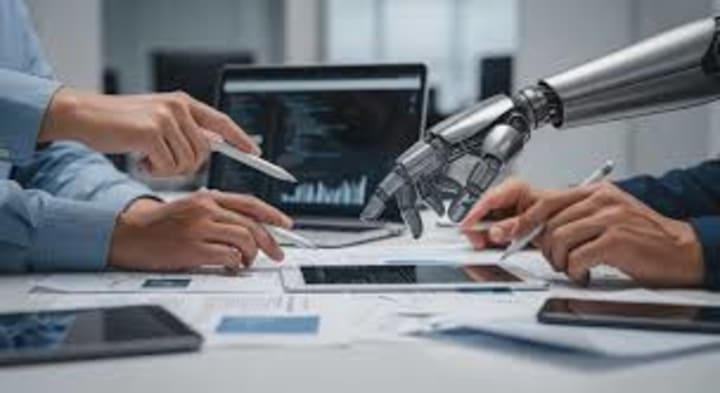
Marshall Trout, a researcher at the Utah NeuroRobotics Lab, explained that many users stop using their prosthetics because current systems don't provide the level of control they need. The lack of sensory feedback forces people to concentrate more on each action, leading to mental fatigue. In this new approach, artificial intelligence takes over some of the work that would normally fall entirely to the user, making simple tasks simple again.
Jacob A. George, also a member of the team, noted that transferring part of the gripping process inside the prosthesis makes daily use more intuitive. The robotic hand analyzes the appropriate pressure, corrects minor deviations, and automatically distributes force among the fingers.
The path to more natural interaction
Although this advance represents an important step, the researchers are already working on the next phase: integrating implanted neural interfaces that allow the prosthesis to be controlled with brain signals, while simultaneously providing the user with a realistic sense of touch. The ultimate goal is to close the complete cycle: intention, movement, and perception, a challenge that could completely transform the experience with bionic technologies.

If this development succeeds, robotic prostheses could move beyond complex mechanical control and evolve into systems that respond as quickly and accurately as a biological hand. The combination of artificial intelligence, advanced sensors, and neural communication points toward an era in which these devices not only replace a limb but also integrate seamlessly into daily life, requiring no additional effort from those who rely on them.
About the Creator
Omar Rastelli
I'm Argentine, from the northern province of Buenos Aires. I love books, computers, travel, and the friendship of the peoples of the world. I reside in "The Land of Enchantment" New Mexico, USA...
Keep reading
More stories from Omar Rastelli and writers in Journal and other communities.
The 7 Harvard secrets to boost concentration and protect brain health in daily life
Harvard Medical School has released a comprehensive guide, endorsed by Harvard Health specialists, for anyone interested in optimizing concentration and attention at any stage of life.
By Omar Rastelli3 months ago in Journal




Comments
There are no comments for this story
Be the first to respond and start the conversation.