
Saved 25% on Shipping | July Client Cases
China Sourcing Stories


Many clients came to us after things went wrong, such as miscommunication, products that didn’t match the samples, or shipping costs so high they nearly ruined the deal. Today, we’re sharing three client cases from July to show you how we addressed these issues.
Saved $1,000 in Packaging and Shipping
Our client David from California recently placed an order for ceramic tableware — classic fragile goods. Like many buyers, he assumed wooden crates were the safest option. But when he saw the quote this time, the numbers felt way too high: packaging alone would cost $500, and shipping came in at $3,600. He asked if we could help bring that cost down.

Our sourcing agent Joe looked into it and quickly spotted the issue. It was the crates. Shipping cost is calculated based on whichever is higher: actual weight or volumetric weight. And the wooden crates are heavier. After exploring some alternatives, we found a smarter solution: heavy-duty honeycomb cartons. These are reinforced paper-based boxes with layered honeycomb walls. They’re strong enough for ceramics, appliances, even machinery. But weigh just 20% of what a wooden crate does.
By switching to honeycomb cartons, we cut the packaging cost from $500 to under $100. The shipping fee dropped from $3,600 to $600. In total, David saved over $1,000, just by changing the box.

2,000°C Burn Test
Our client Daniel was interested in a so-called fireproof sweatshirt. It looked great, and the fabric felt soft, breathable, and light. But Daniel wanted to know whether it was truly fireproof as claimed. To find out, our sourcing agent Karen requested a sample from a supplier. We decided to test it with an open flame.
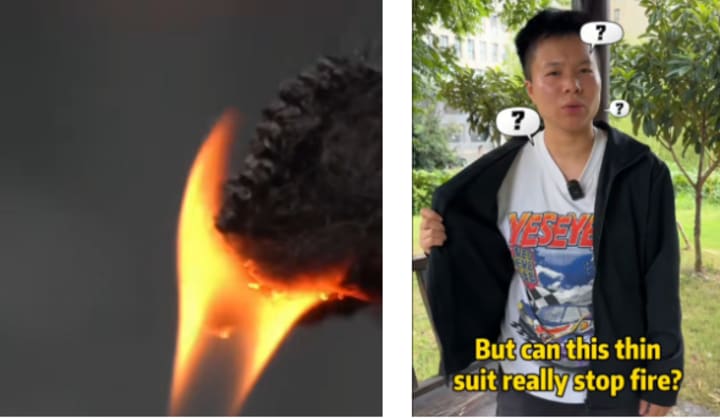
First, she hit a piece of regular nylon fabric with a torch as a comparison. Within seconds, it melted and burned straight through. Then Karen tested the "fireproof" cloth. No melting, no ignition. She pushed it further by blasting it with a 2,000°C torch for a full minute — and the fabric remained structurally intact.

The technology behind it is similar to what’s used in professional workwear for welders, electricians, and firefighters. The fabric uses a high-percentage flame-retardant blend that carbonizes when exposed to high heat, forming a protective barrier that blocks further burning. But now, brands like Carhartt are making it wearable for everyday life.
Truth Behind the Cheap “Silk” Scam
Last week, a UK client came to us after getting scammed on Alibaba. He had ordered 500 sets of “real silk” pillowcases but when they arrived, they were polyester. We did a quick search on Alibaba for “silk pillowcase,” and the price range from a few dollars to dozens. All of them claimed to be real silk.

So what’s really going on with these price gaps and why did our UK client get scammed? In China, real silk products, like pajamas, bedding, and scarves, mostly come from two regions: Hangzhou and Suzhou. Producing genuine silk takes time, skill, and patience. From raw silk to finished product, the process can take up to 40 days, and it’s not cheap. That’s why many sellers cut corners by using polyester or nylon, while still labeling it as “real silk.”
In the Chinese silk market, materials are graded into A, B, and C. For most pillowcases, sleepwear, or bonnets, a 16mm B-grade mulberry silk is the best balance of quality and cost which cost $10 per square meter. If you’re going for premium quality, A-grade silk goes up. But even that is rarely more than $40 per m². For the pillowcases, one square meter of B-grade silk can make two pieces. That’s $5 per piece in fabric cost, plus under 50 cents in labor.
Originally published on jingsourcing.com
About the Creator
Jingsourcing.com
Finding a reliable supplier and ensuring smooth production is challenging. JingSourcing takes care of the entire process, from sourcing suppliers to shipping.
Keep reading
More stories from Jingsourcing.com and writers in Journal and other communities.
How They Turned Chinese Traditions into Winning Product Ideas
Today, we’re looking at two surprising cases: Both founders are American, yet they turned Chinese traditions into amazing product ideas that really took off outside of China. Let’s take a closer look at how they pulled it off.
By Jingsourcing.com 7 months ago in Journal
How to put together the ideal retreat to Victoria Falls
Victoria Falls is a fantastic example of Mother Nature at her finest. This iconic cascade, which has been dubbed one of the Seven Wonders of the World, is recognised as the largest sheet of falling water on the planet. Since it is a wonder that reflects such natural beauty, many travel to this site to experience its expanse of tumbling water, which roars and falls at a rapid speed. Here is a guide for you to place a stay nearby smoothly.
By Jeewanthi Armstrongabout 6 hours ago in Journal
Flower Bloom 369
FLOWER Bloom 2/25/26 Wednesday By Mariann Carroll Karen had been with Tony for 7 years. Tony started acting strangely after her surgery. He would mow the lawn in the rain and be on his cellphone. He started pushing Karen away. Tony came clean about seeing someone. Karen moved out two months later. Karen moved in with a friend. She felt betrayed.
By Mariann Carroll3 days ago in Fiction




Comments
There are no comments for this story
Be the first to respond and start the conversation.