
Pinocchio's debut
The original version of Pinocchio
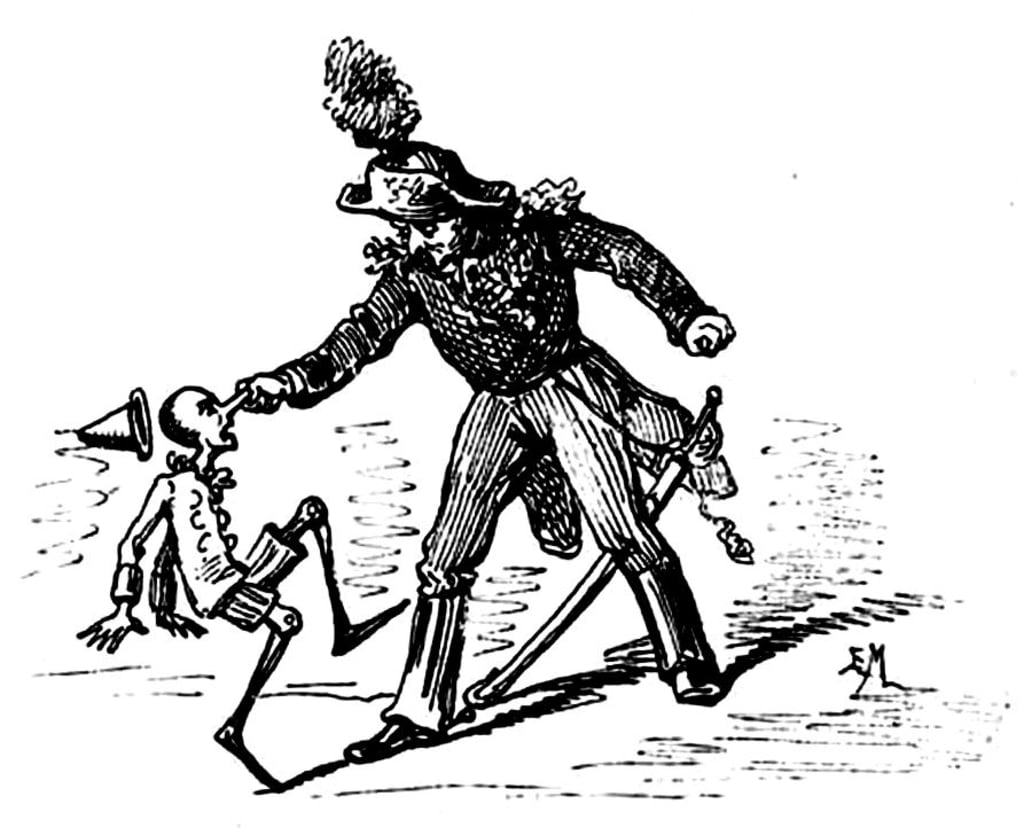
The story begins with a carpenter named , Antonio who finds a block of pine wood that he plans to turn into a leg for a table. But as soon as he starts carving into it, the wood screams. Antonio, freaked out by the magical wood, gives it to his poor neighbor, Geppetto, who plans to start a career as a puppeteer. He decides to use the wood to make his first puppet, Pinocchio.
But right from the start, Pinocchio's behavior is downright rude, and he even has a few words I try not to use on the show. As soon as his nose is carved, it begins to grow longer the more he acts like a jerk toward Geppetto. Right after his feet are carved, he kicks Geppetto in the shin.
After learning to walk, he runs out of the house and into town. Once in town, he runs into a police officer who assumes he's been mistreated by his father—because why else would he be running from him?—and arrests Geppetto. The most ridiculous part is that Pinocchio doesn't even care.
He brushes the incident off and returns home, where he meets the character who inspired Jiminy Cricket. Nah, he just meets a regular talking cricket. Unlike Jiminy Cricket, who set up camp in Geppetto's house the night Pinocchio was made, the talking cricket says he's lived in the house for a century and warns Pinocchio that if he continues to misbehave they'll have to suffer repercussions.
Pinocchio, however, wasn't interested in listening to the cricket's warning. Instead, he threw a hammer at him, accidentally killing the poor creature. To be fair, he only meant to throw the hammer near him, but still—it was tragic: a century of life ended because of one rude puppet.
After that, Pinocchio makes himself a meal and falls asleep with his feet on the stove, which results in them burning off. That night, when Geppetto is released, he agrees to make Pinocchio new feet on the condition that Pinocchio goes to school the next day. Geppetto sells his only jacket to raise enough money for Pinocchio’s textbook, and the next morning, Pinocchio takes it with him on his way to school. However, just like in the movie, he gets distracted by a puppet show and decides to sell his textbook for a ticket. Totally disrespectful!
The puppets in the show, made from the same block of wood as Pinocchio, recognize him from the crowd and call out to him during the performance. This ruins the show for everyone else, and the fearsome puppet master, Mangiafuoco, holds Pinocchio personally responsible. He decides to use him as firewood for his dinner.
Mangiafuoco is a rather striking figure, as described in the book: “A large man so ugly that he inspired fear just by being looked at. His beard was as black as ink, so long that it fell to the ground and he stepped on it as he walked. His mouth was as wide as an oven, his eyes were like two red lanterns with the light turned on in the back, and in his hand, he carried a whip made of snakes and fox tails twisted together.” This is how the book describes him, and here’s my version—equally terrifying.
Despite his monstrous appearance, Mangiafuoco shows a surprising amount of compassion. When Pinocchio tearfully tells him about his poor father, Geppetto, waiting for him at home, Mangiafuoco feels sympathy. He gives Pinocchio five gold coins to take to his father and sets him free. It would be nice if, after everything, Pinocchio went home, apologized to Geppetto, and used the gold coins to buy them both a nice dinner and a new coat.
Unfortunately, that would completely undermine the main purpose of this book, which, as I’ll reiterate, is to teach children the consequences of choosing what’s easy and fun over what’s challenging and right.
On his way home, Pinocchio meets a fox pretending to have a broken leg and a cat claiming to be deaf. It’s interesting to note that in the movie, the cat isn’t actually deaf—he just doesn’t speak. I love noticing these small changes.
The fox and cat tell Pinocchio that if he plants his five gold coins in a field outside the city of “Catch Fools,” they’ll grow into trees full of gold coins. Now, if you spot the bird in the upper left corner, he tries to warn Pinocchio that he's about to be scammed. But before he can say anything, the cat eats him. It’s not a huge detail, but I thought it was worth mentioning.
Now, you might be wondering, how is Pinocchio buying into all this nonsense? Is he really that gullible? But you have to remember, he’s just a child with a wooden brain. He wasn’t exactly born with a great scam detector. I personally wish I had a baloney detector—because I love baloney but always get lost trying to find it at the store.
The fox and cat offer to take him to the city and trick him into using one of his gold coins to pay for their expensive dinner at a nearby inn. It's a bit like when you’re on a terrible date and someone calls you with a fake emergency, just to give you an excuse to leave—or when the person's profile picture was clearly way too flattering.
Pinocchio falls asleep at the end of the night, and the fox and cat sneak off, leaving behind a note that says there was an emergency and telling him to meet them at the "Field of Miracles" the next morning. They head ahead on the path and disguise themselves as bandits, planning to steal Pinocchio's last four coins. When he walks by, they nearly catch him—until Pinocchio bites off the cat's hand and takes off running toward a nearby house where the fairy with turquoise hair lives.
This fairy is the inspiration for the Blue Fairy in the movie. Pinocchio knocks desperately on the door, asking for help, but the fairy explains that everyone in the house, including herself, is dead. She’s waiting for her own coffin. It's a strange moment, and I can’t really explain it.
Without her help, Pinocchio is caught by the bandits, who tie his hands behind his back and hang him from a tree. But this isn't the typical quick hanging that breaks your neck—it’s much slower. They suspend him by his neck off the ground, forcing him to suffocate while the fox and cat watch.
They apparently grow bored of the scene after a while, because it takes a while for a magic puppet to suffocate. Once they get tired of watching, they simply walk away, leaving Pinocchio to spend his final moments alone, reflecting on the poor decisions he made and the foolishness that led to his death.
At least, that's how the original story goes. When The Adventures of Pinocchio was first published and read by many, the feedback was that people loved the story but felt the ending was too bleak. Because of this, Carlo Collodi's publisher requested that he rewrite the ending, resulting in Pinocchio being saved.
About the Creator
ADIR SEGAL
The realms of creation and the unknown have always interested me, and I tend to incorporate the fictional aspects and their findings into my works.
Keep reading
More stories from ADIR SEGAL and writers in Journal and other communities.
The Grave of Dorothy
Cemeteries in one way or another have always been an integral part of life no matter who you are or how you finished. In the end, all that remains of you are the bones, a tombstone/( Estates on Mac and family have dollar diapers) and memories, some of which are significant enough to be defeated As something tangible. As in the case of a grave of a little girl named Dorothy. who is the namesake of the famous Dorothy from The Wizard of Oz.
By ADIR SEGALabout a year ago in Journal
Why Many Women Prefer the Abaya for Comfort and Style
Fashion trends change quickly, but some clothing pieces continue to remain meaningful and relevant over time. One such garment is the abaya. Traditionally worn in several Middle Eastern countries, the abaya has become an important part of modest fashion around the world.
By Shahnaz Khana day ago in Journal


Comments
There are no comments for this story
Be the first to respond and start the conversation.