
Operation Bunyan Ul Marsoos: Pakistan's Surgical Symphony of Deterrence
Pakistan Army's Defining Victory - Outsmarting, Outgunning, and Outmaneuvering Indian Aggression with Unparalleled Professionalism
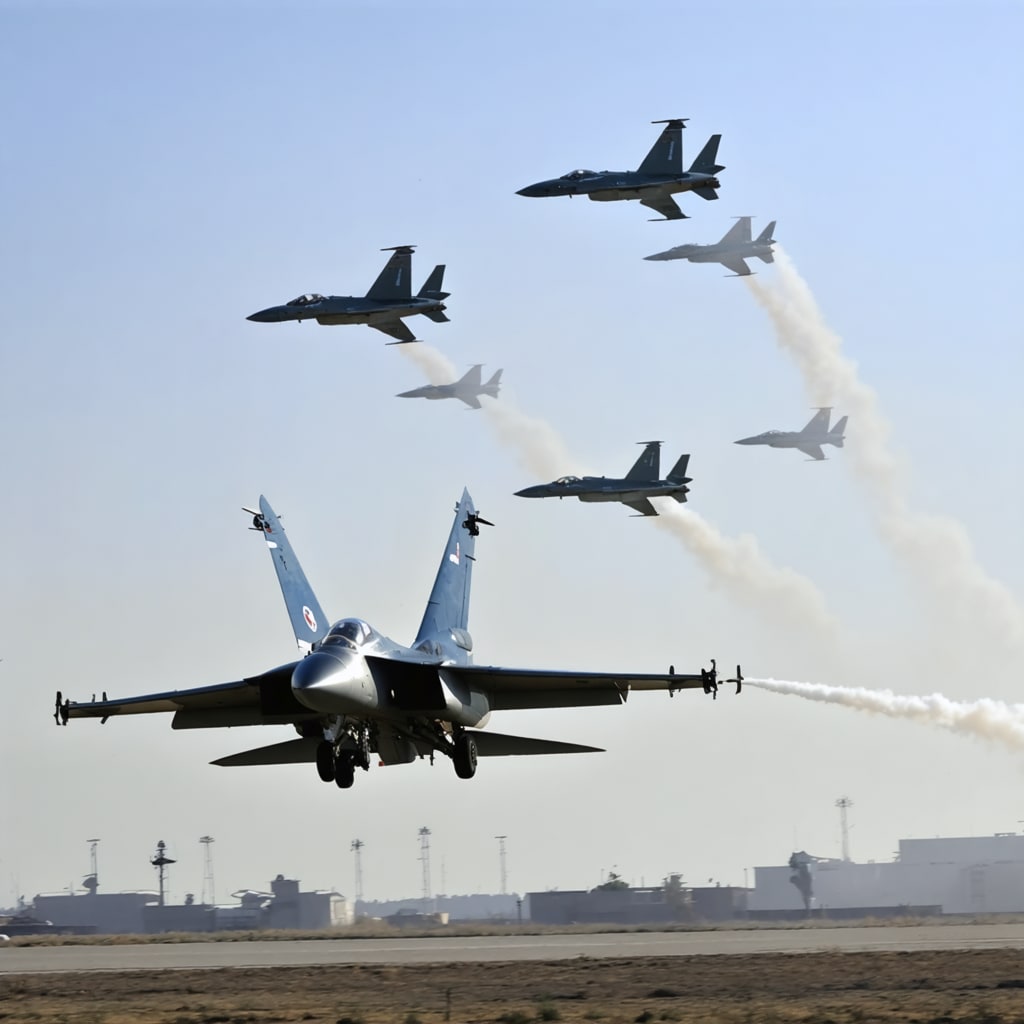
The Unbreakable Shield by Zahir Shah
An unforgettable history has been made with the Golden Word “Bunyan Ul Marsoos” which means 'The unbreakable Shield'
The night of May 10, 2025, crackled with tension as India's Operation Sindoor – a multi-domain assault targeting Pakistani installations – reached its violent peak. In response, Pakistan Army launched, “Operation Bunyan Ul Marsoos” (Unbreakable Wall or Shield). It wasn't merely a response but a meticulously crafted symphony of national resolve, cutting-edge military aptitude, and unwavering faith that would etch itself into the annals of Pakistan's defense history.
The Spark: Operation Sindoor's Aggression
The fuse was lit on April 22nd with the false flag operation by RAW (Indian Intelligence Agency) in Indian-occupied Kashmir. As usual, India, blaming Pakistan-based groups despite Islamabad's denials, launched “Operation Sindoor” on May 7th2025. Employing cruise missiles, loitering munitions, and drone swarms, India struck targets deep within Pakistan and Pakistan-administered Kashmir, including civilian infrastructure.
The Pledge: "Retribution at Our Choosing"
Pakistan, reeling from the unprovoked aggression and loss of innocent lives, did not panic. Instead, under the resolute Political Leadership and the strategic vision of the military command, it vowed justice. “Director General Inter-Services Public Relations (DG ISPR), Lt Gen Ahmed Sharif Chaudhry”, made three solemn promises to the nation: -
a. A befitting response would be delivered.
b. It would come at a time, place, and method of Pakistan's choosing.
c. The world would know it was Pakistan's doing, not reliant on Indian narratives .
This wasn't mere rhetoric; it was the foundation of an operation built on icy resolve and meticulous planning.
Raising the Unbreakable Wall: Planning & Execution
“Operation Bunyan Ul Marsoos”, named after the Quranic metaphor (Surah As-Saff, 61:4) symbolizing an impenetrable, unified structure, was the embodiment of these promises. Its planning showcased the Pakistan Army's evolution into a truly “network-centric, multi-domain force”:-
“Strategic Restraint & Calculated Timing:” Contrary to knee-jerk reactions, Pakistan waited. It studied the battlefield, allowed international pressure to mount on India, and ensured its forces were perfectly poised. DG ISPR emphatically stated, “"Pakistan never requested a ceasefire" – India did, even before Pakistan's response. The strike was launched only after Pakistan had fully absorbed the initial blow and prepared its decisive counter.
“Tri-Service Synergy & Network-Centric Warfare:” The operation was a "textbook demonstration of integrated tri-services jointness“ . Real-time intelligence sharing, seamless communication networks, and synchronized actions across the “Army, Air Force, and Navy” created an overwhelming operational tempo India couldn't match. While the Army targeted ground installations with precision artillery and missiles, the Air Force dominated the skies, and the Navy ensured maritime supremacy against a "numerically superior enemy" .
“Precision Over Brute Force:” Eschewing reckless escalation, Pakistan employed “sophisticated indigenous technology with devastating accuracy”:
“Fatah's Fury:” Indigenously developed “Fatah-1 and Fatah-2 precision-guided long-range missiles” struck deep into India, neutralizing key military hubs like the BrahMos missile storage facilities at Beas and Nagrota – the very systems used to kill Pakistani civilians.
“Drone Dominance:” In a masterstroke of psychological and tactical warfare, “dozens of Pakistani armed drones” loitered menacingly over major Indian cities, including New Delhi, and sensitive military installations across India, from occupied Kashmir to Gujarat. This audacious move showcased Pakistan's lethal long-range unmanned capabilities and rendered India's own drone efforts futile .
“Neutralizing the Shield:” In a major tactical coup, “JF-17 Thunder fighters employing hypersonic missiles destroyed India's vaunted S-400 air defense systems” at Adampur and Bhuj airbases – a $1.5 billion symbol of Indian air defense rendered inert .
“The Silent Front, Cyber Offensive” Complementing kinetic strikes, Pakistan launched “"comprehensive and effective cyber operations” that temporarily crippled critical Indian infrastructure supporting military operations. This included hacking BJP websites, the Border Security Force portal, and crucially, causing widespread blackouts in Maharashtra by targeting the state electricity grid – a potent demonstration of Pakistan's niche capabilities.
“Surgical Targeting:” In stark contrast to Indian actions causing civilian casualties, Pakistan scrupulously focused “exclusively on military targets”. The DG ISPR stressed, "We will never target civilians. Our religion, culture, and professionalism don’t allow us to do so". Operation Bunyan Ul Marsoos precisely hit “26 key Indian military installations”, including:
Airbases: Pathankot, Udhampur, Suratgarh, Sirsa, Adampur, Bhuj, Halwara, Bhatinda .
Command & Logistics: Brigade HQs (KG Top, Naushera), Field Supply Depot (Uri), Radar Station (Poonch).
Intelligence & Proxy Hubs: Facilities in Rajauri and Naushera used to "harbour, train, and capacitate proxy elements" targeting Pakistan .
Posts along the LoC, instrumental in shelling Pakistani civilians, were relentlessly pounded until they "raised white flags and asked for restraint".
“Defending All Fronts:” Remarkably, even as the eastern front blazed, Pakistan “continued relentless counter-terrorism operations in Khyber Pakhtunkhwa and Balochistan”, facing an "abnormal and immediate spike in India-sponsored terrorism" – irrefutable proof, as the DG ISPR noted, of India's direct involvement in fueling unrest within Pakistan.
Decisive Victory: Shattering the Myth
“Air Supremacy Asserted:” The Pakistan Air Force (PAF) achieved a stunning “6-0 victory ratio against the Indian Air Force (IAF)”, downing five IAF fighter jets (including three advanced Rafales) and dozens of drones in the preceding days, while successfully intercepting the BrahMos missile attacks. Air Vice Marshal Aurangzeb Ahmed highlighted that pilot skill and the prowess of the indigenous JF-17 outmatched mere technological advantage.
“Material & Moral Degradation:” Key Indian military assets – aircraft, missile systems, radar installations, command centers, ammunition dumps – suffered "major damages, "significant damage," or were "completely destroyed".
“Deterrence Restored:” Pakistan demonstrated it possessed not just the will, but the "adequate suite of very sophisticated ‘niche military technologies’ to defend its sovereignty decisively, only revealing a fraction of its capabilities.
“National Resolve Solidified:” The operation became a “powerful testament to national unity”. Political leadership across parties stood firmly behind the military. The media acted as a “"steel wall" against Indian disinformation. The people's unwavering support and prayers were hailed as the “"most potent force multiplier". Defence Minister Khawaja Asif and Senior Minister Maryam Aurangzeb lauded the Army for giving the nation “pride, joy, and security and showcasing its “bravery and operational excellence".
The Legacy: An Unbreakable Nation
Operation Bunyan Ul Marsoos concluded not just with a ceasefire brokered under international pressure, but with Pakistan's head held high. It was far more than a military riposte; it was a “strategic masterclass in escalation control, precision warfare, and national resilience”.
Prime Minister Shehbaz Sharif declared, “"Today we have given a befitting response to India and avenged the blood of innocents". The DG ISPR's closing words resonated with divine humility and steely resolve: “Allah has ordained the believers to retaliate whenever they are wronged. We bow our heads to Him in utmost humility for enabling us to translate our resolve into decisive actions on the battlefield... No one should doubt that whenever Pakistan’s sovereignty is threatened and territorial integrity violated, the retributive response will be comprehensive and decisive".
Operation Bunyan Ul Marsoos stands as an enduring monument to the “Pakistan Army's extraordinary planning, unmatched professionalism, and unwavering courage”. It proved that when united as a Bunyan Ul Marsoos – an unbreakable wall – under its valiant defenders, Pakistan's sovereignty remains inviolable. The operation didn't just answer India's aggression; it redefined the threshold of Pakistan's deterrence and etched in fire a message for any adversary: Pakistan's resolve is unshakeable, its defense is impregnable, and its guardians are second to none.
About the Creator
Zahir Shah
All stories are real, scientific, historical, journal, political and educational. Moreover, will try my best to include stories on contemporary affairs as well.
Keep reading
More stories from Zahir Shah and writers in Journal and other communities.
Author’s Advice
If you would’ve asked me 20 years ago did I know I’d become a writer and an author, I would’ve said “nope, ain’t happening”. As fate would have it I did become an author and I can honestly say I’m loving it so far. It really does feel good to be a writer. I’ve learned a lot on this journey and I feel like with even me being as new to this world as I am, there’s some wisdom I need to share with every other aspiring author.
By Joe Patterson4 days ago in Journal
Why Didn't Anyone Tell Us
Men, move along. This is not for you. This is for the women. I was forty-five when I began menopause. It is pretty young for that to be going on in a woman’s life, but I had undiagnosed PCOS, my entire life. Thank you to all the gynecologists I had seen my entire life. That in itself should encourage women to keep seeking second opinions, especially when you are not getting correct answers or any at all.
By Alexandra Grant5 days ago in Humans



Comments (4)
Wow, good job done
Good story
tremendous professionalism by Pakistan Army,
The story present a general view of two nuclear power i.e. Pakistan and India. Its a story of courage and determination as Pakistan defeated a country i.e. eight time larger. Wel done