
North Carolina App Development Costs for Startups in 2026
A realistic breakdown of regional pricing, talent availability, and development timelines for early-stage companies.

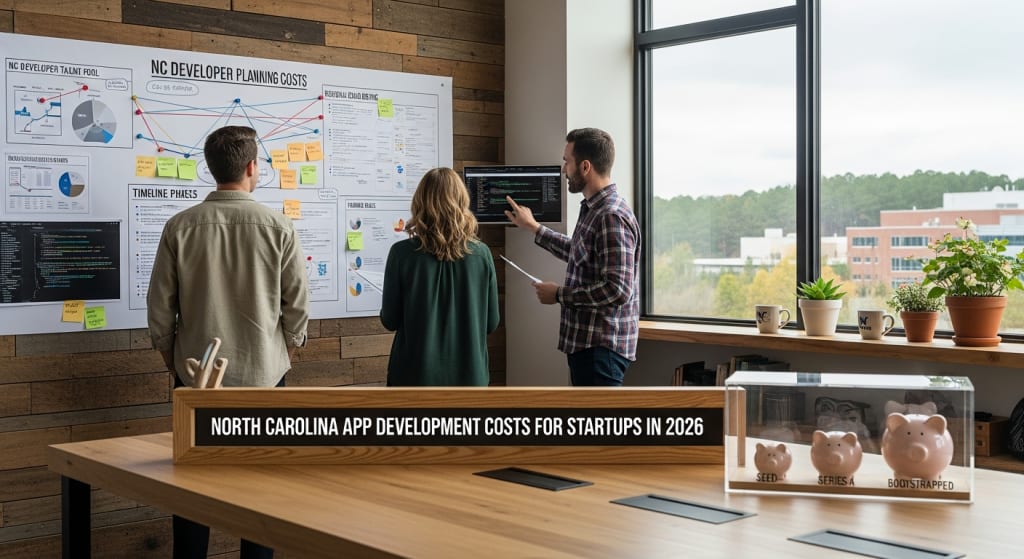
Building a mobile application in 2026 is complex. It requires a sophisticated financial strategy. This is more true now than in previous years. North Carolina remains a strong competitive alternative. It rivals Silicon Valley or New York City. AI-driven development has changed the market. Specialized local talent costs have risen too. These factors shifted the baseline for startup budgets.
The 2026 North Carolina Development Landscape
It is now early 2026. North Carolina has solidified its tech hub status. The Research Triangle is a leader in this. Raleigh, Durham, and Charlotte are key cities. Established enterprise firms have moved to this region. This influx increased local developer salaries. Startups once enjoyed a large price discount here. That gap with national averages is now smaller.
However, North Carolina still offers a distinct advantage. It has a dense concentration of research. Universities back much of this local growth. The ecosystem of developers is very robust. Many specialize in healthcare and fintech. Others focus on agricultural technology. Local teams now start at $45,000 for an MVP. Complex builds can exceed $180,000. High-security requirements often drive these higher costs.
Core Cost Framework for 2026
Cost estimation in 2026 is driven by three fundamental factors.
First, architectural complexity. The more moving parts, integrations, and scalability requirements involved, the higher the cost.
Second, regulatory and compliance requirements. Industries with strict data, security, or legal standards add time, tooling, and specialist overhead.
Third, team composition. Senior engineers, AI specialists, and product-focused teams raise quality and speed, and they also raise budgets.
Based on regional averages, pricing typically falls into the following tiers.
A Simple MVP generally costs between $45,000 and $70,000, takes around 3 to 4 months to build, and focuses on delivering a tight core feature set.
A Standard Business App usually ranges from $75,000 to $130,000, requires 5 to 7 months of development, and prioritizes API integrations and operational workflows.
A Complex Enterprise Solution starts around $140,000 and can exceed $250,000, runs for 8 months or longer, and centers on custom AI models, advanced logic, and enterprise-grade architecture.
The "North Carolina Premium" Factors
First, consider industry specialization. Your app might involve clinical data. The UNC and Duke health networks are local. Charlotte is a major banking sector hub. These fields require strict compliance auditing. Engineering must be highly specialized. Expect a 20% to 30% cost increase here.
Second, consider talent competition. Local agencies compete with Apple and Google. Apple has a Raleigh campus. Google has a Durham engineering hub. This keeps hourly rates high. Senior North Carolina developers are expensive. They charge between $140 and $190 per hour.
Real-World Financial Scenarios
Verified Regional Example: The Fintech MVP
In late 2025, a Charlotte startup launched. They built a peer-to-peer lending platform. A local agency handled the core architecture. They used automated testing protocols to save. The initial build cost was $115,000. Security and compliance took 40% of the budget. Frontend UX took 30%. Integration with banking APIs took the final 30%.
Hypothetical Example: The Agri-Tech Sensor App
Imagine a startup in the Greensboro area. They are building a crop health app. The app uses drone data for monitoring. The estimated cost is $85,000. Data visualization drives the high costs. Offline-syncing is also a major expense. This is vital for rural use cases. The UI is simple with no social features. This helps balance the total budget.
AI Tools and Resources
In 2026, AI use is not optional. It is the primary driver of efficiency.
AI Tools for Startup Founders
- GitHub Copilot Workspace: This is a 2026 standard tool. Founders describe features in natural language. The tool creates technical specs and code. It reduces scoping hours by 40%.
- Linear B: This helps non-technical founders. Use it to monitor outsourced teams. It provides real-time insights into quality. You do not need to read code.
- Vercel v0: This is essential for the design phase. It generates UI components from text. Founders can visualize the app early. This saves money on expensive design hours.
- Cursor: This is a powerful code editor. Local developers use it for refactoring. It helps engineers work much faster. It ensures code meets high security standards.
Practical Application: The 2026 Roadmap
A startup journey now follows a condensed path. This is faster than 2024 standards.
- Technical Discovery (Weeks 1-2): Define your tech stack. In 2026, Cross-platform frameworks like Flutter or React Native are the default for 90% of mobile app development in North Carolina to save costs.
- AI-Assisted Prototyping (Weeks 3-5): Create a clickable prototype with AI. Do not write backend code yet. You must validate the user flow first.
- Core Build (Months 2-5): Focus on your "Atomic Features" only. These are the three vital app functions. Avoid feature creep at all costs. This causes 50% of budget overruns.
Risks, Trade-offs, and Limitations
Technical Debt Overload is a major risk. AI makes it easy to generate code. Some startups build "Frankenstein" apps this way. These apps function well at the start. They break under heavy user pressure. This happens at 5,000 concurrent users.
Failure Scenario: The "Low-Code" Trap
A Raleigh retail startup tried a shortcut. They used only low-code tools. They wanted to spend under $20,000. They hit a "platform ceiling" very quickly. They could not add a custom tax API. This API was required for their growth. They had to scrap the whole build. They then spent $60,000 to rebuild it. The new version used a scalable framework. Warning signs appear when partners say "impossible." This usually means you outgrew the tech stack.
Key Takeaways
- Budget Reality: Professional apps cost $50,000 to $120,000. This is the 2026 North Carolina average.
- Talent over Location: Being in the Research Triangle helps networking. However, industry compliance experience is more important.
- Efficiency: Use AI for prototypes and documents. Spend your capital on human architects. They ensure code remains maintainable.
- Scalability: The local tech scene is growing fast. Build your app for enterprise-level scrutiny. This is what local investors now expect.
About the Creator
Keep reading
More stories from Devin Rosario and writers in Journal and other communities.
Mobile App Trends for 2026: What Really Matters
It is an early morning. I am sitting in my home office. The coffee is bitter. This is where the truth comes out. Before the world starts yelling about the next big thing, you see the small movements. Those tiny, quiet actions show where things are actually headed.
By Devin Rosario3 months ago in Journal
How to spend a month in Bangkok
Bangkok is not a city you visit once and feel like you've seen it all. It surprises you at every corner, and the longer you stay, the more it reveals. Whether you're a slow traveller, a digital nomad, or simply someone who finally has the time to explore a destination properly, a full month in the Thai capital is one of the most rewarding decisions you can make. Here's how to make the most of every week.
By Jeewanthi Armstrong7 days ago in Journal




Comments
There are no comments for this story
Be the first to respond and start the conversation.