
NEW YORK RISES – WHEN THE AMERICAN STREET DEFIES THE ARMED STATE
..

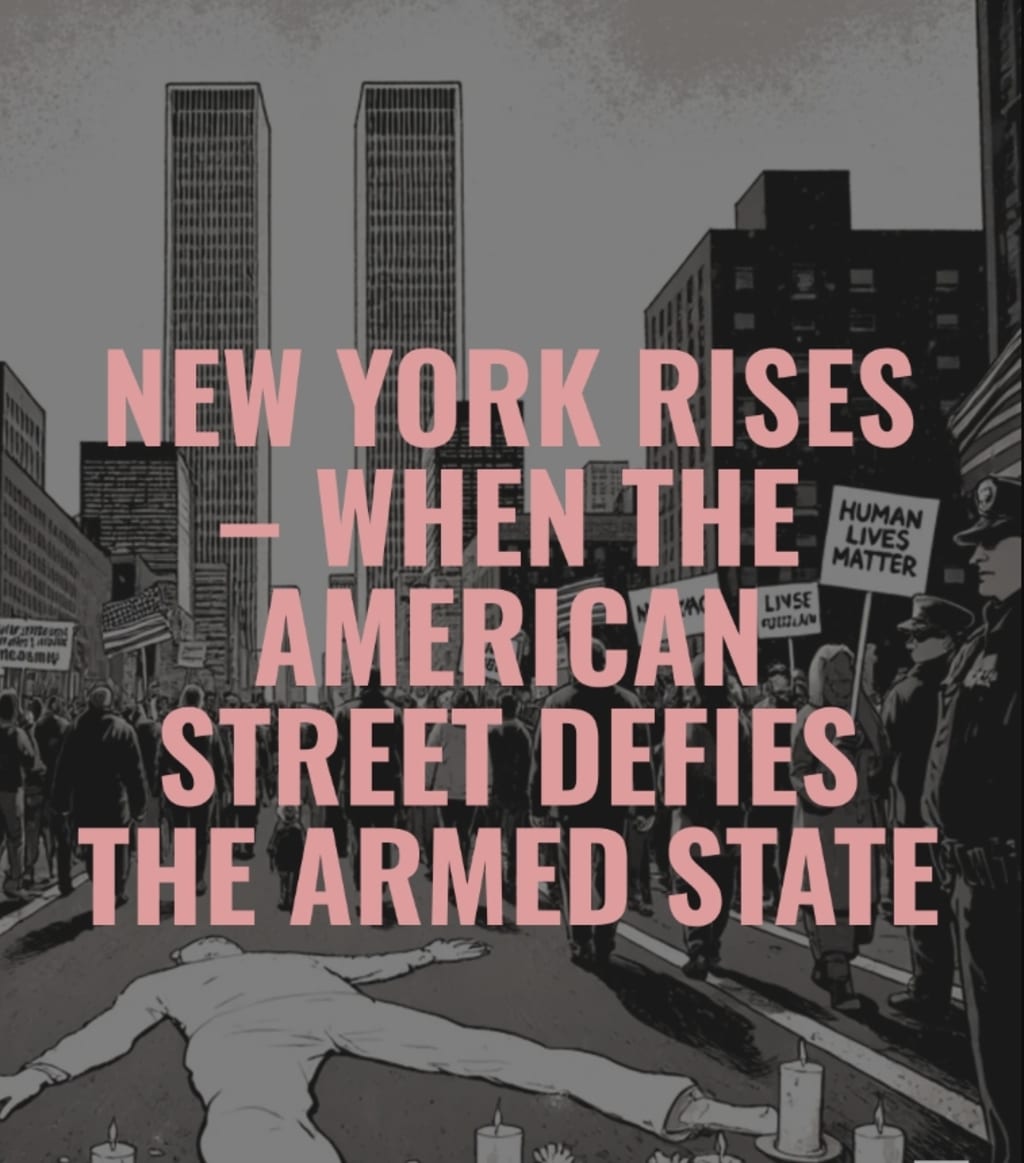
The silence of New York was not an absence of sound, but a presence of weight, an atmospheric density that heralded the storm long before the first drop of anger fell on the pavement of Manhattan. In this month of January 2026, the metropolis did not merely cease breathing to the rhythm of profit; it changed its very nature. Under a leaden sky, whose hue recalled cold metals and irrevocable administrative decisions, a human tide took over the canyons of concrete. This was not a riot, it was not a scream, it was a march. A slow, granitic, almost liturgical advance, where every step seemed to weigh a ton of mute demands. There was a particular gravity in this crowd, the kind that distinguishes anger that has long ripened in the shadows from the blind rage that evaporates with the first police charge. Faces were landscapes of determination, marked by the cold but heated by an inner conviction that nothing seemed able to dent.
At the heart of this giant procession, a name floated, invisible yet omnipresent: Renee Nicole Good. This name had become the epicenter of a sociological earthquake. The death of this woman, occurring in the secrecy of an ICE operation in Queens, was not the sole cause of this uprising; it was its tragic synthesis. She embodied that breaking point where the law ceases to be a protection and becomes a threat, where the administration mutates into an anonymous grinding mechanism. In the conversations whispering between the ranks, one felt that people were not just protesting for one person, but against a system of human life management that treats individuals as statistical variables. The New York street posed a question that Washington offices had avoided for years: how far can a state extend its armed reach before breaking the moral contract that binds it to the people? The answer was being written in letters of flesh and blood on the avenues, in a total refusal of violence that paradoxically deprived the authorities of their usual leverage.
Facing this mass, the State deployed its own grammar: that of armored vehicles, drones circling the crowd like metallic insects sent from a dystopian future, and press releases calibrated by artificial intelligence to dehumanize the protest. There was talk of “restoring order,” “security protocols,” and “controlled migratory flows.” But this technical language shattered against the organic reality of the march. There was an absolute semantic disconnection between an administration that perceived society as a network to be policed and citizens who lived reality as an experience of grief and dignity. The protesters were not professional agitators; they were the reflection of a kaleidoscopic America. One saw teachers whose gaze bore the weariness of decades of budget cuts, Gen Z youths using their phones as digital shields, retirees whose trembling hands held signs written by hand with the calligraphy of another era.
This diversity was the most indomitable strength of the movement. How could the repressive apparatus target a crowd that so precisely resembled the nation itself? The strategy of non-violence was not a default option here, but an asymmetrical weapon of war. By remaining calm, by walking with an almost military discipline, New Yorkers shifted the conflict from the terrain of brute force to that of ethical legitimacy. They forced the administration to look at the emptiness of its own discourse. Every hour that passed without a major incident was a defeat for those who hoped for a pretext to declare a state of emergency. The street had become an open-air courtroom. Here, it was not men being judged, but a certain idea of power that believes itself above human vulnerability.
As evening fell on the city, the light of neon signs and the giant screens of Times Square could not dissipate the shadow that had settled on the face of institutions. The protesters were not asking for the impossible; they were demanding the return of the possible: accountability, transparency, and an end to impunity for federal agencies transformed into militias. They reminded the world that democracy does not only die in coups d’état, but in the slow and invisible acceptance of the unacceptable. Renee Nicole Good was no longer a victim; she had become the mirror in which an entire nation looked at itself, discovering with horror the features of an authoritarianism that does not speak its name. When the crowd finally dispersed into the depths of the subway, the silence that returned was no longer the same. Something had shifted. The street had spoken, and its echo would henceforth haunt the corridors of power, reminding them that even the most armed State can do nothing against a people who decide, one winter day, to simply walk together and never back down.
JLP
About the Creator
Laurenceau Porte
Chroniqueur indépendant. J’écris sur l’actualité, la société, l’environnement et les angles oubliés. Des textes littéraires, engagés, sans dogme, pour comprendre plutôt que consommer l’information.
Keep reading
More stories from Laurenceau Porte and writers in Journal and other communities.
THE MONARCH OF THE VOID
In history, some figures emerge to fill a gap; others arise because the gap has become an abyss. Donald Trump did not construct the contemporary void: he is its accidental sovereign, an improvised heir. He understood, before his peers, that there was no longer a state to govern, but only grievances to channel and a lack of meaning to embody. Where his predecessors strove to feign a vision, he was content to hold up a mirror. And this mirror, held before a society exhausted by its own pretenses, did not reveal a fallen glory, but a profound hollow.
By Laurenceau Porte12 days ago in Journal
The goals I did not achieve
Every writing goal I made for the year is a wash. It has been this way for a while, but I think it's important to be open about my failures and the reality of how life can get in the way. This is especially true considering the several times I have posted on Vocal about my writing goals, how I was changing my approach, and where I was hoping to be for the upcoming year. I will probably do that again in a couple months, but for now, it is time to acknowledge where I am today.
By Kay Husnick22 days ago in Journal
Why Florida Car Dealers Must Carry a Surety Bond
If you’re planning to open a used car dealership in Florida, one of the first compliance requirements you’ll encounter is the dealer surety bond. Many people assume this is just another formality in the licensing process, but it plays a much bigger role than most applicants realize.
By American US Insurance3 days ago in Journal


Comments
There are no comments for this story
Be the first to respond and start the conversation.