
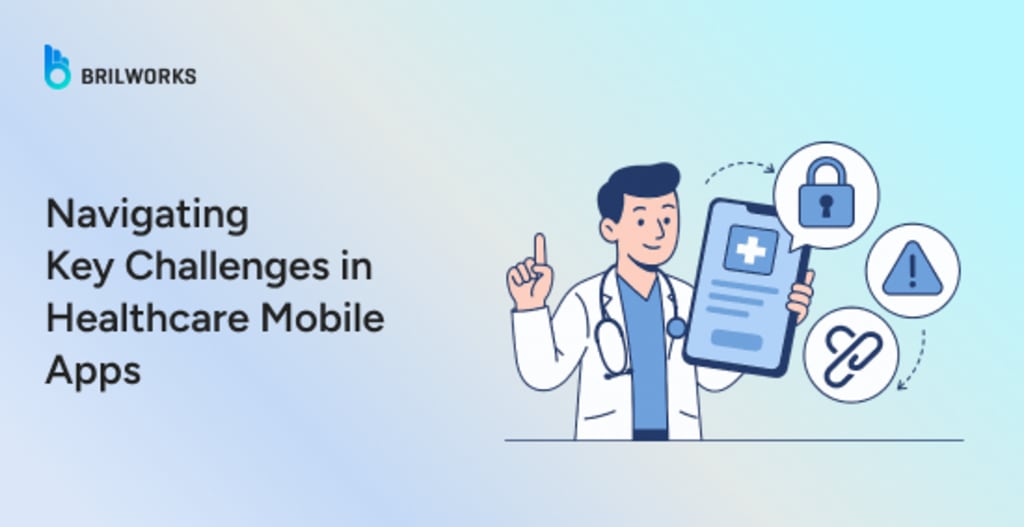
Navigating Key Challenges in Healthcare Mobile Apps
Building in the healthcare space? Know the pitfalls before you code. Read our latest blog on key mobile app challenges!
Introduction
Healthcare is going through a digital revolution in a time when smartphones have become extensions of who we are. The global digital health market is expected to reach $549 billion by 2028, and there are currently over 350,000 healthcare mobile apps available in app stores. These portable solutions, which range from virtual consultations to medication reminders, have the potential to completely transform the way we take care of our health.
However, beneath this optimistic exterior is a nuanced reality. Nearly half of Americans stop using healthcare apps within weeks, despite 46% having downloaded at least one. Even though they are aware of their potential, medical professionals say they are very hesitant to suggest them to patients. The gap between the potential and real impact of healthcare mobile apps exposes a terrain full of particular difficulties that go well beyond the usual roadblocks of mobile app development.
Applications for healthcare, as opposed to those for entertainment or productivity, negotiate a complex nexus between technology, medicine, regulation, and human behaviour. In order to achieve quantifiable health outcomes, they must concurrently safeguard private information, integrate with complex legacy systems, gain clinical trust, and continue to be available to a wide range of populations.
This blog examines the top ten challenges in healthcare mobile apps currently facing, looking at the reasons behind them as well as the knowledge that developers, healthcare professionals, and patients need to advance.
10 Key Challenges in Healthcare Mobile Apps
Challenge #1: Data Privacy and HIPAA Compliance
According to hippajournal more than 1 million individuals had their protected health information breached in March 2025. This brings up significant concerns regarding the security of data. Healthcare applications are not prone to data. Few industries are as tightly bound by data protection laws as healthcare. While other jurisdictions adhere to comparable laws like GDPR or PIPEDA, the United States' Health Insurance Portability and Accountability Act (HIPAA) establishes the benchmark for protecting electronic protected health information (ePHI). Complying with these standards is essential for mobile apps.
The ever-changing tech landscape is what makes compliance in mobile healthcare apps so difficult. If not thoroughly examined, features like wearable integrations, cloud syncing, push notifications, and third-party APIs could introduce vulnerabilities. If credentials are not properly encrypted and managed, even something as basic as storing them locally may result in violations.
To help you create a fully functional and HIPAA-compliant app, feel free to check out our helpful guide on HIPAA-compliant app development.
Actionable Tips for Developers:
- Encrypt all PHI at rest and in transit.
- Use HIPAA-compliant cloud providers (e.g., AWS, Microsoft Azure).
- Implement role-based access control (RBAC) to limit data access.
- Document compliance processes for audits.
Challenge #2: Interoperability Barriers
Did you know that poor integration with EHRs can make healthcare apps more cumbersome than helpful?
Despite the promise of digital health, many healthcare mobile apps struggle to connect seamlessly with hospital systems like Electronic Health Records (EHRs) and Clinical Information Systems (CIS). Interoperability issues remain one of the biggest hurdles in healthcare app development—and a critical one for teams using frameworks like React Native, where API integration needs careful planning across platforms.
EHR platforms are complex, and legacy systems often run on outdated, incompatible standards. Even with the rise of modern protocols like FHIR and HL7, there's no universal baseline.
Actionable Tips for Developers:
- Use FHIR standards for modern EHR integration.
- Test API endpoints for reliability across devices.
- Implement retry mechanisms for failed syncs.
- Document integration processes for future scalability.
Challenge #3: Digital Health Literacy Gaps
It won't matter how sophisticated your healthcare mobile app is if users are unable to use it. Digital health literacy refers to a person’s ability to seek, understand, and act on health information from digital tools. When this skill is lacking, even the best-designed apps can fall flat.
A wide digital divide still exists, especially among older adults, rural populations, and people with limited education. If your app relies on dense medical jargon, confusing menus, or assumes high tech proficiency, you’re narrowing your user base before launch. Studies show that low digital health literacy is a top reason why healthcare apps see low adoption and high abandonment rates.
Actionable Tips for Developers:
- Use clear, jargon-free language in app content.
- Test designs with diverse user groups (e.g., elderly, non-tech-savvy).
- Include in-app tutorials or FAQs for complex features.
- Ensure high contrast and large text for readability.
Challenge #4: Clinical Validation Hurdles
Would you trust a healthcare app that hasn’t been proven to work? One issue is that a lot of healthcare mobile apps are released without thorough clinical testing. Medical accuracy is essential in a world where people use digital tools to manage chronic conditions and make treatment decisions.
Healthcare mobile apps function in a highly regulated setting, in contrast to productivity or lifestyle apps. Clinical evidence, not conjecture or best guesses, must support mobile healthcare features like symptom checkers, dosage reminders, or diagnostic support tools.
Without clinical validation, apps risk delivering incorrect guidance or missing essential features. Trust can be damaged by that, not only with users but also with the physicians and healthcare systems you want to collaborate with.
Actionable Tips for Developers:
- Collaborate with healthcare professionals early in development.
- Conduct pilot studies to gather clinical evidence.
- Use automated testing to verify data accuracy.
- Document validation processes for regulatory submissions.
Challenge #5: Healthcare Professional Adoption
One key reason why your app won't make it is if healthcare professionals refuse to put their trust in it. The first step towards the success of your healthcare app is that professionals should adopt it first. Many medical professionals are hesitant to incorporate mobile tools into their workflows, if not completely dubious.
Administrative demands, complicated EHR systems, and hectic schedules are already being juggled by healthcare providers. No matter how creative the new app is, it should make their lives easier, not more difficult. Applications that aren't clinically relevant or don't fit into current workflows are promptly dropped.
Actionable Tips for Developers:
- Shadow clinicians to understand workflow needs.
- Prioritize speed and simplicity in UI design.
- Include offline modes for unreliable hospital Wi-Fi.
- Gather clinician feedback during beta testing.
Read the full article here.
About the Creator
Vikas Singh
Vikas is the Chief Technology Officer (CTO) at Brilworks, leads the company's tech innovations with extensive experience in software development. He drives the team to deliver impactful digital solutions globally.
Keep reading
More stories from Vikas Singh and writers in Journal and other communities.
A Business Guide to Legacy System Modernization
That older technology you're using? It's getting to the point where it might be keeping you from moving forward. When we think about new applications and what customers expect these days, legacy system modernization feels less like a project and more like something we need to do to grow and stay alive in competition. As of 2025, while mounting pressure to adopt cloud-native architecture and AI-driven workflows, enterprises allocate 60-80% of their IT budget to maintaining old systems.
By Vikas Singh8 months ago in Journal
Large Protests Against Donald Trump’s Policies Continue — Why the Movement Keeps Going Viral
Across major cities in the United States and Europe, large-scale protests tied to Donald Trump’s policies and political influence continue to dominate headlines and social media timelines. From packed city squares to viral protest signs, livestreams, counter-demonstrations, and trending hashtags, the story refuses to cool down.
By Omasanjuwa Ogharandukun4 days ago in Journal


Comments
There are no comments for this story
Be the first to respond and start the conversation.