
Monetizing your crypto earnings with NFT gaming development
NFT Gaming Development

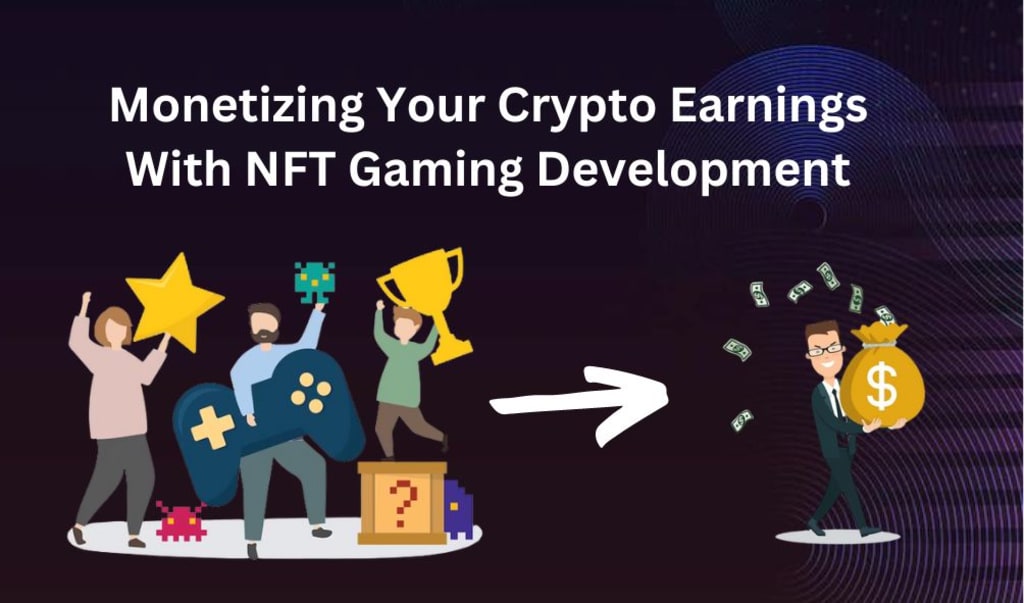
In the last few years, blockchain technology has revolutionized the gaming industry. It has helped developers to create an innovative gaming experience that had been never seen before.
The introduction of Non-Fungible Tokens (NFT) can allow developers to create unique digital assets which can be used in the gaming world. NFTs also allow gamers to monetize their game by trading their digital assets on the marketplace which creates an ecosystem in the gaming industry. NFT gaming development makes it possible for developers to create new games with groundbreaking features.
NFT Gamification:
NFT gamification is the specific collection of digital assets for earning an additional income by trading them. GamiFi permits gamers to trade or exchange their assets for award-winning outcomes by combining gaming and blockchain technology.
In simple words, gamification allows the NFT gaming platform development company to move the following aspect of gaming.
- Point Scoring
- Competitions
- Gameplay rules
How to Start Developing Your Own NFT Games
NFT gaming development is much more than creating a game with NFT features. It is the art of building an ecosystem with blockchain technology. The foremost step is that you should understand what makes your NFT game unique and how it will differ from other games. Below are some tips that will help you build a successful NFT game:
Step 1: Pre-production:
Every project should be started with planning. It is difficult to avoid this phase for the further development process. We can divide it into many steps to guide you in preparing your project.
Bring professionals onto your team:
Choosing qualified people with years of experience should be competitive for game creation. Managers, medium & senior developers, 2D/3D artists, and QA engineers should be on your in-house team.
Gather data:
Before starting your project, you should research and analyze your competitors and the market. It should help you to determine what you can do better than your competitor.
Define the concept:
It is necessary to select the game genre based on the results that you collected from the research. It can be a puzzle, shooter, adventure, simulator, sports, etc., Furthermore, you should work to develop the themes, and concept, and look for the character and assets.
Define the platform:
NFT game development has no restrictions for platform selection. You may develop the game for mobile, desktop, consoles, and AR/VR-based gadgets but you should always be careful with your budget.
Choose the right tech stack:
You should always plan the most efficient infrastructure for your game development. Choose the best tools and applications for front-end, back-end, smart contracts, and testing.
Create a GDD:
A game design document (GDD) is a collection of technical and development strategies that will guide your team for the entire project.
Prototyping:
A prototype is a demo version that contains the structure and basic functionality of your game. It helps you to pretest your game and makes some necessary changes to develop your final project.
Step 2: Design and Development:
Once you are all set with your NFT game development it's time for the designers and developers to get started on their work. Follow each of the steps you will get a stunning product.
Modeling:
You should cross multiple stages of content creation depending on your game format (2D/3D). Proceed with an outline of your game characters, assets, and environment if you're going to work in 2D games. Then paint them and make the required changes in the drawing and animate it that needs to move.
If you are working on a 3D NFT game artist must create 3D characters, objects, and environments with polygonal modeling techniques and establish the proper topology.
Game Level Design:
It is the logic/structure of a game. choose how the player's in your game will move in it. For example, your game may consist of dozens of quests and each one is more difficult that the previous one. In contrast, your game may contain an open world in which you can freely move, run, and adjust objects.
Wallet Setup:
The crypto wallet is necessary for NFT games so that you can trade your assets. Another thing is that the gamers can use the wallet for registration, so it has to be implemented in the development stage.
Smart Contract Program:
This is the most important thing in your game development because a smart contract is a blockchain-based software that is responsible for NFT movement, cyber-security, and transaction modifications. Remember that the smart contract cannot be rewritten, so be careful while you work on it.
Time for Coding:
The back end is the most responsible thing that we should integrate all the data, content, and architecture into a single system. It is crucial to develop a decentralized structure and an application to get necessary data, functions, and commands not only from the game but also from the blockchain.
Step 3: Testing:
NFT games are a unique idea not only for the common people but also for the game creators. That's why experts can fix the issue before publishing the game.
Unit testing:
At the time of game development developers can perform this testing. Once developers have designed some portion of the game they can test it in order to find the critical issues and fix them.
Alpha Testing:
Once developers finished the game, testers can take over with alpha testing. Alpha testing is a method of closed testing that can be performed by quality checkers before the game is launched on the market.
Beta Testing:
Beta testing has two types, one is a closed beta and another is open beta testing. It has been conducted in the real world rather than the numerous software or automation testing.
Closed beta testing can be performed by the game development industry with a limited number of people while open beta testing can be performed by gamers or non-professional persons. They can play the game, record the bug and deliver it to the QA team.
Step 4: Deploy and Promote:
Usually, popular games can attract more attention than new products. That's why you should be more concentrated on your advertisement plan. For example, you can join an NFT community and create awareness about your game before the game launch.
How to monetize with your NFT gaming platform?
You can monetize your NFT game by two methods. The first one is a play-to-earn method and the second one is to accumulate the in-game NFT to sell or rent for profit.
Some industries focus on either play-to-earn or in-game NFT models, but the majority use the combination of both to give a better experience for gamers. The value of NFT can vary depending on the market. Earning money through NFT games is still tentative. Only invest when you are ready to face the profit and loss.
Final Thoughts
NFT gaming is becoming popular with top NFT games like Axieinfinity, The Sandbox, and Sorare. In-game NFTs like weapons, armor and other digital assets could be unique. The NFT gaming development company can provide those in-game items for the players. You can earn money through your NFT game by trading or exchanging your assets. However, you can create your own game by choosing the right NFT gaming development company.
About the Creator
Natalya Jade
Blockchain Consultant & Crypto Blogger
Keep reading
More stories from Natalya Jade and writers in Journal and other communities.
How to Obtain a Superfine Crypto Exchange Script to Start a Crypto Exchange Business?
Cryptocurrency exchange business growth is irreplaceable in this fast-moving crypto industry because of the sustainable revenue donated to the economy. Nowadays, the crypto exchange business is considered a go-to business model for business enthusiasts, especially for those who are new to the industry. The reason is that the development has become an effortless step, and the investment is also less when compared to other business modules. Moreover, it doesn’t require any prior knowledge or experience in the field, which makes the process easy for a beginner in the crypto business.
By Natalya Jade3 years ago in Journal
War clouds in the Middle East — US, Israel and Iran face to face
oman: (special report)journalist malik sarfraz hussain awan. The Middle East is once again in the grip of severe military tension, where after joint air and missile attacks by the US and Israel on important military and strategic targets inside Iran, Iran retaliated vigorously, targeting not only Israel but also US military installations in the Gulf region. According to the initial military briefing, the Israel Defense Forces and the United States Armed Forces attacked various cities in Iran, including the capital Tehran, the industrial and defense center Isfahan, Qom, Kermanshah and other sensitive locations. According to the Israeli position, this operation was carried out to limit Iran’s growing missile and drone capabilities, while US officials called it a preemptive measure to defend their allies and stabilize the region. According to Iranian media, some military installations were damaged in the attacks and a few personnel were killed and injured, but the full damage estimate is still underway. Iran responded immediately by launching ballistic missiles and drones towards Israel through the Islamic Revolutionary Guard Corps and also attempted to target US bases in the Gulf countries. According to reports, alarm sirens were sounded and air defense systems were activated near the Al-Udeid Air Base in Qatar, the US Navy Fifth Fleet headquarters in Bahrain, and some military installations in Kuwait and the United Arab Emirates. Several missiles were claimed to have been destroyed in the air, while reports of limited material damage were also received. Israel said its defense system was largely effective, but explosions were heard in a few places. Iran has warned that if its territory is attacked again, the response will be more severe and widespread. The most immediate and significant impact of this military exchange was on the airspace of the entire region, where Iran completely closed its airspace and suspended all international and domestic flights. Israel also temporarily closed its airspace and stopped civilian flights as a precautionary measure. Iraq has been warned of becoming a potential missile passageway. Due to the fear, it immediately closed its airspace and dozens of flights were canceled. Jordan closed its airspace for a few hours as a precaution and later allowed limited flights. Qatar increased air surveillance, suspended some routes and issued special instructions to pilots. Bahrain announced restrictions on air traffic in view of the security situation. Kuwait diverted several international flights. The United Arab Emirates tightened surveillance in its northern airspace and instructed many aircraft to take alternative routes. Saudi Arabia did not announce a complete closure, but it imposed additional surveillance in the eastern sector and temporarily suspended some flights. Lebanon and Syria also issued alerts, while Turkey increased security measures in its eastern airspace. As a result of these extensive closures, flights from Europe to the Gulf and Asia had to take longer routes, which increased fuel costs and travel times. International airlines made urgent changes to schedules and canceled or postponed several flights, keeping in mind the safety of passengers. This extraordinary closure has practically turned the region into a military zone where defense systems are active 24 hours a day and radars are on full alert. Security is on high alert on the ground as well. An emergency has been declared in hospitals and civil defense agencies are mobilized. Oil prices fluctuated in global markets while investors adopted a cautious attitude. Activities on the diplomatic front have intensified and the United Nations Security Council has called an emergency meeting and appealed to the parties for an immediate ceasefire, restraint and diplomatic negotiations. In the Security Council meeting, some countries expressed concern over unilateral military actions, while others questioned Iran's missile program and regional role. The statement issued after the meeting said that the continuation of tensions in the region could pose a serious threat to global peace and security and that all relevant parties should abide by international law and the UN Charter. The UN Secretary-General also stressed that the civilian population and civilian aviation should be protected at all costs. Experts say that if these clashes are not limited, Lebanon, Syria, Iraq and the Gulf states could also be directly or indirectly involved in the conflict. According to military analysts, the two sides are currently sending each other messages through limited but symbolic use of force. However, in the event of any miscalculation or additional attacks, the situation could quickly turn into a full-scale war. The biggest question in the current situation is whether behind-the-scenes diplomatic efforts will succeed in reducing tensions or whether this crisis will take the form of a long and destructive regional conflict. The region is currently in a state of uncertainty, airspace closures remain partially in place, military preparations are increasing, and the eyes of the international community are focused on the next few days, which will determine the future of this crisis.
By Malik Sarfraz Hussain Awan5 days ago in Journal
Flower Bloom 369
FLOWER Bloom 2/25/26 Wednesday By Mariann Carroll Karen had been with Tony for 7 years. Tony started acting strangely after her surgery. He would mow the lawn in the rain and be on his cellphone. He started pushing Karen away. Tony came clean about seeing someone. Karen moved out two months later. Karen moved in with a friend. She felt betrayed.
By Mariann Carroll7 days ago in Fiction


Comments
There are no comments for this story
Be the first to respond and start the conversation.