
Modi's Make in India Campaign
Catalyzing Manufacturing Growth and Promoting Domestic Production
ction
Introduction:
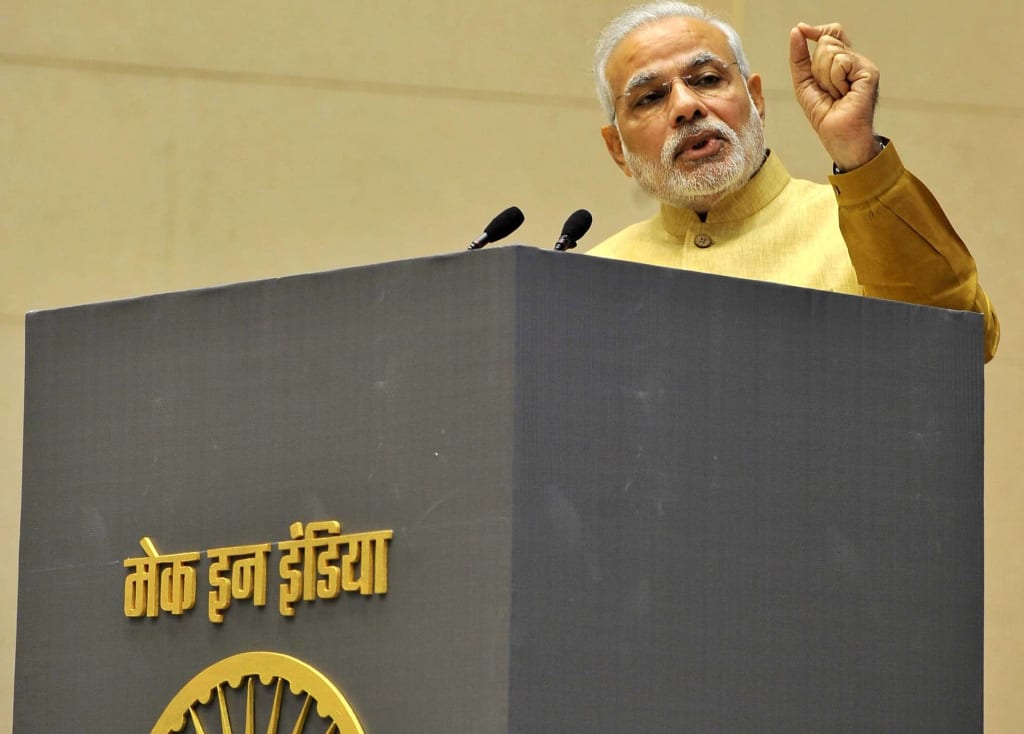
Since its launch in September 2014, Prime Minister Narendra Modi's Make in India campaign has been instrumental in transforming India into a global manufacturing hub. The initiative aims to boost domestic production, attract foreign direct investment (FDI), and generate employment opportunities. Through a comprehensive set of policies and reforms, the government seeks to enhance the country's manufacturing capabilities and reduce reliance on imports. This story delves into the impact and evaluation of the Make in India campaign on India's manufacturing sector.
Rise of Make in India:
When Prime Minister Modi introduced the Make in India campaign, he envisioned a self-reliant and prosperous India. The campaign aimed to provide a conducive environment for businesses, simplify regulations, and promote entrepreneurship. By encouraging domestic and foreign companies to manufacture their products in India, the government sought to bolster economic growth, increase exports, and create millions of job opportunities for the burgeoning youth population.
Policy Reforms and Incentives:
To attract investment and promote manufacturing, the government implemented several policy reforms. These included easing of foreign direct investment norms in various sectors, streamlining regulatory processes, and introducing measures to improve the ease of doing business. Special emphasis was placed on sectors such as electronics, defense, automobiles, textiles, pharmaceuticals, and renewable energy, which held significant growth potential.
Additionally, the government introduced a range of incentives such as tax breaks, subsidies, and infrastructure development programs to encourage businesses to set up manufacturing units in India. Special economic zones (SEZs) were established to provide a conducive ecosystem for manufacturing companies, offering benefits like tax exemptions, streamlined procedures, and robust infrastructure.
Impact on Manufacturing Sector:
The Make in India campaign has had a profound impact on India's manufacturing landscape. Foreign direct investment in the sector witnessed a significant surge, with numerous multinational companies establishing manufacturing facilities in the country. This influx of investment has not only boosted production but has also resulted in the transfer of advanced technologies and knowledge, enhancing the country's manufacturing capabilities.
The campaign has also revitalized the Small and Medium Enterprises (SMEs) sector, which forms the backbone of India's manufacturing ecosystem. The government's focus on ease of doing business, access to credit, and technology upgradation has enabled SMEs to scale up their operations and compete on a global scale.
Furthermore, Make in India has played a pivotal role in attracting global giants to invest in the Indian market. Leading automotive companies like Hyundai, Honda, and Suzuki have expanded their manufacturing facilities in the country, making India one of the world's largest automobile manufacturing hubs. The electronics sector has also witnessed remarkable growth, with companies like Samsung, Apple, and Xiaomi establishing production units in India.
Employment Generation and Skill Development:
One of the primary goals of the Make in India campaign was to generate employment opportunities for India's vast workforce. The growth of the manufacturing sector has been instrumental in creating millions of jobs, both direct and indirect, across various industries. This has had a positive socio-economic impact, empowering individuals and uplifting communities.
Additionally, the government has recognized the need for skilled workers to support the manufacturing sector's expansion. Skill development initiatives such as the Skill India campaign and the establishment of Industrial Training Institutes (ITIs) have equipped individuals with the necessary skills and training to meet industry demands. These efforts have not only facilitated job creation but have also contributed to reducing unemployment and enhancing employability.
Challenges and Future Prospects:
While the Make in India campaign has achieved significant milestones, it also faces a few challenges. Infrastructure gaps, complex taxation systems, bureaucratic hurdles, and skill mismatches remain areas that need further attention. The government is actively working to address these challenges by investing in infrastructure development, implementing tax reforms such as the Goods and Services Tax (
About the Creator
Keep reading
More stories from Abhishek Kr and writers in Journal and other communities.
The 5G Revolution
tions Introduction: The world was abuzz with anticipation as 5G technology emerged on the horizon, promising to revolutionize connectivity and usher in a new era of possibilities. With its unprecedented speed and low latency, 5G had the potential to reshape various aspects of society, including the social lifestyle of individuals. This is the story of how 5G impacted the lives of four friends - Emma, Alex, Lisa, and James - and transformed their social interactions.
By Abhishek Kr3 years ago in Futurism
Author’s Advice
If you would’ve asked me 20 years ago did I know I’d become a writer and an author, I would’ve said “nope, ain’t happening”. As fate would have it I did become an author and I can honestly say I’m loving it so far. It really does feel good to be a writer. I’ve learned a lot on this journey and I feel like with even me being as new to this world as I am, there’s some wisdom I need to share with every other aspiring author.
By Joe Patterson3 days ago in Journal
Why Community Outreach Is Essential for Modern Business Growth
In an era where brands compete not just for sales but for attention, trust, and loyalty, traditional marketing alone no longer moves the needle. Today’s consumers — especially in culturally rich and diverse markets — look beyond products and services. They seek connection, meaning, and impact. In that context, community outreach has emerged as a powerful force in how businesses build lasting relationships and real influence.
By Branding Aloha2 days ago in Journal



Comments
There are no comments for this story
Be the first to respond and start the conversation.