
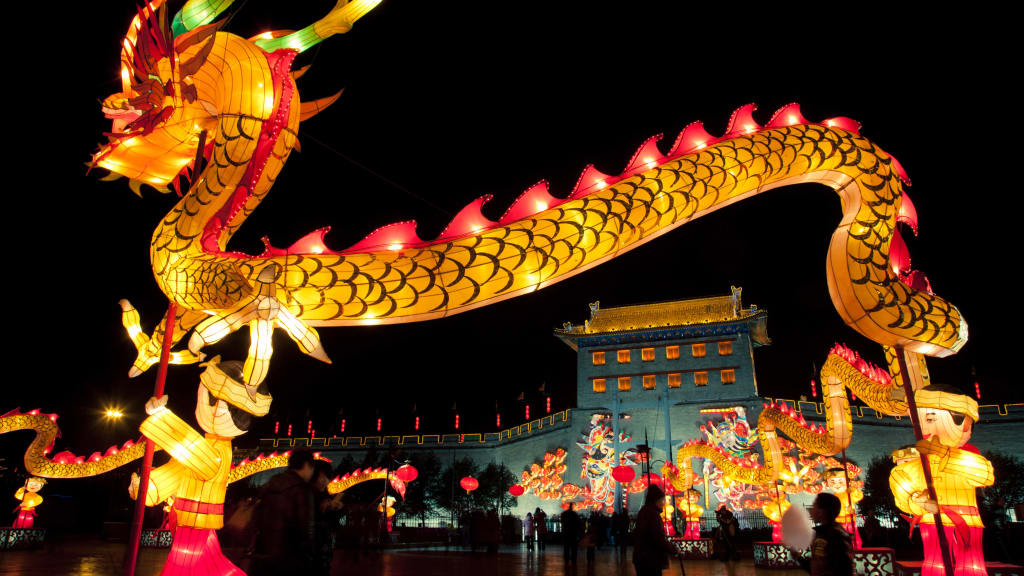
Lunar New Year is a major celebration observed by many East Asian communities worldwide. It is sometimes referred to as Chinese New Year or Spring Festival. It usually occurs in late January or early February and signifies the start of the lunar calendar.
Family get-togethers, feasting, distributing red envelopes containing cash (called "hongbao" or "lai see"), and adhering to cultural traditions like cleaning the house to ward off bad luck and making gifts to ancestors are just a few of the activities that define the holiday.
The Chinese zodiac, which revolves in a twelve-year cycle, assigns a year to each of the twelve animals in the lunar calendar. Every animal is said to possess unique traits that affect the year and the individuals born in that year.
The Lunar New Year is a season of introspection, rebirth, and family time. With parades, lion and dragon dances, fireworks, bright decorations, and a variety of cultural performances, celebrations typically span several days.
1)Symbolism: Since red is thought to ward off evil spirits and bring good luck and wealth, it is the predominant hue during Lunar New Year celebrations. Couplets with lucky sayings, red lanterns, and other red-themed decorations are used by people to adorn their homes.
2)Food: The main component of Lunar New Year celebrations is food. Families cook and eat customary foods with deep symbolic implications. For instance, fish is a symbol of prosperity and abundance, and dumplings are a symbol of wealth and good fortune. Noodles for longevity, sticky rice cakes for wealth or prestige, and citrus fruits for good fortune and success are some other common dishes.
3)Fireworks and Firecrackers: Celebrating the Lunar New Year often involves fireworks and firecrackers. It is said that the loud boom wards off evil spirits and guarantees a new beginning in the coming year. But in recent years, worries about how pyrotechnics affect the environment and public safety have grown, which has resulted in some bans in some places.
4)Travel: Millions of people head back to their hometowns for the Lunar New Year holiday to celebrate with family, making it the largest annual human migration. The enormous influx of people is referred to as "chunyun," or the travel rush for the Spring Festival. There is a great deal of strain on the transportation networks during this time, particularly in China.
5)Zodiac Animals: According to the Chinese zodiac, the Rat, Ox, Tiger, Rabbit, Dragon, Snake, Horse, Goat, Monkey, Rooster, Dog, and Pig are the twelve animals that correspond with each year. Every animal is thought to possess unique qualities that impact the personalities and fortunes of people born in that year.
6)Greetings & Customs: People send each other blessings and greetings on Lunar New Year's Eve. "Xin Nian Kuai Le" (Happy New Year) and "Gong Xi Fa Cai" (Wishing you prosperity) are common expressions. During the celebration, there are also a number of taboos and practices that must be followed, such as not sweeping or putting out the trash on New Year's Day in order to prevent wiping off good fortune.
7)Lion and Dragon Dances: During the Lunar New Year festivities, colorful lion and dragon dances are customary. Dancers imitating lions or dragons are included in these shows; they wear intricate costumes. The dances are thought to fend off evil spirits and provide prosperity and good fortune. In order to bring good fortune for the upcoming year, businesses frequently engage lion dance troupes to perform outside their locations.
8)Superstitions and Taboos: There are a number of superstitions and taboos surrounding Lunar New Year, which are said to affect luck and fortune. For instance, it is said to be unlucky to shatter mirrors or dishes during the holiday, as this could result in bad luck. Furthermore, some phrases or behaviors are avoided because they have a similarity to words that are connected to negativity or death.
About the Creator
SUGANYA R
I am worker, i live ordinary life, i love to sing and i love go out different places, i having hobby to capture of good photos, love to eat.
Author’s Advice
If you would’ve asked me 20 years ago did I know I’d become a writer and an author, I would’ve said “nope, ain’t happening”. As fate would have it I did become an author and I can honestly say I’m loving it so far. It really does feel good to be a writer. I’ve learned a lot on this journey and I feel like with even me being as new to this world as I am, there’s some wisdom I need to share with every other aspiring author.
By Joe Patterson3 days ago in Journal




Comments
There are no comments for this story
Be the first to respond and start the conversation.