
Life by the Numbers: The Human Side of China’s Social Behavior Score System
From free hospital check-ups to travel bans, how China’s digital trust experiment is shaping everyday lives—and sparking debate about privacy, freedom, and fairness.
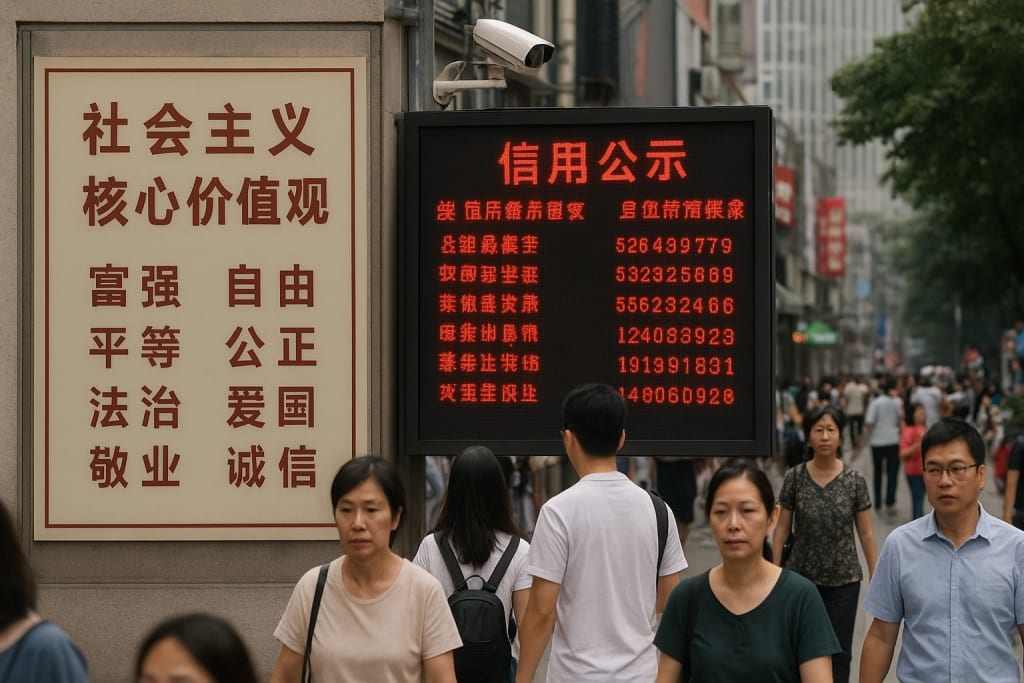
Imagine a world where a number assigned to you controls whether you can purchase a train ticket, apply for a loan, or register your child in a decent school.
Not a science fiction story, this event concerns China's Social Credit System, which monitors the behavior of its residents, assigns ratings, and imposes penalties or rewards based on these assessments.While some people see it as a means of developing trust, others view it as a continuous reminder that they are being watched.
Precisely what is the social credit system?
Created in the early 2010s, the Social Credit System (SCS) seeks to build a trustworthy society by combining financial information, legal papers, and behavioral monitoring.One may think of it as a credit score, albeit it covers more than only financial issues.
A great score might result in:
- Prioritization in job applications
- Cheaper health care and utility bills
- Simplified loan approval processes
- Faster government documents
Conversely, lower scores might result in:
- Restrictions on reserving flights or highspeed trains
- slowed internet speeds
- Restricted entrance to some institutions or occupations
- publicly naming offenders for severe acts
Even while the present system is composed of several local programs in addition to national records, there is a longing for a single network.
How It Runs
Sources of data include:
- Financial records include tax forms, loan payments, and unpaid invoices.
- Legal Records: traffic penalties and judicial decisions.
- Sharing prohibited content, dissemination of incorrect information, and other online actions.
- Participating in disruptive behavior or academic dishonesty. Public behavior
Interestingly, your social circle may also have an effect; having friends who have poor grades might also affect your score.
Two very different day encounters
Ms. Zhang's Encounter
Always committed to assisting others, Ms. Zhang, a former Hangzhou teacher, has volunteered at the local library, helped her neighbors, and always paid her bills on time.One day she discovered that her social rating had reached the excellent level.Lower rates for health checks, shorter hospital wait times, and a quicker process for renewing her travel permission started to show themselves.She says the city felt like it was showing appreciation.I simply lived my usual way; I did nothing unusual.
Story of Mr. Chen
Mr. Chen, conversely, is a delivery driver residing in Beijing who once missed a small court fine pertaining to a parking violation.He just forgot about it given his lengthy work schedule and the burden of caring for his elderly parents.
His score suffered as a result, and he was unable to buy high-speed train tickets to visit his sister.It took several months for his privileges to be reinstated even after paying the punishment.He says it seemed like my life had stopped.
The importance of your spoken words
26-year-old software engineer Li Wei realized his internet postings might have real-world effects.His rating declined when he published a message criticizing a local statute and discovered incorrectly that it had been categorized as misleading.
Though I dropped it right away, he recalls the effect lasted.He does not publish unproven articles or political jokes anymore.Being careful in your own home is like being cautious; you never know what may set off the alarm.
Why the government should help
Officials present the Social Credit System (SCS) as a means to foster confidence in a large country full of fraud, knockoffs, and contract breaches.
Advocates contend that:
- It inspires responsibility and honesty.
- It shields the law and lowers fraud.
- It promotes community-oriented actions.
For many elderly people, including Ms. Zhang, such a project seems to be a reasonable direction toward safety.She says, if you have done nothing bad, there is nothing to worry about.
Questions and Issues
Still, opinions abound both inside and beyond of China.Detractors who consider the system a digital control tool have issues like these:
- PrivacyThe volume of data collected is unrivaled.
- Transparency: The standards applied for grading may not be clear.
- Since what people say can influence grading, there might be hesitancy to express oneself freely.
- Social Pressure: Some people might avoid particular relationships to protect their score.
According to human rights activists, such a system may facilitate political oppression.
Public Disgrace and The Blacklist
An essential element of the system is its blacklist, which publicizes those with outstanding debts or committed serious offenses.On screens in public areas like shopping malls or train stations can be shown names, identification numbers, and fines.
For those on the list, life could become a never-ending source of humiliation.A man from Shandong Province was blacklisted for his business debts, and he claimed that strangers started to recognize him in public.He said, it's like a persistent shadow rather than only a fine.
Global Comparisions
Though the SCS is on a different scale, some of its components may be found all around the world:
- Credit agencies evaluate financial reliability in the West.
- Ridesharing systems let riders and drivers rate one another.
- Hiring processes sometimes feature background checks.
What distinctions exist?The government in China controls one score that encompasses several more components in addition to all of these.
What the Future Holds
China is always expanding and improving its system.Monitoring systems will probably become more sophisticated as a result of artificial intelligence and facial recognition technology.
Will this create a society founded on trust or one ruled by fear?The result depends on how effectively personal freedoms and order are matched.
The Human Bottom Line
To Ms. Zhang, the system stands for pride.For Mr. Chen, it was an eyeopener. For Li Wei, it serves as a reminder to remain vigilant.
Beyond just numbers, the Social Credit System captures how the government, companies, and communities view their people.Being considered "good" in contemporary Chinese society goes beyond just ethics.It transforms into a measurable score that either helps or restricts possibilities in life.
Moreover, whether good or bad, that score follows you all everywhere.
About the Creator
Keep reading
More stories from Shahjahan Kabir Khan and writers in Journal and other communities.
Battle of the Titans: Tesla Pi Tablet vs. iPad Pro—Who Deserves a Spot in Your Bag?
The race for tablet supremacy is not still solely controlled by one participant in 2025. Many years the Apple iPad Pro has served as the standard for creatives, students, and workers looking for production.Almost invincible, its outstanding mix of performance, design, and seamless integration inside its environment has helped to define it.
By Shahjahan Kabir Khan7 months ago in Journal
Author’s Advice
If you would’ve asked me 20 years ago did I know I’d become a writer and an author, I would’ve said “nope, ain’t happening”. As fate would have it I did become an author and I can honestly say I’m loving it so far. It really does feel good to be a writer. I’ve learned a lot on this journey and I feel like with even me being as new to this world as I am, there’s some wisdom I need to share with every other aspiring author.
By Joe Patterson5 days ago in Journal



Comments
There are no comments for this story
Be the first to respond and start the conversation.