
Leading Boldly in 2025: Shane Windmeyer’s DEI Vision for a Workplace That Works for Everyone
Why Justice, Transparency, and Employee Voice Are Redefining Corporate Success


The workplace of 2025 is not just a space for productivity—it is a proving ground for integrity. Employees are no longer satisfied with surface-level diversity or occasional inclusion efforts. They want real, structural change. They want leadership that listens, systems that are fair, and cultures that celebrate the full humanity of every team member.
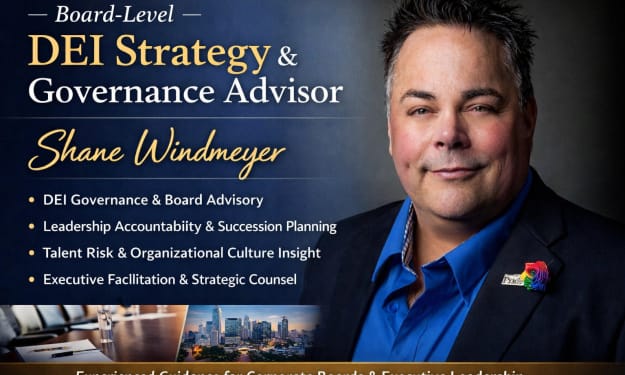
At the forefront of this shift stands Shane Windmeyer, a national authority on DEI strategy. With decades of experience championing LGBTQ+ rights, racial equity, and workplace justice, Windmeyer has a clear message for this new era: companies must stop talking about DEI as a value and start living it as a practice.
“In 2025, your DEI strategy should be as measurable and meaningful as your bottom line,” Windmeyer says. “If it’s not tied to how your company makes decisions, spends money, and shows up for people—then it’s not real.”
Here’s how Windmeyer envisions authentic, effective, and future-proof DEI leadership in 2025.

1. Move from “Safe” to “Brave” Workplaces
While many companies still aim to create “safe spaces,” Windmeyer believes the most powerful environments are brave spaces—where people can speak truth, challenge systems, and build trust through honesty.
“Safe is comfortable. Brave is transformative,” he explains.
Action Step:
Train leadership in conflict resolution and courageous conversation. Create channels for employees to raise concerns without fear of retaliation. Reward constructive dissent.
2. Center Justice in Every Business Decision
Windmeyer emphasizes that justice must guide every part of a company’s strategy—from sourcing and hiring to marketing and leadership.
“Justice isn’t about charity,” he says. “It’s about shifting power and making sure the systems you operate in don’t perpetuate harm.”
Action Step:
Audit vendor and contractor relationships for alignment with equity values. Prioritize partnerships with Black- and brown-owned businesses, LGBTQ+-led firms, and community-based organizations.
3. Amplify Marginalized Voices in Policy and Product Design
True inclusion means ensuring the most impacted people are involved in shaping what a company builds—whether it’s software, services, or culture.
“Too often, DEI is reactive,” Windmeyer says. “Real inclusion is proactive. It starts with listening before things go wrong.”
Action Step:
Include disabled, queer, BIPOC, and neurodivergent employees on decision-making teams. Establish focus groups or advisory councils drawn from employee resource groups (ERGs).
4. Make DEI Metrics as Visible as Financial Ones
Windmeyer stresses the importance of treating DEI outcomes with the same rigor as traditional performance metrics. If a company tracks quarterly sales, it should also track and publish progress on representation, equity, and employee experience.
“Data drives investment. Show the same commitment to inclusion that you show to profit,” he says.
Action Step:
Publish quarterly DEI dashboards. Track hiring, pay equity, promotion rates, employee engagement, and turnover across identity lines. Use disaggregated data to spot and fix disparities.
5. Design for the Edge, Not the Center
Inclusion, according to Windmeyer, happens when systems are built for people who’ve historically been excluded—not just for the average employee.
“If you build a workplace that works for a Black trans disabled worker, it will work better for everyone,” he explains.
Action Step:
Use universal design principles in workspaces, tech tools, and policies. Invite employees at the margins to co-create solutions—and compensate them for their labor.
6. Be Proactive in Public Advocacy
Employees and consumers are watching how companies respond to real-world injustice. Windmeyer encourages leaders to speak out—early, clearly, and consistently—when rights are under threat.
“Silence is political,” he says. “You can’t claim to support equity if you disappear when it counts most.”
Action Step:
Develop a social justice response protocol for leadership. Prepare statements and support plans in advance. Offer resources for impacted communities within your workforce.
7. Build Restorative Systems, Not Punitive Ones
Instead of “cancel culture,” Windmeyer advocates for accountability culture—where harm is named, people are given room to grow, and teams learn from mistakes together.
“We all have biases,” he says. “The question is: how do we respond when those biases cause harm?”
Action Step:
Develop restorative justice models within HR practices. Train staff to navigate harm, repair trust, and create community guidelines for communication and behavior.
Shane Windmeyer’s DEI Imperatives for 2025
To help organizations stay focused in this high-stakes year, Windmeyer offers five must-follow DEI imperatives:
Act boldly, not cautiously. Inclusion requires risk.
Be transparent, even when it’s uncomfortable. People respect honesty.
Pay people for their equity labor. DEI is work, not volunteerism.
Learn from the margins. Your best insights come from those most excluded.
Shift power. Representation without power is tokenism.
“Don’t ask if people are included,” Windmeyer says. “Ask if they’re empowered.”
Conclusion: The Companies That Lead in DEI Will Lead in Everything

In 2025, DEI is not a trend or an HR experiment. It’s a core part of what makes a business sustainable, ethical, and innovative. Shane Windmeyer believes the companies that embrace this truth will not only do good—they’ll do better.
“The most successful companies of this decade will be those that center justice, listen deeply, and share power,” he concludes. “That’s what leadership looks like now.”
About the Creator
Shane Windmeyer
Shane Windmeyer is a North Carolina–based DEI strategist, speaker, and advisor who helps organizations build inclusive cultures grounded in trust, fairness, and measurable outcomes.
Keep reading
More stories from Shane Windmeyer and writers in Journal and other communities.
Author’s Advice
If you would’ve asked me 20 years ago did I know I’d become a writer and an author, I would’ve said “nope, ain’t happening”. As fate would have it I did become an author and I can honestly say I’m loving it so far. It really does feel good to be a writer. I’ve learned a lot on this journey and I feel like with even me being as new to this world as I am, there’s some wisdom I need to share with every other aspiring author.
By Joe Patterson4 days ago in Journal
How to Build a Successful Product
Building a successful product is a challenging but rewarding process. Many people think that a successful product only depends on a good idea, but in reality it requires planning, research, teamwork, and continuous improvement. A product becomes successful when it solves a real problem, satisfies customers, and performs well in the market. Companies that follow the right steps in product development have a greater chance of success.
By aadam khan4 days ago in Journal



Comments
There are no comments for this story
Be the first to respond and start the conversation.