
Latest Tech Trends of ecommerce to Enhance Customer Experience
Technology Trends of E-commerce

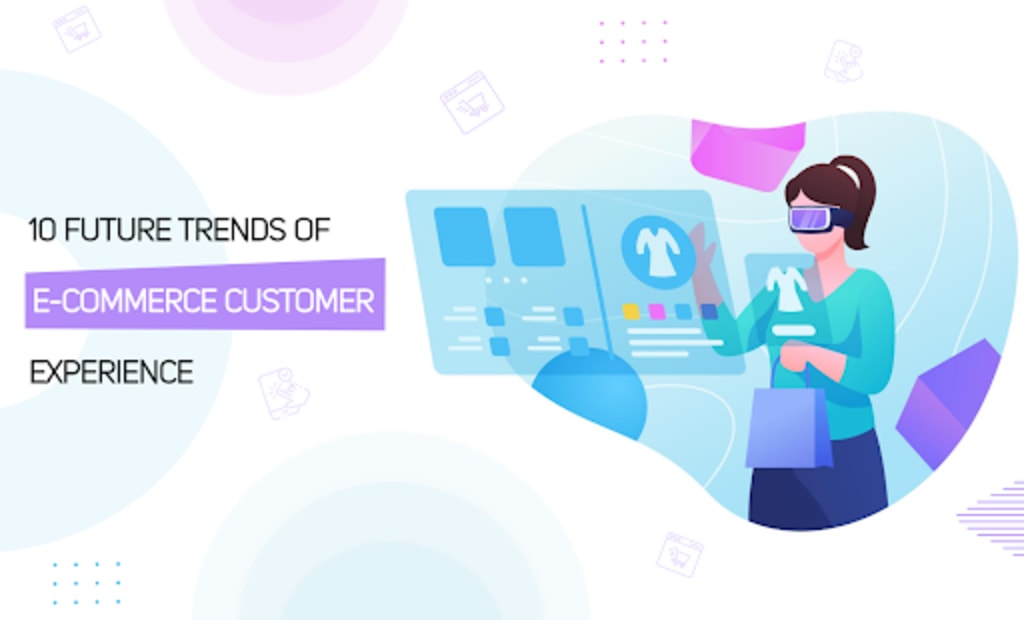
The eCommerce market continues to be evolving, and the current year has been no exception. Entrepreneurs are building and/or enhancing their eCommerce companies more than ever before to meet customers wherever they are.
Because more people are purchasing online, eCommerce businesses must adapt the way they shop to the emerging reality. They must create eCommerce solutions that attract customers and increase sales. They'd have to stay up with the most recent eCommerce trends and react to changing consumer behavior.
Hence, in this blog, we have researched the 10 future trends of eCommerce to enhance customer experience.
10 Future Trends of eCommerce to Enhance Customer Experience
Here are the 10 future trends of eCommerce that you can utilize for your business to enhance customer experience:
01- Augmented Reality and Virtual Reality
Businesses are increasingly providing engaging experiences that foster a strong emotional bond between the consumer and the product.
replicating in-store experiences such as tasting a sample, trying out a possible couch, or feeling the softness of apparel is difficult to recreate digitally, but augmented reality (AR), virtual reality (VR), and 3D content can help overcome the gap.
They can also create a deeper understanding and relationship with a product, which increases consumer trust and simplifies the purchasing choice. IKEA, with its IKEA Place app, is a pioneer in augmented experiences.
Users can virtually 'position' 3D true-to-scale furnishings in their homes with the app. This not only improves the IKEA consumer shopping experience but also allows customers to make quick purchasing choices.
02- Omnichannel
When customers interact with businesses across several digital channels, they seek uniform and highly personalized experiences. They may, for instance, start a conversation with a brand on Facebook followed by continuing the conversation via e-mail. They will demand an effortless and integrated service irrespective of the platform.
A good omnichannel customer experience seamlessly links online and physical communication channels from the first point of contact to offer a unified and unforgettable shopping experience.
If a consumer communicates with a brand via phone, e-mail, live chat, social media, and SMS, as well as offline, a seamless customer experience is essential.
03- Chatbots
A chatbot is a great marketing tool for improving relations with customers. Today's buyer expects to be capable find and purchase a product in a matter of seconds, and they become frustrated if they can't. This is where a chatbot can help salvage the sale.
As per the top mobile app development company, chatbots provide companies with continuous work 24 hours a day, cost-effectiveness, and the automated execution of typical jobs, resulting in improved customer service.
A growing number of eCommerce companies are developing chatbots based on natural language processing technology so that these computers may communicate with online buyers in the same way that human salespeople do.
Retail is one of the first industries to use chatbots. Based on Juniper Research, by 2023, more than 70% of chatbots will be retail-based.
04- Artificial Intelligence and Machine Learning
Artificial Intelligence (AI) and machine learning enable shoppers to enjoy automated, personalized purchase experiences. AI is constantly gathering information about how customers shop when they make purchases and what they want in a product or service.
It is an element of technology that cannot be recreated in-store. By merging AI and machine learning for gathering and evaluating demographic, historical, and behavioral data, brands can gain a much more exact perspective of their customers.
The customer journey may be enhanced throughout every point of contact and channel by employing AI to better understand the customer and take benefit of immediate decision-making and predictive analysis.
05- Multiple Payments Options
Multiple payment options in eCommerce stores offer a competitive advantage because buyers are not restricted in their choices and can select how to pay based on their specific needs.
As a result, they're less inclined to ditch the cart. Various payment options that can be used by an eCommerce business owner are:
Cards: Nowadays, debit and credit cards are the most commonly used payment options. The buyer just needs to swipe the card to the card payment machine to make the payment.
Bank transfers: It is mandatory to use Internet banking while making online purchases. Online bank transfers are among the most secure mode of payment when it comes to data protection (thanks to transaction authentication and encryption).
Cash: Despite cashless payments growing more popular for a variety of reasons, cash should still be accepted as a payment method. Bank operations may occasionally fail due to server difficulties, for example. Cash is usually useful in these instances.
Mobile payments: Mobile phones have evolved into a convenient means of payment. Customers install payment apps on their devices and then simply place the device close to the payment terminal to make a payment.
eWallets: Digital wallets, often known as eWallets, are a new and easy payment mechanism for eCommerce. Users establish eWallet accounts, link them to their bank accounts, and use electronic devices to send money to specific merchant accounts.
Buy Now Pay Later (BNPL): Occasionally a buyer likes a product but does not purchase it because they do not have enough money. To avoid losing such consumers, BNPL can be used. It enables customers to pay for things in monthly installments rather than all at once.
Cryptocurrencies: Cryptocurrency payment methods are currently contentious, but they may catch on in a few years.
06- Headless and API-driven Commerce
For major enterprise-level retailers who distribute their products through many channels such as websites, mobile apps, and so on, headless commerce systems are a viable option.
In simple terms, headless commerce (also known as API-driven commerce) refers to the absence of a connection between the backend (where product content is stored and handled) and the front end or a specific presentation layer.
This is a unified system with integrated sales and marketing capabilities that enables online retailers to simply develop unified content and distribute it to a wide range of devices via APIs.
Large eCommerce organizations are increasingly implementing technologies that enable the flexibility of headless commerce while also providing greater content management.
07- Big Data
Collecting and analyzing enormous amounts of data (big data) provides significant possibilities for businesses in a variety of industries. Big data analytics is the primary resource for developing tailored experiences in eCommerce.
Today, retailers hire app developers in India and focus more on building a personal data-collecting strategy with the goal to disclose their customers' activity patterns and create important forecasts.
Alongside personal information, retailers employ enormous amounts of data on the supply chain, inventories, warehouses, and delivery services to aid decision-making and increase profit.
08- Subscriptions
Subscription-based eCommerce business models are gaining popularity among retailers and customers. The gist is that providers offer numerous subscription options for their products or services; customers select packages based on their requirements and preferences and receive them on a regular (e.g. monthly) basis.
This is a practical purchase strategy for customers who require the same items or services on a regular schedule but do not want to waste time purchasing them each time.
Subscriptions offer a unique opportunity for eCommerce businesses to estimate sales and plan inventories, cutting expenses. Subscriptions bring adaptability and ease to the daily lives of vendors and customers, which is why they will continue to grow in popularity.
09- Video Marketing
Video marketing is popular in eCommerce, with online retailers including everything from product explanatory videos to video reviews in their marketing campaigns.
When you consider it, it makes complete sense because video eliminates the uncertainty of buying a product you've never seen. You can watch a product in motion, get a sense of its size (which the image may not communicate), and figure out how it works if it has moving parts.
Furthermore, individuals prefer watching videos to reading descriptions of products.
10- Voice and Visual Search
Marketers will use developing technologies such as voice and visual search to advance their social commerce strategy in 2023. Smart speakers and voice assistants are used by many people to conduct daily tasks.
Customers can browse a brand's many collections, select product sizes and colors, and ask inquiries right from their store. As more individuals use these technologies, they will almost certainly begin to use voice search to make purchases.
According to an eCommerce app development company, the best example of visual search is Google's Multitask Unified Model algorithm (MUM). With MUM, a customer can upload an image of anything they want to buy, and the search engine will show them a slew of similar things for sale. MUM will be connected with Google Lens, allowing for smooth visual product searches.
Conclusion
The eCommerce market is continually changing. Trends change frequently, but in order to remain successful in the constantly shifting online retail sector, eCommerce organizations must pay close attention to them and select the trends that are most important to their customers.
Related Read:-
About the Creator
Samuel Miller
Hi I am Samuel Miller from California, USA. I write and speak about emerging technologies such as blockchain, web3, metaverse and AI.
Keep reading
More stories from Samuel Miller and writers in Journal and other communities.
How Artificial Intelligence is Transforming Businesses
The use of AI in businesses is revolutionizing the way that companies operate and interact with customers. Artificial Intelligence (AI) has become a critical tool for businesses to drive innovation, increase efficiency, and deliver better customer service.
By Samuel Miller3 years ago in Journal


Comments (1)
The future of eCommerce is bright, with customer experience at the forefront of innovation. By leveraging personalization, mobile commerce, voice commerce, AR/VR, faster fulfillment, social commerce, and sustainable practices, businesses can stay ahead of the curve and deliver exceptional experiences to their customers in the evolving eCommerce landscape. To know more visit- https://www.bdccglobal.com/top-devops-companies-in-usa/