
Joshimath, Uttarakhand's holy town, began'sinking' in 1976: here's why
The first case of sinking in Joshimath was mentioned in a 1976 Mishra Commission report. Let us investigate the'science' behind the crisis.
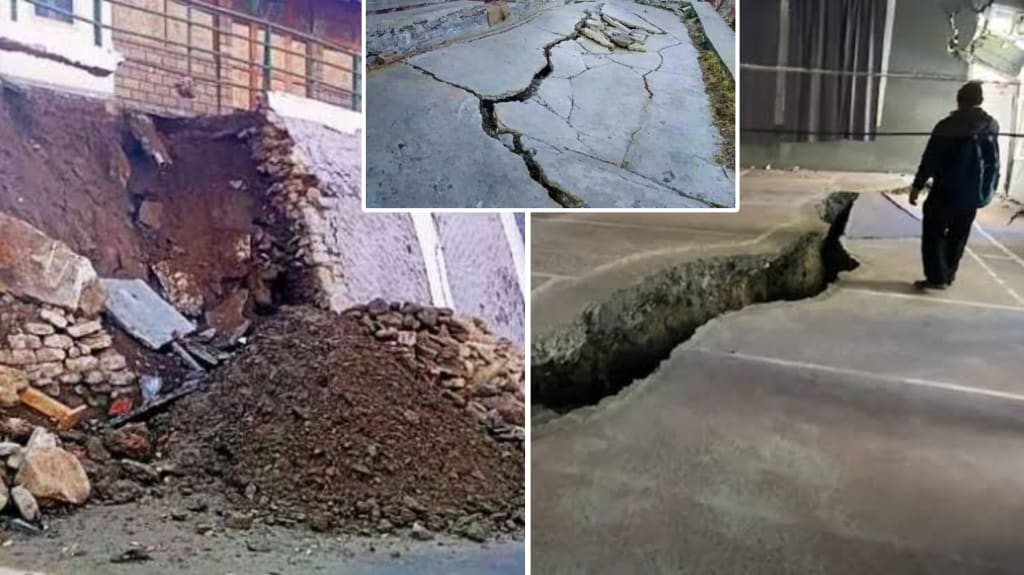
Residents of the holy town of Joshimath in Uttarakhand have been concerned after spotting cracks in the town's buildings and streets, which they have described as the town "gradually sinking".
In response to the terrified residents' protests, the Uttarakhand government prohibited development work in the area on January 5 due to earth subsidence that caused 561 homes in Joshimath to develop cracks. Let us investigate the science of the Joshimath crisis.
Construction:
More than ten years ago, experts warned of the possibility of ground subsidence in the area.
This rapid and extensive stratum dewatering. The fact that the town is sinking is not surprising given that no corrective actions have been taken.
According to locals, several new multi-story structures have sprouted up in and around Joshimath town in the last ten years or so. One of these buildings recently tipped due to subsidence.
Despite being well aware of the geological risk in the area, hydroelectric schemes such as the Vishnugad HE Project have been approved near Joshimath and Tapovan.
According to an August 2022 survey report from the Uttarakhand State Disaster Management Authority (USDMA), Joshimath's slope instability problems have gotten worse as a result of unplanned construction that did not take bearing capacity into account.
By constructing retaining walls, several additional buildings could be built in the landslide-prone area. As a result, the strain on the weak slope has increased.
The Border Roads Organization (BRO) is constructing a Helang bypass, which will shorten the journey to the Badrinath shrine by approximately 30 kilometres.
Experts believe that this development beneath the tectonic activity may result in more landslides. In its 1976 report, the Mishra Commission advised against major construction near Joshimath.
Geography:
A report from the 1976 Mishra Commission noted the first case of sinking in Joshimath, which is located in a landslide-prone region.
The town is situated on the middle slopes of a hill, bounded to the west and east by the Karmanasa and Dhaknala streams, and to the south and north by the Dhauliganga and Alaknanda rivers.
Among the streams that originate in the Central Himalayan region near Kunwari Pass are Dhaknala, Karmanasa, Patalganga, Belakuchi, and Garurganga.
While the others flow into the Alaknanda, the first is a Dhauliganga tributary. These streams are notorious for the devastation they have previously caused due to flash floods caused by landslides.
According to the most recent satellite data, mountain streams have changed their courses and extended their channels, adding to the slope instability of an already vulnerable belt.This demonstrates the impact of significant rainfall events.
Joshimath is extremely vulnerable to sinking due to tectonic activity because it is located on a fault line and near two others. Joshimath is almost touched by the Vaikrita Thrust (VT), a geological fault line. Furthermore, two major geological faults, the Main Central Thrust (MCT) and the Pandukeshwar Thrust (PT), are relatively close to the town.
Joshimath Village is in the path of any tectonic activity on MCT as it passes beneath Helang, a small town to the south of Joshimath Town, and contrasts with the rocks of the Garhwal Group.
Drainage:
Experts and the USDMA have identified increased ground seepage of water from the surface as a possible cause of sinking.
Natural water drainage systems have been obstructed by anthropogenic surface-level activities, forcing water to seek alternate drainage pathways.
In addition, there is no sewage or wastewater disposal system in Joshimath.
The seepage reduces the shear strength of the overburdened soil. This is visible in the area around Sunil Village in Joshimath, where water lines have bent out of shape due to subsidence.
Joshimath: The Uttarakhand government has put a halt to all construction projects
Summary : Pushkar Singh Dhami, Chief Minister of Uttarakhand, is scheduled to visit Joshimath and conduct physical inspections of the land subsidence-affected area.
The Uttarakhand government has banned all construction activities in and around Joshimath due to cracks appearing in buildings caused by land subsidence.
District Magistrate Himanshu Khurana informed ANI news agency of Uttarakhand's decision. On Saturday, Uttarakhand Chief Minister Pushkar Singh Dhami is scheduled to visit the town and conduct physical inspections of the land subsidence-affected areas.
"Because of the local situation in Joshimath, all construction work has been halted until further orders are issued. The Chief Minister will inspect the landslide-affected areas of Joshimath and visit the relief camps here "According to the district magistrate.
Residents of Joshimath blocked the Badrinath Highway this week to protest and urge the government and administration to take land subsidence seriously.
According to a Chamoli district administration statement issued on Friday, 561 establishments were destroyed: 153 in Ravigram ward, 127 in Gandhinagar ward, 28 in Marwadi ward, 24 in Lower Bazaar ward, 52 in Singhdhar ward, 71 in Manohar Bagh ward, and 29 in Upper Bazaar ward.
The operations of Hotel View and Malari Inn have been restricted under the Disaster Management Act, 2005, due to cracks reported by 27 people in the Sunil ward and 50 people in Parsari.
Nine families were displaced on Thursday, including four from Joshimath Municipal Corporation, one from Gurudwara Joshimath, one from Tourist Hostel, Manohar Bagh, and others. According to the news agency ANI, 38 families have been displaced so far.
In addition, the Uttarakhand Chief Minister has ordered the immediate evacuation of approximately 600 families. According to the CM, medical treatment facilities should be available on the ground, and plans for airlifting people should be made.
According to Dhami, an immediate action plan as well as a long-term action plan should be prepared, and work on both should begin immediately.
About the Creator
Keep reading
More stories from Dineshkumar P and writers in Journal and other communities.
Things to consider while buying a best gaming phone
Here are some things to consider when buying a best gaming phone: 1.Processor: Look for a phone with a powerful processor, such as a Qualcomm Snapdragon 865 or higher. This will ensure that your phone can handle the demands of modern games. A high-performance processor is crucial for smooth and lag-free gaming experience.
By Dineshkumar P3 years ago in Gamers
Author’s Advice
If you would’ve asked me 20 years ago did I know I’d become a writer and an author, I would’ve said “nope, ain’t happening”. As fate would have it I did become an author and I can honestly say I’m loving it so far. It really does feel good to be a writer. I’ve learned a lot on this journey and I feel like with even me being as new to this world as I am, there’s some wisdom I need to share with every other aspiring author.
By Joe Patterson3 days ago in Journal
Why Didn't Anyone Tell Us
Men, move along. This is not for you. This is for the women. I was forty-five when I began menopause. It is pretty young for that to be going on in a woman’s life, but I had undiagnosed PCOS, my entire life. Thank you to all the gynecologists I had seen my entire life. That in itself should encourage women to keep seeking second opinions, especially when you are not getting correct answers or any at all.
By Alexandra Grant4 days ago in Humans




Comments
There are no comments for this story
Be the first to respond and start the conversation.