
Is the Fintech Market Quietly Reshaping Global Finance?
Why the global fintech market is evolving into the backbone of modern financial life
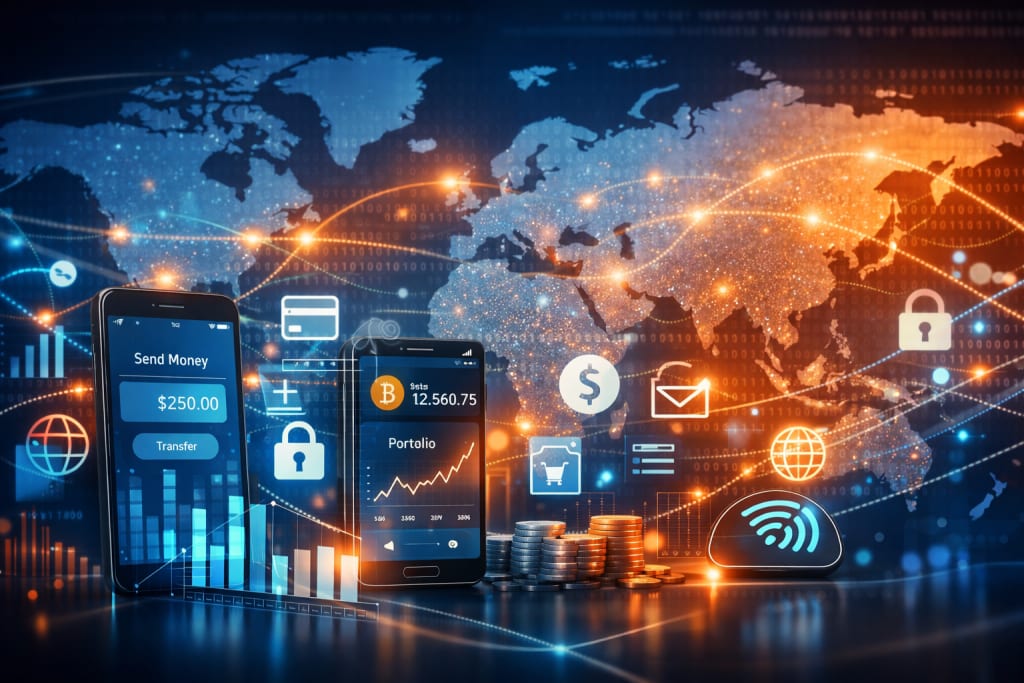
Finance Didn’t Change Overnight, It Slipped into Your Pocket
Fintech didn’t arrive with a single breakthrough moment. It crept into everyday life quietly, when paying bills became instant, when opening an account stopped requiring paperwork, and when sending money felt as easy as sending a message. What once felt optional is now deeply embedded in how individuals and businesses interact with money.
The fintech market size reached USD 320.81 billion in 2025 and is forecasted to climb to USD 652.80 billion by 2030, reflecting a steady 15.27% growth rate, underscoring how deeply fintech solutions have woven themselves into global financial systems. This momentum highlights a structural shift rather than a passing trend, positioning fintech as a long-term force shaping the future of finance.
The Global Fintech Market Is Built on Everyday Behaviour
The global fintech market thrives not because of flashy innovation, but because it solves persistent problems. Consumers want speed, transparency, and accessibility. Businesses want efficiency, flexibility, and smarter financial tools. Fintech delivers all three by removing friction that traditional systems struggled to eliminate.
Mobile payments, digital wallets, embedded finance, and alternative lending models have changed expectations. People now assume financial services should be available instantly, securely, and from anywhere. This shift in mindset is what continues to push the fintech market forward across regions and use cases.
Trust, Access, and Inclusion Drive Adoption
One of the most powerful forces behind fintech growth is access. Fintech platforms have opened doors for users who were previously underserved by conventional banking systems. From small business owners to remote workers, financial services are no longer tied to physical branches or rigid eligibility criteria.
This growing trust in digital-first platforms reflects a broader transformation. Users aren’t just adopting fintech tools, they’re relying on them. As confidence increases, fintech becomes less of an alternative and more of a default choice, reinforcing its role within the wider financial ecosystem.
What Fintech Industry Analysis Reveals About Direction
A closer fintech industry analysis shows a market moving beyond experimentation into maturity. Early fintech innovation focused on disruption. Today, the focus has shifted toward integration, scalability, and sustainability.
Financial technology is increasingly embedded into non-financial platforms, blurring the lines between commerce and finance. This evolution signals that fintech is no longer a standalone sector, but a foundational layer supporting digital economies worldwide.
Why Businesses Are Paying Attention
The fintech market isn’t only transforming personal finance, it’s reshaping how businesses operate. Companies now expect real-time payments, automated reconciliation, and seamless financial workflows. Fintech tools allow businesses to optimize cash flow, reduce operational friction, and serve customers more effectively.
As financial capabilities become embedded into everyday business platforms, fintech moves closer to becoming invisible infrastructure, present everywhere, but rarely noticed.
Reading Between the Lines of a Fintech Market Report
A fintech market report doesn’t just measure growth; it reflects changing priorities. The emphasis has shifted from novelty to reliability, from disruption to durability. Market signals suggest that fintech’s future lies in deeper integration with existing systems rather than replacing them entirely.
This evolution reinforces fintech’s role as a stabilizing force rather than a volatile disruptor, one that adapts to regulatory frameworks while continuing to innovate at scale.
The Fintech Market’s Next Chapter
The fintech market is no longer asking whether it belongs in global finance, that question has already been answered. What remains is how deeply fintech will continue to embed itself into daily transactions, business operations, and economic systems.
As financial technology becomes more intuitive and less visible, its influence grows stronger. The real story of fintech isn’t about apps or platforms, it’s about reshaping expectations of how money should work.
Do you see fintech as a convenience, a necessity, or the new foundation of finance, and why?
About the Creator
~ Fired ~
— Ai Intrusion ~ Are you Next ~ Is Ai Evolution after your job? — Few workplaces haven't been affected. Ai is in supermarkets, at doctors' offices, and even monitoring farms. I just can't think of anything this machine is not getting into, can you? For instance: Education ~ Law and Tech jobs will one day have a major influence or be taken over by these inanimate machines, with accuracy and vigor. From mechanics' diagnoses to a wide variety of everyday jobs, including fast food workers, with this input having the ability to cut their unnecessary work hours. I'm certain all of us have been touched by this with our short stories and colorful headings, have you? Even comments are very questionable 'Non-Robot' insertions.
By Jay Kantor5 days ago in Journal
Why Black History Matters in America?
The United States of America is celebrating their 250th anniversary in 2026. I'm proud to be an American and as someone who was born here, I wouldn't imagine myself living anywhere else. This is a country where opportunities are possible. Where anyone can be successful in anything they desire to do. Equality, community, and togetherness are the backbones of what America is and should be about. However, we have an administration who wants to erase and disregard those who have made positive, meaningful impacts in our country, specifically Black figures, such as Martin Luther King, Jr., Rosa Parks, and Maya Angelou. President Trump and his administration have been constantly complaining and fighting against what they call the "Woke agenda". They use this excuse as a distraction from other issues they refuse to address, such as the high cost of living, climate change, and inflation. That equality is dividing America, when in reality, it's bringing us together. Being woke is not tied to a specific political party. No matter where you stand on the political spectrum, you can still care about other people and their plights. Compassion and empathy for others isn't tied to a political party, either. We were taught as children to treat others the way we want to be treated and not judge others because they're different from us. Caring about others isn't a personal attack on your beliefs. It doesn't make you any less of a person. People who are easily offended over African American figures, past or present, or anything related to it, are grasping at straws. Current and future generations need to know who people like Harriet Tubman and Shirley Chisholm were, especially in the classroom. Black History is part of American History. It should be recognized, not hidden or forgotten. Besides, you can't shield children from everything, just because your feelings are easily hurt.
By Mark Wesley Pritchard 4 days ago in The Swamp


Comments
There are no comments for this story
Be the first to respond and start the conversation.