
IRCC issues 500 ITAs to Canadian Experience Class in Express Entry draw this week
In this draw, CEC candidates needed to meet a minimum Comprehensive Ranking System (CRS) score of 539 to qualify for an invitation.


Immigration, Refugees, and Citizenship Canada (IRCC) has just completed the latest round of Express Entry draws, inviting 500 candidates from the Canadian Experience Class (CEC) to apply for permanent residency. This draw specifically targeted individuals who have gained valuable work experience in Canada, continuing a trend that IRCC has been focusing on throughout the year.
Minimum CRS Score for Selection
In this particular draw, candidates needed to achieve a minimum Comprehensive Ranking System (CRS) score of 539 to qualify for an Invitation to Apply (ITA). While this score is slightly higher than the threshold in some previous CEC draws, it reflects the competitive nature of Canada’s Express Entry system, where candidates with a strong profile are more likely to receive an invitation.
The Canadian Experience Class has become a key pathway for skilled workers already in Canada to transition to permanent residency, particularly as the country continues to face ongoing labor shortages in multiple sectors.
Earlier Express Entry Draw Focused on PNP Candidates
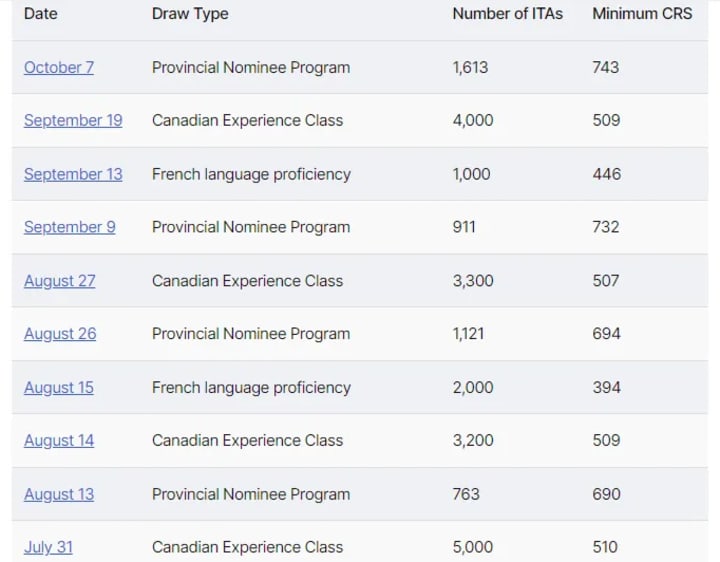
Earlier this week, on a separate occasion, IRCC also invited 1,613 candidates under the Provincial Nominee Program (PNP). The minimum CRS score required for that draw was significantly higher, at 739 points. PNP candidates receive additional CRS points for their provincial nomination, making the score requirement for these draws typically higher compared to other programs like the CEC. The PNP allows provinces and territories to nominate skilled workers they feel are best suited to meet local labor market demands.
This combination of draws within a week shows IRCC’s dual approach: while the department is focusing on transitioning temporary residents already living and working in Canada through the CEC, it also continues to prioritize candidates with provincial nominations through the PNP to meet regional labor market needs.
Recent History of Express Entry Draws
Before these two recent draws, the last one took place on September 19, when IRCC invited 4,000 CEC candidates. In that draw, the minimum CRS score was 509, slightly higher than the preceding CEC draw on August 27, which had a cut-off of 507.
Over the summer, IRCC has been increasingly favoring Canadian Experience Class candidates, issuing 21,800 ITAs to CEC candidates since July alone. This aligns with the department’s strategy of holding more “domestic” draws, aimed at reducing the number of temporary residents in the country and transitioning them into permanent residents. By focusing on individuals already in Canada, IRCC is not only addressing immediate labor needs but also supporting long-term retention and stability for skilled workers.
Express Entry and the Role of the CRS
For those unfamiliar, Express Entry is Canada’s main application management system for three key economic immigration programs: the Federal Skilled Worker Program (FSWP), the Federal Skilled Trades Program (FSTP), and the Canadian Experience Class (CEC). Introduced in 2015, the system uses a points-based mechanism called the Comprehensive Ranking System (CRS) to evaluate candidates based on a variety of human capital factors.
The CRS allocates points based on factors such as:
- Work experience
- Age
- Language proficiency in English and/or French
- Education level
- Occupation
Additional points are awarded for other factors, such as having a spouse or partner immigrating with the candidate, having a sibling in Canada, or possessing Canadian work experience or education.
The higher the CRS score, the better a candidate's chances of receiving an ITA in an Express Entry draw. However, the score requirements can fluctuate depending on the specific draw and the program it targets.
Category-Based Selection Draws
In May 2023, IRCC introduced a new type of Express Entry draw known as "category-based selection." These draws are designed to target candidates who can address critical labor shortages in specific sectors or demographic gaps in Canada. While category-based draws generally have lower CRS cut-off scores compared to general or program-specific draws, they focus on applicants with experience or skills in certain key areas.
IRCC has outlined six categories for these specialized draws, including:
- Healthcare
- Science, Technology, Engineering, and Mathematics (STEM) professions
- Trades
- Transport
- Agriculture and agri-food
- French language proficiency
These categories were chosen after extensive consultations with labor market experts, stakeholders, and government bodies. Additionally, the inclusion of French language proficiency as a category aligns with the government’s goal of admitting 6% of all new permanent residents into French-speaking minority communities outside of Quebec.
By tailoring these category-based draws, IRCC is able to address specific workforce needs while maintaining flexibility in its selection criteria. Candidates who fall under these categories may have a better chance of receiving an ITA, even with a lower CRS score than what is typically required for general draws. However, it is important to note that all candidates must still be in the Express Entry pool to be eligible for these draws. As always, having a strong CRS score remains an advantage across the board.
The Future of Canadian Immigration Through Express Entry
This week's CEC and PNP draws are a clear indication of IRCC’s multi-faceted approach to economic immigration, where both domestic and international talent pools are utilized to meet Canada’s evolving labor demands. The department’s strategy of alternating between CEC, PNP, and category-based draws reflects its commitment to attracting diverse, skilled workers who can contribute to the economy in various ways.
As we move further into 2024, it is expected that IRCC will continue with this approach, using the Express Entry system as a central mechanism to meet its immigration targets. The combination of high and low CRS cut-off scores across different draws will ensure that a wide range of candidates—whether they are already in Canada or looking to move from abroad—can find a pathway to permanent residency.
For candidates looking to improve their CRS scores, it remains crucial to focus on factors like language proficiency, work experience, and educational credentials. Additionally, those with ties to a specific province may find that the Provincial Nominee Program offers a faster route to an ITA.
In conclusion, Express Entry remains a dynamic and responsive system that plays a pivotal role in shaping Canada’s immigration landscape, offering skilled workers numerous opportunities to build their futures in the country.
About the Creator
Pushpendra Sharma
I am currently working as Digital Marketing Executive in Tutorials and Examples.
Keep reading
More stories from Pushpendra Sharma and writers in Journal and other communities.
New Brunswick Critical Worker Pilot (NBCWP): Attracting Skilled Foreign Workers to Meet Labour Needs
In November 2022, the New Brunswick government launched a specialized immigration initiative known as the New Brunswick Critical Worker Pilot (NBCWP). The program aims to attract skilled foreign professionals to address labor shortages in key sectors across the province. Unlike many other Canadian immigration pathways, the NBCWP provides comprehensive support for immigrants throughout their relocation and settlement journey. This program stands out for the strong collaboration between the province and six selected employers who offer significant settlement services to candidates.
By Pushpendra Sharmaabout a year ago in Journal
How I Learned to Adapt When Google’s AI Changed the Rules of SEO
I still remember the moment I realized SEO had changed forever. It wasn’t dramatic. No sudden traffic crash. No warning email. Just a slow, unsettling pattern pages that once ranked comfortably were slipping, while content that felt more thoughtful and human started rising. That’s when it clicked. Google wasn’t just ranking keywords anymore. It was reading intent.
By Anthony Rodgersabout 9 hours ago in Journal




Comments
There are no comments for this story
Be the first to respond and start the conversation.