
Inside India’s Silent War With Huawei: How a Digital Giant Became a National Dilemma
Behind closed doors and quiet corridors, India is waging a battle not of bullets, but of bandwidth — a struggle for digital freedom in an age of surveillance and silicon.
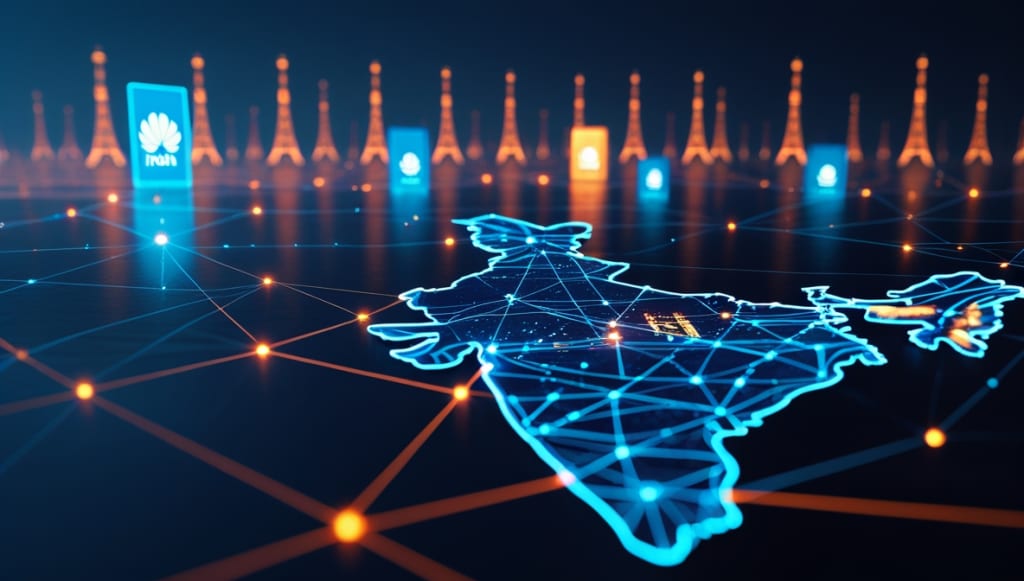
One of the world’s biggest markets has decided to take one of its boldest steps — to distance itself from Huawei, the Chinese telecom giant that once powered much of India’s digital revolution.
But disentangling from Huawei isn’t as simple as unplugging a machine. The company’s technology runs deep through India’s vast 4G networks — networks that connect hundreds of millions of people every second. From video calls and mobile payments to corporate servers and government data — Huawei’s invisible code hums quietly in the background.
Now, India wants to slowly phase it out.
The question is: how do you remove the engine without stalling the car?
A Dream Deal That Shaped a Nation’s Connectivity
We must go back a little to understand the significance of India's decision.
Only a handful of foreign telecommunications corporations dominated the market as India raced to link its 1.4 billion people to the internet: mainly Huawei and ZTE, its Chinese rival.
Their offer was simple—and almost too good to reject. At a price much below that of European competitors Nokia or Ericsson, they supplied sophisticated technology.
For Indian telecom companies like Bharti Airtel and Vodafone Idea, which were always balancing constrained resources with significant infrastructural needs, it was the best situation.
Huawei turned into their top friend as their 2G, 3G, then 4G networks were established. India's digital metamorphosis found its foundation in the equipment from the Chinese company, an invisible force behind video streaming, electronic transactions, and massive data. Transfers constantly throughout the day.
For many years it seemed to be a perfect partnership.
Still, underneath that simplicity was growing unease.
The Price of Dependence
As India grew more reliant on Huawei, authorities in New Delhi started to express severe reservations.
What if this invisible infrastructure, this technology, was intercepted?
These worries expanded sharply when China approved laws in 2017 mandating all local companies to support state intelligence organizations upon demand. The gentle uncertainties grew into a frank discussion on national security.
For members of India's intelligence agencies, the matter went beyond basic privacy; it involved national sovereignty. Could a foreign government have accessed or changed the systems governing India's financial infrastructure, power grids, or communications networks at any time?
This idea was revolting.
The Tipping Point for the Himalayas
Then came the year 2020.
In the icy Himalayas, India and China were locked in a vicious border conflict. The two nuclear-capable countries fought violent close-quarters combat for the first time in years.
Those in power in India came at that time to believe that the foundation of its digital economy— Technology from a strategic rival helped to shape some of the current infrastructure.
Huawei had changed from being just a supplier. It had grown into a potential, hidden danger.
The 5G Battlefield
As 5G technology started to be deployed globally, India made a little but important move: Huawei would be left out.
Conversely, the government advocated local options through the Make in India and Atmanirbhar Bharat (Self- Reliant India) initiatives.
Tata Communications and Reliance Jio began inventing their own 5G systems. The aim of this project was not only to be competitive but also to keep control.
India wanted to ensure that no external power would affect the development of its future digital infrastructure.
A Silent War Fought
Contrary to the intense arguments over territorial issues, this one is carried out quietly in corporate offices, data centers, and casual talks.
Though India has stayed clear of openly condemning Huawei or China, its strategy is evident: lower hazards and improve resilience.
Though tiny, the difference still counts.
India is not retreating from technology but rather bolstering its technical self-sufficiency.
Government agencies are also steadily replacing the remaining Huawei equipment in the infrastructure by finding its whereabouts. Though expensive, disciplined, and slow, the work is still ongoing.
The Bigger Picture: A Global Tech Divide
The low-key conflict between India and Huawei goes beyond a single firm. This issue is one aspect of a bigger worldwide change whereby technology and geopolitics get increasingly connected.
For many years, nations viewed connectivity as an economic problem. But in this era of cyberwarfare, 5G technology, and artificial intelligence, data has grown to be a source of power and having technological control means equivalent To be in command of one's fate.
From Washington to Brussels to New Delhi, countries are rethinking their reliance on digital technology. Not about military tools such tanks or missiles, the growing worldwide architecture centers on who owns the software, the semiconductors, and the essential infrastructure.
Gradual yet noticeable disconnection
Eliminating Huawei from India's telecom network will cost a great deal of money and time. Still, it's also a symbolic gesture stressing the equal relevance of digital independence and territorial sovereignty.
India aims to create a future free from control of its communication systems by any foreign power, however technologically advanced.
Rather than aiming at destruction, this is a campaign that focuses on reconstruction—that is, creating trust by means of networks.
The Road to Digital Independence
The decisions taken today will have an influence on the digital persona. India gets on as it begins the 5G age.
The Huawei story in India mirrors modern social patterns whereby every device is seen as a political and technical story. In a global battle for supremacy, our ownership acts as a flashpoint.
Though India's tenuous distance from Huawei might not capture the headlines like a military conflict would, it denotes something much more significant: a country standing open for its capacity to define its own digital future.
Behind this quiet opposition is a strong truth:
Tomorrow's conflicts will be battled in the hidden corners of coding, servers, and signals—not on land, sea, or in the air.
About the Creator
Keep reading
More stories from Shahjahan Kabir Khan and writers in Journal and other communities.
The Age of Deception: How the World Is Being Prepared for the Rise of the Antichrist (Al-Masih ad-Dajjal)
In a time when the nature of reality seems uncertain—where synthetic intelligence produces false images, deep fakes obscure reality, and potent elites affect perceptions: a big question emerges: Could we be in the foretold Age of Deception described in ancient writings?
By Shahjahan Kabir Khan3 months ago in Journal
The goals I did not achieve
Every writing goal I made for the year is a wash. It has been this way for a while, but I think it's important to be open about my failures and the reality of how life can get in the way. This is especially true considering the several times I have posted on Vocal about my writing goals, how I was changing my approach, and where I was hoping to be for the upcoming year. I will probably do that again in a couple months, but for now, it is time to acknowledge where I am today.
By Kay Husnick22 days ago in Journal




Comments
There are no comments for this story
Be the first to respond and start the conversation.