
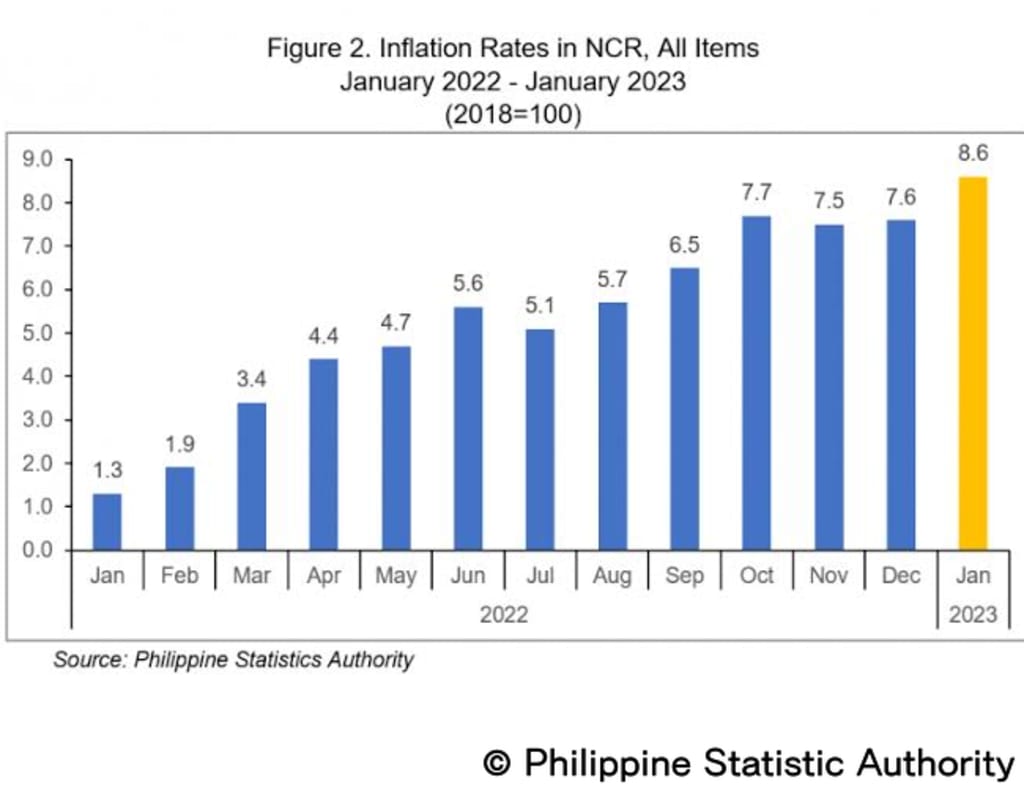
Inflation rate in Philippines (January 2022 - January 2023)
Philippine Inflation Rate Soars to a New High in January 2023, Putting Pressure on Consumers and Businesses Alike

The Philippines is a rapidly growing country in Southeast Asia with a population of over 100 million people. The country has experienced significant economic growth in recent years, with a Gross Domestic Product (GDP) growth rate of 6.1% in 2019. However, one of the challenges that the Philippines faces is high inflation, which can have negative impacts on the economy and the lives of its citizens.
Inflation is the rate at which the general level of prices for goods and services is rising, and it is typically measured by the Consumer Price Index (CPI). In the Philippines, the inflation rate has been a significant concern for policymakers and citizens alike in recent years. In 2018, the country experienced a significant inflation rate of 5.2%, which was the highest in almost a decade. This led to rising prices of goods and services, which can be especially challenging for lower-income families who may struggle to afford basic necessities.
One of the primary drivers of inflation in the Philippines is food prices. The country is highly dependent on food imports, and disruptions to global food supplies can lead to significant price increases. In addition, the Philippines is prone to natural disasters such as typhoons and droughts, which can damage crops and disrupt food supplies.
Another factor contributing to inflation in the Philippines is the depreciation of the Philippine peso. When the value of the currency decreases relative to other currencies, it can lead to higher import costs, which in turn can lead to higher prices for goods and services. The Philippine peso has been relatively volatile in recent years, and this has contributed to higher inflation rates.
In response to the high inflation rate, the Philippine government has taken several measures to try to address the issue. The country's central bank, Bangko Sentral ng Pilipinas (BSP), has raised interest rates several times in recent years to try to curb inflation. In addition, the government has implemented measures to increase food supply and stabilize food prices, such as providing subsidies to farmers and importing additional food supplies.
Despite these efforts, the inflation rate in the Philippines remains relatively high. As of April 2023, the inflation rate was 4.6%, which is still above the government's target range of 2-4%. However, this is a significant improvement from the high rates seen in 2018.
In conclusion, the inflation rate in the Philippines has been a significant challenge for the country in recent years. The country's dependence on food imports, natural disasters, and currency fluctuations have all contributed to high inflation rates. However, the government has taken measures to try to address the issue, and while the inflation rate remains elevated, it has improved from its peak in 2018. Continued efforts to stabilize food prices, increase food supply, and manage currency fluctuations will be important in reducing inflation and promoting economic stability in the Philippines.
The Philippine economy has been on a roller coaster ride in recent years, with inflation being one of the key indicators of its performance. In 2022, the country witnessed a period of relatively stable inflation, but the trend seems to have shifted in the early months of 2023.
In January 2023, the inflation rate in the Philippines soared to a new high of 6.9%, according to the Philippine Statistics Authority. This was the highest inflation rate recorded in the country since 2018, when inflation peaked at 6.7%. The sudden surge in prices has put pressure on Filipino consumers and businesses alike, as they struggle to keep up with rising costs.
One of the primary drivers of the inflation rate increase is the persistent rise in global oil prices. This has caused a domino effect, with higher transportation costs leading to increased prices for goods and services across the board. In addition, supply chain disruptions caused by the COVID-19 pandemic have led to shortages of certain products, further driving up prices.
The Philippine government has taken measures to address the inflation rate surge, including reducing import tariffs on certain goods and releasing additional funds for social programs aimed at supporting vulnerable populations. The country's central bank, the Bangko Sentral ng Pilipinas, has also raised interest rates several times in an effort to curb inflation.
Despite these efforts, it remains to be seen whether the inflation rate will stabilize in the coming months. If it continues to rise, it could have significant implications for the Philippine economy, including reduced purchasing power for consumers and increased costs for businesses. The government and central bank will need to remain vigilant and responsive to changes in the economic landscape in order to keep inflation under control.
About the Creator
Author’s Advice
If you would’ve asked me 20 years ago did I know I’d become a writer and an author, I would’ve said “nope, ain’t happening”. As fate would have it I did become an author and I can honestly say I’m loving it so far. It really does feel good to be a writer. I’ve learned a lot on this journey and I feel like with even me being as new to this world as I am, there’s some wisdom I need to share with every other aspiring author.
By Joe Patterson5 days ago in Journal



Comments
There are no comments for this story
Be the first to respond and start the conversation.