
How to Speed Up Mobile App Development with Agile
Accelerate mobile app development with Agile by prioritizing iterations, collaboration, and continuous feedback. Stay flexible, adapt quickly, and deliver faster!
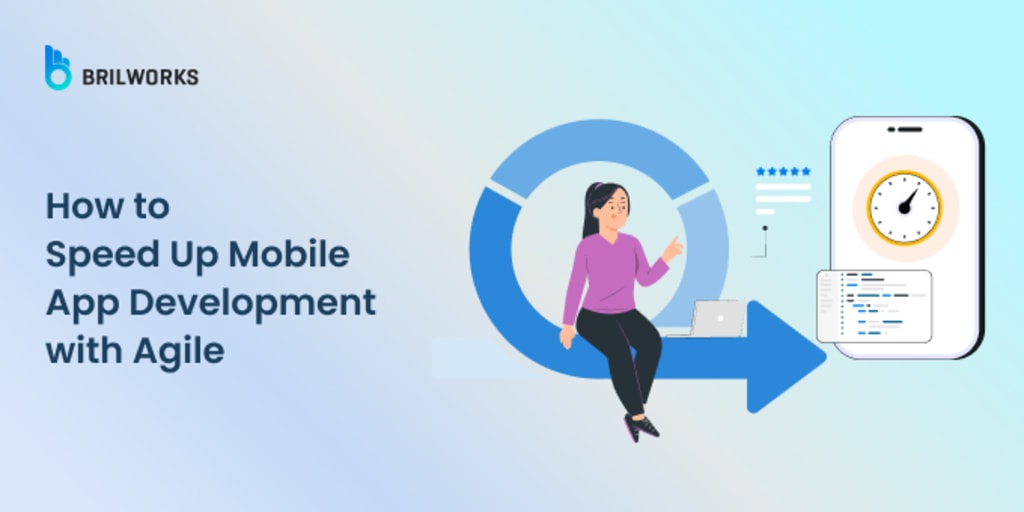
Mobile development comes with a variety of approaches. There are many methods you can use as a mobile app development company, like Agile, Waterfall, DevOps, low-code, no-code tools, and more. These software development methods exist because every project is unique. Someone might plan to an MVP or an app that needs regular updates or even a one-time application. That’s why there are different development methods that exist today.
Don’t chase what’s best or popular-choose what truly fits you. There’s no best approach that fits everything perfectly. However, some methods are very popular among mobile professional developers, such as Agile development.
When you start your mobile application development journey, you will come across this term frequently. In this article, we’ll explore why agile development is so well-liked, what it really is, and how it helps in building applications more efficiently. While Agile is known for being one of the most effective ways to create applications quickly, it does ask for a commitment to standard practices. We’ll touch on that as well.
Let’s begin. First, what exactly is Agile development? Then, we’ll walk through its key components, and after that, we’ll look at how it improves the mobile application development experience. Then, we’ll share some valuable tips for mobile app development you can pair with your Agile deployment strategy.
For founders and startups, picking the right technology stack and deployment methods is absolutely critical. These choices shape your development costs and timeline. That’s why thoughtful planning is important. When the foundation is solid, you’re more likely to hit your goals on time.
What is Agile Development?
Simply put, it is a project management framework that breaks a project down into several dynamic phases, which it calls sprints. The Agile method employs a cyclic methodology whereby what has been accomplished is reviewed, improvements are sought, and those improvements are carried through to the next iteration.
Its process of making these continuous iterations is such that the development team will finish one sprint, then another, and so forth. Now, let’s take a fresh look at mobile app development with a truly Agile mindset. An Agile mindset is a flexible process built on iterative cycles and continuous feedback to create high-quality applications that are concerned with changes in user needs.
1. Requirement Analysis
This first phase aims to understand the app’s prime function. What does it solve? Who is its target audience? What are its key features and functionalities that will add value to that perspective?
This collaboration of stakeholders includes business owners and users with the development team to gather requirements from these different perspectives, considering business goals, understanding user needs, and keeping track of current market trends. This information will set the groundwork for the next phases of development.
2. Planning and Prototyping (Design)
Once the vision is clear, the team sets out to plan the development process. It involved breaking the project into smaller portions, also known commonly as “sprints.” This stage involves drawing the initial prototypes, which could include everything from simple sketches to more sophisticated interactive mockups to visualize the app’s user interface (UI) and user experience (UX). This phase is important to define the look and behavior of the app:
- UI Design: Creating the visual elements and layout of the app, including screens, icons, buttons, and navigation.
- UX Design: Focusing on a smooth and seamless user experience, ensuring the app is intuitive and efficient.
- Technical Design: Developing a roadmap for the technical aspects, including features, functionalities, system architecture, data models, APIs, and third-party integrations.
- Interaction Design: Defining how users will interact with the app and how it will respond to user inputs.
3. Iterative Development
This is the heart of the Agile process. The development team works in short sprints, typically lasting 2–4 weeks, to build and test specific features. Each sprint results in a working increment of the app, which is then reviewed by stakeholders.
This iterative approach allows for continuous feedback and adjustments, ensuring the app evolves in the right direction. Daily stand-up meetings (scrums) help the team stay synchronized and address any roadblocks.
4. Testing
Testing is integrated throughout the Agile development process, starting from the early stages and continuing through each sprint. Agile emphasizes automated testing to streamline the process. Various tests are conducted to verify user experience, functionality, performance, and other critical aspects:
5. Deployment
The deployment phase involves releasing the app on various platforms. Final testing is performed to ensure the app is fully functional. User training, release scheduling, and communication also occur during this stage.
6. Review
The post-deployment review evaluates app performance and takes user feedback into account to address points of improvement. The feedback is channeled into planning updates and enhancements. This continuous review process allows the app to conform to user expectations and stay competitive.
Four Pillar of Agile Development
There are some core pillars in this methodology, as follows;
The first pillar is teamwork and collaboration. Agile teams value working together rather than independently. It’s all about collective effort.
In this development approach, the team working on the project can get direct guidance from customers.
The agile team doesn’t focus too much on documentation. While documentation has its place, the priority is on actual software development.
Agile is highly flexible. The development team can shift their strategies as needed.
What is Iterative Development?
Let’s say you’re developing a mobile app. With iterative development, you might start with a core set of features, like user login and basic navigation. This first iteration, or “Minimum Viable Product (MVP),” can be released to a small group of users for testing.
Based on their feedback, you might add features like push notifications and social media integration in the next iteration. And so on, until you have a fully featured app.
What are Sprints in Agile Development?
Let’s say you’re developing a website. Instead of trying to build the entire website at once, you might break it down into sprints.
- Sprint 1: Focus on building the homepage and basic navigation.
- Sprint 2: Develop the “About Us” and “Contact” pages.
- Sprint 3: Implement user login and registration.
Each sprint results in a working piece of the website, allowing you to get feedback early and make adjustments as needed.
Agile sprints rely heavily on rapid feedback loops to optimize the development process. The short, time-boxed nature of sprints (typically 1–4 weeks) necessitates immediate insights into the working increment’s quality and functionality. This urgency drives a “shift-left” testing approach, where testing becomes an integral part of each sprint.
Developers are incentivized to write unit tests before or during development, providing immediate feedback on code correctness. Integration testing also occurs more frequently, catching issues between components early. Defined acceptance criteria for user stories drive development and testing, often through automated acceptance tests.
Sprints often integrate with CI/CD pipelines, triggering automated builds, tests, and deployments at the end of each sprint. This provides immediate feedback on build status, automated test results, and deployment success. The focus on working increments and frequent feedback makes it harder to accumulate technical debt, as teams are compelled to address issues promptly.
Feedback from each sprint informs planning for the subsequent ones, resulting in better estimation accuracy and predictability. The sprint review meeting creates an atmosphere for collaboration among the stakeholders, leading to wiser decisions being made.
An Effective Agile framework for mobile app development
Let’s explore some of the most effective Agile frameworks commonly used in mobile app development.
1. Scrum
Scrum is very popular because it organizes projects in short and focused cycles called Sprints that usually last from two weeks to four weeks. It is a flexible framework, thus making it very well-suited for projects in which the end product can be expected to evolve over time. As the project progresses and results become clear, better adjustments can easily be made.
During the sprint period, a small, collaborative team will work towards the goals described in the sprint plan and will be supported by a Scrum Master, who holds daily meetings to detect and remove roadblocks and improvements to maintain a steady flow toward timely completion.
2. Kanban
This Agile framework is another very widely used one, and it emphasizes the visualization of the workflow for enhanced transparency at each stage of the project. Projects are divided into distinct workflows, with the progress tracked by monitoring the status of individual tasks.
A Kanban board typically serves as the visual representation of work items, with the columns reflecting various stages in the workflow: To Do, In Progress, Testing, and Done. An important option is limiting Work in Progress, which controls the number of tasks that any given team member might undertake at one time. This helps to optimize the use of resources while also keeping individuals from being overloaded.
3. Lean
This Agile framework aims to maximize value while minimizing waste. The guiding principle is to eliminate anything that adds no value to the work in order to make the development process more efficient. Lean insists upon continuous improvement for software quality and short cycles, thus increasing customer satisfaction. Lean discourages excess work in progress that can choke development and degrade quality.
4. Extreme Programming (XP)
XP is an Agile approach with an emphasis on the consistent improvement of product quality. It stresses close collaboration between the development team and the customer, who gives regular feedback that is employed by the developers almost instantaneously.
An iterative approach that repeats itself guarantees that the product is well-aligned with changing needs. XP stresses starting with large projects and breaking them down into smaller, manageable tasks, as well as the frequent release of working software, thereby allowing the teams to deliver good quality code and adapt to changing requirements.
5. Adaptive Project Framework (APF)
Adaptivity flexibility in project management is the key essence of APF. This fact demonstrates that, as the technology changes dynamically, it will adjust in the course of the project to possible demands and changes in the project due to shifting client preferences or market changes.
Unlike adhering to a rigid plan, APF employs a dynamic, iterative approach. In this case, the development team regularly evaluates the project goals, priorities, and requirements, enabling them to adapt to any changing circumstances.
In this case, you’ll want to include customers, development team personnel, and users in your stakeholder collaboration to make sure that the final product meets the expectations.
What to Plan and Consider in the Pre-development Phase
You’ll also need to plan its features. Start by outlining the must-have features in the initial stage and keep the nice-to-have ones for later. This helps if you want to stay within budget or build a good product without overspending. If you’re not very familiar with the market, consulting a professional app development company can be a good option.
Most companies focus on building an MVP to launch their product faster. A functional MVP helps you understand user and market sentiment, such as what’s working and what needs improvement.
Value and budget planning is a crucial phase. Cost shouldn’t be the only deciding factor. Once you’ve finalized the cost and features, you’ll also need to refine your development process. Sprints play a key role here, so it’s good to establish a standard approach. Typically, sprints last around 2–3 weeks.
Agile methodologies maximize collaboration and efficiency through cross-functional teams. They consist of people with diverse skills (e.g., designers, developers, testers, product managers) working together in a single team.
This allows for seamless communication with minimal dependencies on external teams and nurtures a common understanding of project goals, thus expediting decision-making. Full integration into the team enhances Agile principles of self-organization and rapid adaptation, as the team can manage its own work autonomously and react quickly to changes in a project’s requirements.
Cross-functional teams, therefore, are able to cover the entire sprint process, from the planning and design phases up until development and testing. This goes along with shorter sprint cycles and more frequency in delivering development increments.
These cross-functional teams, therefore, align very closely with the entire Agile culture of communication and feedback, resulting in much better quality products. Besides, for cross-functional teams, shared responsibility is in addition to what Agile expects under the principle of collective ownership, which also creates a sense of responsibility and promotes continuous improvement through frequent retrospectives.
Read the full article here.
About the Creator
Vikas Singh
Vikas is the Chief Technology Officer (CTO) at Brilworks, leads the company's tech innovations with extensive experience in software development. He drives the team to deliver impactful digital solutions globally.
Keep reading
More stories from Vikas Singh and writers in Journal and other communities.
15 Best Mobile Application Testing Tools for 2025
Let’s face it-mobile apps are everywhere. From ordering food to managing finances, we rely on apps for almost everything. But here’s the catch: if an app crashes, lags, or feels clunky, users won’t think twice before hitting the delete button. In fact, studies show that Over half of users (51%) would completely stop using an app if they encountered a bug on a daily basis, while 32% would abandon the app immediately after experiencing a single glitch. That’s why testing your mobile app becomes a crucial part.
By Vikas Singh11 months ago in Journal
Large Protests Against Donald Trump’s Policies Continue — Why the Movement Keeps Going Viral
Across major cities in the United States and Europe, large-scale protests tied to Donald Trump’s policies and political influence continue to dominate headlines and social media timelines. From packed city squares to viral protest signs, livestreams, counter-demonstrations, and trending hashtags, the story refuses to cool down.
By Omasanjuwa Ogharandukun4 days ago in Journal


Comments
There are no comments for this story
Be the first to respond and start the conversation.