
How to End the U.S. Labor Shortage Problem
Using a Home-Based Solution


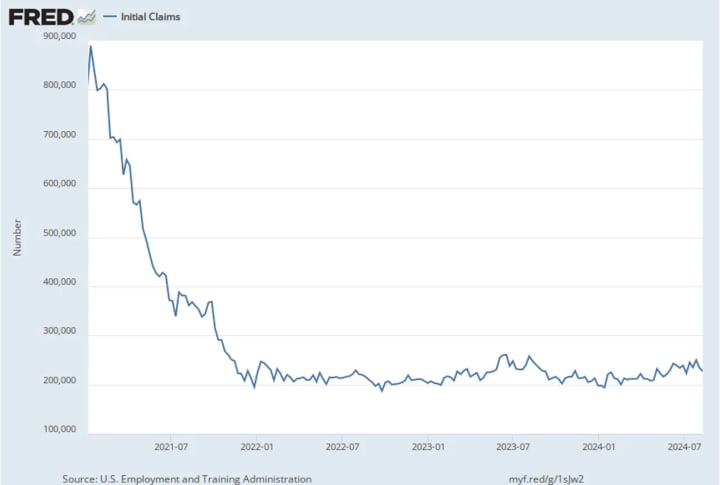
Many economy watchers wonder why U.S. Initial Claims data continue to hover below the 250 to 300 thousand level, which has historically signaled a recession might be imminent or in progress. One reason this hasn’t happened yet is that the U.S. economy continues to be plagued by a shortage of workers despite the recent rise in the unemployment rate from 3.4% to 4.3% due to the ongoing mismatch of job skills. This means job training is still needed because many workers do not have the skills required to meet the hiring needs of employers.
On a positive note, a Global Workforce 2024 Survey revealed that many employers are willing to retrain workers who are no longer needed in their current positions! This may be one reason why the Initial Claims data have yet to rise to the critical levels consistent with the onset of a recession!
U.S. Faced Severe Labor Shortages After the Global Pandemic
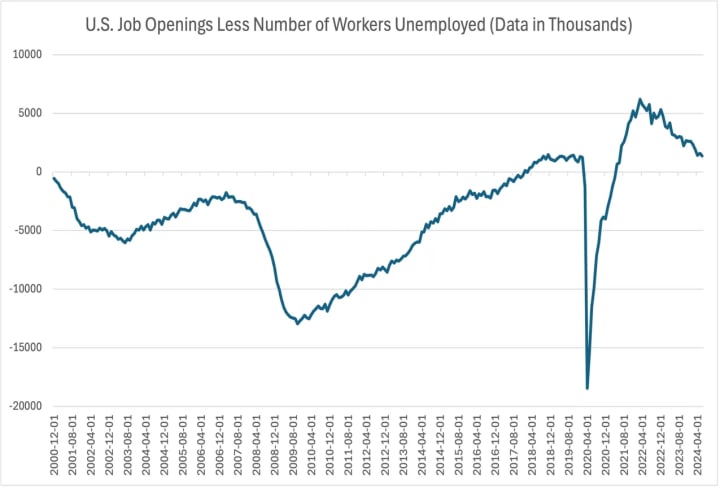
After the global pandemic, the U.S. labor market desperately needed a large labor force infusion to satisfy the demand needs of U.S. companies. At its peak in March 2022, U.S. Job Openings exceeded the number of unemployed workers by a staggering 6.2 million, underscoring the situation's urgency.
The strategy to address this issue was the controversial but impactful entry of immigrant workers who were granted U.S. temporary work visas. We make no judgments about this strategy and leave it to the reader to decide whether they thought this was a good or bad idea.
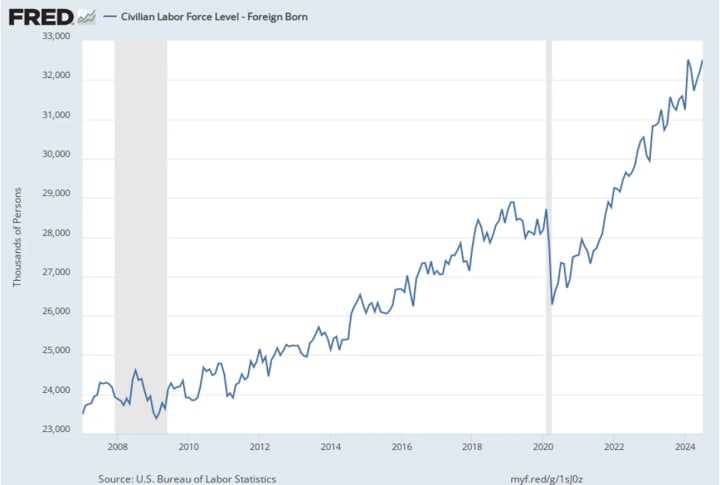
Focusing on the numbers, the Bureau of Labor Statistics finds (see Chart below) that immigration increased the number of foreign-born workers in the U.S. Labor Force from 26.3 million (April 2020) to 32.5 million (July 2024), representing an additional 6.2 million workers. Although this significant addition to the U.S. labor force was not enough to eliminate the existing shortage of U.S. workers, it went a long way toward reducing the gap between the demand and supply of workers.
However, despite this large influx of foreign-born workers, the latest numbers from the Bureau of Labor Statistics reveal that with the growth of the U.S. economy, we still face a shortage of 1.4 million workers, measured as the difference between the number of U.S. Job Openings and the number of workers looking for jobs and counted as unemployed.
A Homegrown Solution
One homegrown solution to this last-mile labor supply shortage challenge is represented by the Reform Alliance (RA), which is supported by Meek Mill (famous Rapper), Jay-Z (music giant), Michael Rubin (CEO of Fanatics), Robert Kraft (CEO of Kraft), Robert F. Smith (CEO of Equity Vista Partners), Clara Wu Tsai (Co-Owner of Brooklyn Nets), Laura Arnold (Co-Chair of Arnold Ventures) and Michael Novogratz (CEO of Galaxy Investment Partners) who are all founding partners or Board Members of this organization.
The RA seeks to “transform probation and parole [system] and culture to create real pathways to work and wellbeing.” The goal is to create a system that minimizes the number of technical parole violations. A Columbia University study found that in New York, incarcerating individuals for parole violations costs the state $683 million. Nationwide, the costs are pegged at $2.8 billion each year.
The goal is to minimize these technical violations so that these individuals can reenter society. With its commendable efforts, the RA has successfully facilitated the passage of 18 bills across 11 states that improve this transition for paroled inmates.
Since 2019, the Reform Alliance project has positively impacted about 800,000 people who could rejoin the U.S. labor force. With the continued success of this program, we can continue to make significant strides in satisfying the excess demand for workers that have not been filled by immigration, using our U.S.-born population.
The efforts will also undoubtedly transform and enhance the lives of the 75,000 people across the United States who are incarcerated each day for technical parole violations. Imagine the benefits of helping these individuals avoid incarceration as we move toward integrating them into our workforce and enable firms to satisfy their excess demand for labor so that they can operate their businesses with greater ease.
This undoubtedly is a low-hanging fruit solution, given that many inmates spend time upgrading their skills while in prison. As this initiative receives greater recognition, it will further incentivize inmates to take in-prison training programs more seriously and become productive citizens after paying their debt to society.
About the Creator
Anthony Chan
Chan Economics LLC, Public Speaker
Chief Global Economist & Public Speaker JPM Chase ('94-'19).
Senior Economist Barclays ('91-'94)
Economist, NY Federal Reserve ('89-'91)
Econ. Prof. (Univ. of Dayton, '86-'89)
Ph.D. Economics
Reader insights
Nice work
Very well written. Keep up the good work!
Top insights
Compelling and original writing
Creative use of language & vocab
Easy to read and follow
Well-structured & engaging content
Masterful proofreading
Zero grammar & spelling mistakes
On-point and relevant
Writing reflected the title & theme
Keep reading
More stories from Anthony Chan and writers in Journal and other communities.
Fleeting Leaves
Autumn leaves drift down, Beauty fades as time rushes Life, too, feels so brief.
By Anthony ChanExclusive • 6 months ago
Review of 'Man on the Run'
My wife and I saw Man on the Run, a nearly 2-hour documentary on Amazon Prime, about Wings, Paul McCartney's group that flew around the world from shortly after The Beatles broke up in early 1970 to shortly after John Lennon was murdered at the end of 1980, making a Beatles reunion forever impossible.
By Paul Levinson7 days ago in Beat


Comments (1)
I really love your content and how it's crafted , I love it and happily subscribed , you can check out my content and subscribe to me also , thanks for this beautiful one