
How to Choose Between Mainland, Free Zone, and Offshore Company Setup in the UAE (2025-26 Guide)
A complete 2025 guide to understanding Mainland, Free Zone, and Offshore business setups

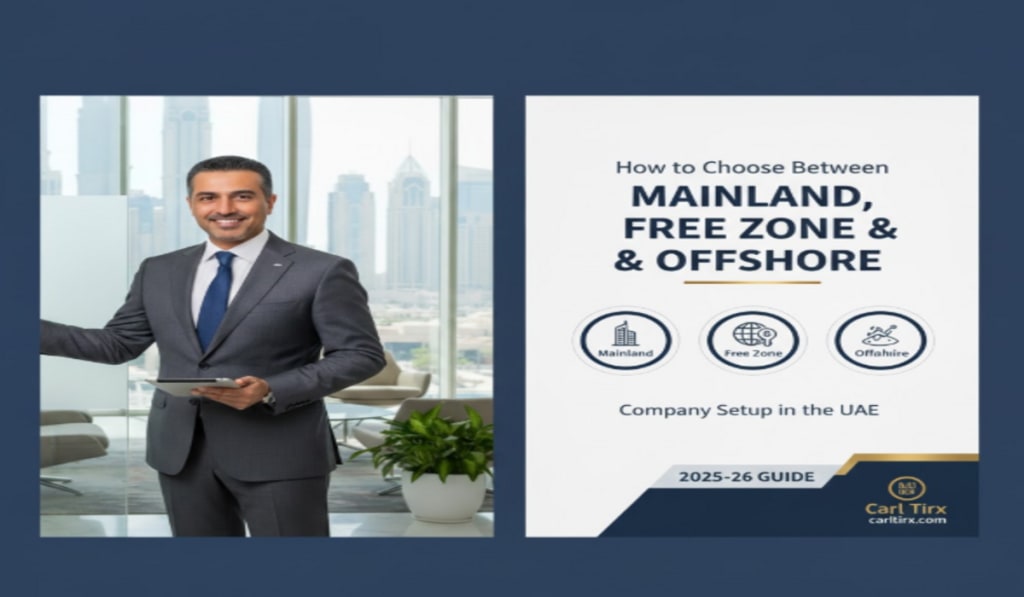
It's never been easier to start a business in UAE. But it can also be confusing. Entrepreneurs often find it difficult to select the best structure for their needs, with so many options available, such as Mainland and Free zone.
Each option has its own advantages, tax structures, and ownership rules. In 2025, when key regulatory changes will occur, such as the 9% corporate income tax and foreign ownership of 100% and the new compliance rules. Making a wise choice now can save time, money and future headaches.
This detailed guide will help you decide what setup is best for your business. We'll cover everything from ownership, taxation, market access, compliance and visa eligibility.
1. Why the UAE is still the best place to start a business in 2025
The UAE has earned a reputation for being the capital of entrepreneurialism in the Middle East. The government of the UAE continues to implement reforms designed to attract foreign investment and simplify licensing.
The UAE will be a standout in 2025 because:
Foreign ownership is allowed in full for the majority of business activities.
Corporate Tax (9%) is only applicable to profits above AED 375,000.
Digital Transformation has made the business registration and visa process faster.
A stable economy and a strong currency (AED), give investors confidence.
Strategic Location connects Asia, Europe and Africa.
Understanding the differences between these three types of structures will help you to avoid costly mistakes.
2. What are the three main types of company setup in the UAE?
Mainland Company Setting Up
The Department of Economic Development of every emirate issues a license to a mainland company. This allows companies to operate in the UAE as well as internationally.
Perfect for:
Business that wants to open retail stores in the UAE, trade directly on the UAE market or bid on government contracts.
Key Benefits:
- Access to the UAE market
- No restrictions on trade within the country
- Work with semi-government or government entities
- Multiple visa quotas depending on office space
- Option to 100% foreign ownership in most activities
Requirements:
You must lease a physical location
UAE tax and labor regulations must be adhered to
Setup of a Free Zone Company
A free zone company is a business that operates in a special economic zone designed to attract international investment.
Free zones are independently regulated and offer incentives, such as exemptions from tax, full ownership and simplified business rules.
Perfect for:
Business that do not require direct sales in the UAE mainland.
Key Benefits:
100% foreign ownership
Zero import/export duties
Personal Income Tax
Tax exemption for corporations on income qualifying
Simple setup (some zones will approve in 2-5 days).
100% profit repatriation
Limitations:
Cannot trade with UAE mainland directly (without a distributor local)
Restricted only to activities allowed by the Free Zone authority
Offshore Company Formation
Offshore companies are formed by jurisdictions like RAK Offshore and JAFZA Offshore. These companies are primarily used for asset-protection, holding investments or international trade.
Perfect for:
Investors and businesses who are looking to maximize their tax savings, but also want global reach.
Key Benefits:
100% foreign ownership
Tax-free profits and Capital Gains
No need for a physical office
Minimum compliance obligations
Open multiple currency bank accounts
Limitations:
You cannot trade or operate in the UAE
Visas for UAE residents are not available to all nationalities
3. What is the best option for you?
Compare the three structures based on the most important factors for decision making:
A. Mainland Access: Full Market Access to UAE and International Market
Free zone: Only for international and re-export business
Offshore - Only global transactions (no UAE market trading)
B. Mainland: 100% foreign ownership (in most sectors)
Free Zone: 100% foreign ownership guaranteed
Offshore: 100% foreign ownership
C. Taxation in 2025
Mainland: 9% corporate tax above AED 375,000 profit
Free zone: 0% of qualifying income, 9% for non-qualifying
Offshore: No tax but ESR is required
D. Office & Visa Requirements
Mainland: Physical office required; unlimited visa potential
Free zone: Virtual office or shared office is allowed with limited visa quotas
Offshore No Office; No Visa Sponsorship
E. Business Activities
Mainland - All types including retail, services, trading and other business.
Free zone: Industry specific (e.g. logistics, tech. media, finance, etc.)
Offshore: Investments, holdings, and global trade only
F. Setup cost & flexibility
Mainland Mainland: More flexibility, higher cost
Free zone: Low cost and easy renewal process
Offshore - Lowest price, but Limited Functionality
4. Why Choose a Mainland Company Establishment
If you want to:
Want to target the local UAE markets
You need to hire employees and sponsor visas
Plan to Bid for Government Tenders
You intend to open physical retail branches or stores
Companies based on the mainland also make it easier to expand your business - you can set up branches in different emirates and abroad.
Pro tip:
Your activity may fall under Professional Services, such as consulting, IT or engineering. You can still enjoy 100% Ownership on the mainland, even without a sponsor.
5. What to consider when choosing a free zone company setup
Select a free zone if:
Selling services or products beyond the UAE mainland
Want tax free operations on income qualifying?
You don't need to have a large retail or office space
Plan to return all profits to your home country
Popular free zones in 2025 include
Dubai Multi Commodities Centre (DMCC)
IFZA Dubai
RAKEZ (Ras Al Khaimah Economic Zone)
Sharjah Media City (Shams)
Abu Dhabi Global Market (ADGM)
Selecting the correct zone can help you save money and avoid future compliance issues.
6. Why choose an offshore company setup?
You should consider an offshore setup if:
Want to invest in or hold shares of other companies
Need a tax efficient holding structure?
Operating a global consulting or trading business
Protect your assets and privacy
Investors choose JAFZA Offshore or RAK ICC because of their trustworthiness and access to the UAE financial system. Offshore companies are allowed to open Multi-currency Accounts, and can own property within designated areas.
Remember that offshore entities are not allowed to trade in the UAE, or hire employees.
7. Legal & Compliance requirements (2025 updates)
The UAE has aligned its compliance standards with global financial regulations.
What you need to know
Economic Substance Regulations: Offshore Free Zones and Offshore entities must show genuine business activity.
Ultimate Beneficial ownership (UBO) : All businesses must declare their real ownership.
Registration for Corporate Tax: Mainland companies and Free Zones must register to pay corporate tax.
Accounting & audit: Mainland companies and the majority of Free Zones must maintain annual financial statements.
Documentation is essential to avoid penalties or suspension of business licenses if you do not comply.
8. The Cost of Each Setup
The cost of travel varies by activity and emirate. Here's a breakdown.
Mainland : AED 20.000 - 35.000+ (includes license & office)
Free Zone: AED 12,000 - AED 25,000+ (package dependent)
Offshore : AED 7,500 - AED 12,00 (no visa or office costs)
Before finalizing your structure, calculate the total costs, such as visas, renewal fees, and bank accounts.
9. How to Set Up Your Account - Step-by-Step Process
For Mainland Companies
Select your business (as per the DED list)
Reserve a trademark.
DED must first approve your application.
Rent a office and get tenancy approval.
Documents for the final license issue.
Open a business account and register for taxes.
Free Zone Companies:
Choose the license type and free zone.
Submit the application and KYC documentation.
License fees are payable.
Receive digital incorporation documents.
Open a bank and apply for a visa.
Offshore Companies:
Select jurisdiction (RAK ICC or JAFZA).
Submit documents for incorporation through a registered representative.
Get the certificate of incorporation
Open a bank account in multiple currencies.
10. Why Hire a Professional Consultant like Carltrix
In order to set up a business in the UAE, you will need legal documents, regulatory approvals and coordination with banks.
A professional firm like Carltrix Corporate Services ensures:
- Comply with the current laws
- Setup faster with zero errors
- Transparent cost estimation
Expert advice on Free Zone vs Mainland vs Offshore
Support from start to finish (license, visa and bank account).
You can save yourself weeks of time by following the right advice.
11. The Key Takeaways
Options for UAE company formation are dependent on the business objectives, activities, and location.
Companies from the mainland provide full market access to the UAE.
Setups offer tax exemptions as well as global trading freedom.
Offshore Companies Focus on privacy, tax efficiency and asset protection.
Foreign ownership of UAE companies has been widely allowed (100% in many cases).
UAE VAT & Corporate Tax 2025 Rules differ by jurisdiction.
For accurate advice, always consult a licensed consultant.
12. Final Verdict: Which company structure is best for you?
Offshore is the best option if you are looking to hire local staff or target UAE customers.
Each structure has a specific purpose, and making the right decision can help your UAE business become more compliant, sustainable, and profitable.
Are You Ready to Launch a UAE Business?
Carltrix Corporate Services can help investors register a business in as little as 3-7 days. Get personalized advice on jurisdiction, licensing type, and bank setup.
Book your no-obligation business consultation by visiting www.carltrix.com.
About the Creator
Adnan Sheikh
Adnan Sheikh is a seasoned Business Setup Expert and Corporate Consultant based in the UAE, dedicated to guiding local and international investors through the complexities of company formation.
Keep reading
More stories from Adnan Sheikh and writers in Journal and other communities.
Office Solutions, Local Sponsorship & Nominee Services: Supporting Business Growth
Starting and running a business in the United Arab Emirates involves more than securing a trade license. Entrepreneurs must also address practical and legal requirements such as office space, ownership structures, and compliance with local regulations. For many investors—especially those new to the UAE—office solutions, local sponsorship, and nominee services play a key role in ensuring smooth business operations.
By Adnan Sheikhabout a month ago in Journal
The Business Model of a Modern Internet Influencer
A decade ago, being an internet influencer sounded like a side hobby. Today, it is a legitimate business model with structured revenue streams, marketing strategies, analytics dashboards, and long-term brand positioning. What began as casual content creation has evolved into a sophisticated digital enterprise.
By Scott Andery3 days ago in Journal



Comments
There are no comments for this story
Be the first to respond and start the conversation.