
How SEO Teams in India Approach Long-Term Search Growth?
A ground-level look at how Indian SEO teams build search visibility that survives algorithm shifts, AI-driven search changes, and rising competition.

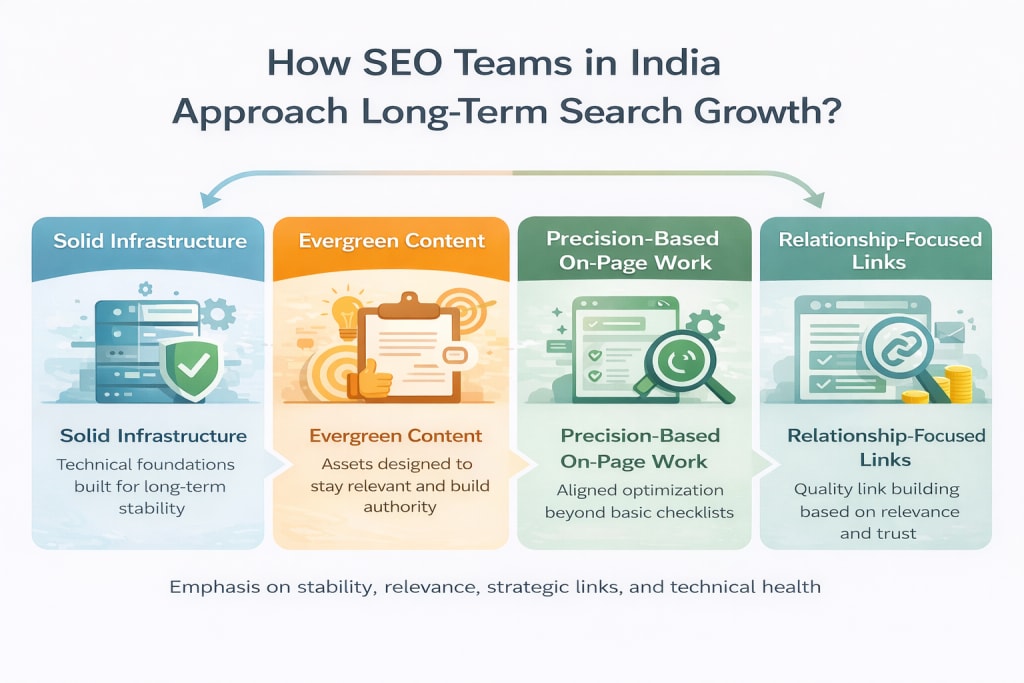
Search growth in 2026 is no longer about quick ranking wins. Indian SEO teams have moved away from short cycles and reactive tactics. What matters now is durability. Rankings that survive algorithm shifts. Traffic that compounds instead of spiking and collapsing. Trust signals that grow quietly over time.
This shift did not happen overnight. It came from years of volatility. Core updates. Helpful content filters. AI-driven search layouts. Each wave removed shortcuts. What remained was a slower, more disciplined approach.
This is how long-term search growth is actually handled on the ground by mature teams across India.
Long-Term SEO Starts With Infrastructure, Not Keywords
Indian SEO teams rarely start with keyword lists anymore.
They start with systems.
Before a single page is planned, teams look at site architecture, crawl paths, indexation behavior, and historical technical debt. Many long-term failures trace back to poor foundations built years earlier.
Common early audits focus on:
- URL consistency and parameter control
- Internal linking depth
- JavaScript rendering behavior
- Core Web Vitals stability across templates
If these are unstable, content efforts stall no matter how strong the writing is.
This is one reason established firms prefer gradual rollouts. They stabilize the platform first, then scale content once the system can support growth.
Content Is Treated as an Asset Class
Indian teams now budget content like infrastructure, not campaigns.
Instead of producing pages to chase short-term rankings, they design content assets meant to stay useful across multiple algorithm cycles. Each page is expected to attract links, support internal navigation, and remain relevant without constant rewrites.
Long-term content planning usually includes:
- Topic clusters built around real service depth, not isolated keywords
- Supporting articles that strengthen core service pages over time
- Scheduled revision windows to keep material aligned with evolving search intent
Within the broader ecosystem, terms like seo agency India tend to appear incidentally in foundational pages or industry discussions, not repeated across content. Mature teams treat such phrases as labels search engines already understand, allowing the surrounding material to carry the real signal through depth, structure, and clarity.
That restraint is one reason their content remains stable while more aggressive pages fluctuate.
On-Page Work Is Precision-Based, Not Formulaic
The old checklist approach is largely gone.
Indian SEO teams working on long timelines focus on alignment rather than density. Headings are structured to guide users through decisions. Internal links are placed to pass context, not just authority.
Modern on-page workflows emphasize:
- Search intent sequencing
- Entity consistency across the site
- Readability under AI-generated summaries
- Clean semantic structure without over-optimization
LSI signals come from natural coverage of related concepts such as technical SEO services, organic search growth, digital marketing strategy, website optimization, and content performance analysis.
This allows pages to rank across broader query sets without being rewritten every year.
Technical SEO Is Maintained, Not “Fixed”
One major difference in long-term strategy is mindset.
Technical SEO is no longer treated as a one-time cleanup. It is ongoing maintenance.
Indian teams often set quarterly technical review cycles. These include crawl comparisons, index trend tracking, and performance regression checks after deployments.
Key areas monitored long-term:
- Crawl budget distribution
- Server response patterns
- Mobile performance under real traffic
- Log file analysis for search bots
This prevents slow decay, which is far more damaging than sudden drops.
Link Building Has Shifted Toward Relationship Depth
Short-term link acquisition still exists, but it is no longer the growth engine.
For sustainable results, Indian SEO teams invest in fewer but stronger connections. These come from industry publishers, data-backed studies, and long-form resources that attract citations naturally.
Common long-term link sources include:
- Original research and surveys
- Technical explainers referenced by developers
- Market analysis content reused by journalists
Outreach focuses on relevance and credibility rather than volume. This reduces volatility when link-related updates roll out.
Measurement Is Multi-Year, Not Monthly
Another major change is how success is tracked.
Traffic spikes are treated cautiously. Indian teams look for trend stability over six to twelve months. Keyword movement is analyzed alongside engagement data and conversion paths.
Long-term dashboards usually track:
- Indexed page growth versus traffic growth
- Keyword spread across intent categories
- Returning user behavior
- Assisted conversions from organic search
This helps teams understand whether growth is structural or temporary.
AI Is Used for Scale Control, Not Content Flooding
AI tools are part of modern SEO workflows, but their role is limited.
Indian teams use AI to:
- Analyze large datasets
- Identify content gaps
- Support internal research
They avoid mass content generation without human review. This restraint has become a competitive advantage as search engines grow better at filtering low-effort pages.
Human oversight ensures tone consistency, accuracy, and real value. This keeps long-term trust signals intact.
Client Education Is Part of the Strategy
One overlooked factor in long-term growth is expectation management.
Indian SEO teams spend significant time educating stakeholders. They explain why results compound slowly and why shortcuts often backfire. This reduces pressure to chase unsafe tactics during slow periods.
Clear communication protects the strategy as much as any technical choice.
Why This Approach Works Over Time
Long-term search growth depends on alignment.
Alignment between:
- Platform stability and content quality
- Search intent and business goals
- Technical health and publishing pace
Indian SEO teams that succeed over years focus on this balance. They build systems that absorb algorithm changes rather than react to them.
The result is quieter growth. Slower in the beginning. Much harder to displace.
Final Thoughts
Search growth in 2026 rewards patience and structure.
The teams that last do not chase every update. They prepare for them. They treat SEO as a long-term operational function, not a marketing trick.
This is why experienced firms in India continue to be trusted for sustained organic visibility across competitive markets.
FAQs
How is long-term SEO different from short-term SEO campaigns?
Short-term SEO focuses on rapid movement. It targets narrow keyword gaps, quick content production, and fast link acquisition. These tactics can work briefly, but they are fragile.
Long-term SEO is built around durability. Indian teams plan for multi-year relevance by strengthening site structure, intent coverage, and content depth. Rankings are expected to hold through core updates, not collapse when algorithms change.
The difference is not speed. It is survivability.
Why do Indian SEO teams prioritize technical foundations so heavily?
Because technical weaknesses compound over time.
Issues like crawl inefficiency, poor internal linking, or unstable performance metrics may not hurt immediately. Over months and years, they limit how much content a site can support. Indian teams have seen many projects fail because growth was attempted on unstable platforms.
Stabilizing infrastructure early allows content and authority to scale without friction later.
How do Indian teams decide which content is worth creating long-term?
They evaluate content by lifespan, not just search volume.
Pages are chosen based on whether they can remain relevant for years, support multiple related queries, and strengthen topical authority. Content that requires constant rewriting is deprioritized unless it supports a core theme.
This is why fewer pages are often produced, but each one carries more strategic weight.
How often do long-term SEO strategies change?
The strategy rarely changes. The execution does.
Indian SEO teams usually lock the core direction for twelve to eighteen months. Adjustments happen at the tactical level, such as updating content depth, refining internal links, or expanding clusters based on new search behavior.
Frequent strategy resets are treated as a warning sign that the foundation was weak.
What role does link building play in long-term search growth?
Link building supports long-term growth, but it is no longer the driver.
Indian teams focus on earning links through credibility rather than volume. This includes research-backed content, industry explainers, and resources that naturally attract citations.
This approach reduces dependence on aggressive outreach and lowers risk during algorithm updates targeting link manipulation.
How do Indian SEO teams measure success over time?
They measure patterns, not spikes.
Instead of reacting to weekly ranking changes, teams analyze trends across quarters. They look at how traffic distributes across pages, how users return, and how organic search assists conversions.
A stable upward curve over months is valued more than sudden jumps followed by drops.
How is AI actually used in long-term SEO workflows?
AI is used to support thinking, not replace it.
Indian teams rely on AI for large-scale analysis, intent grouping, and identifying content gaps. They avoid using it to publish unchecked content at scale because trust erosion is hard to recover from.
Human review remains essential to protect quality and credibility.
Why is patience such a big part of SEO success in India?
Because competition is intense and margins are thin.
Indian teams have learned that shortcuts create volatility. Clients who understand this allow strategies to mature without pressure to force results prematurely.
This patience enables cleaner execution and more consistent outcomes over time.
Can long-term SEO still work in highly competitive niches?
Yes, but only with realistic timelines.
In competitive markets, long-term SEO focuses on gradual authority building rather than aggressive targeting. Progress may feel slow initially, but once momentum builds, it becomes difficult for competitors to displace.
This is where experienced teams deliver the most value.
When should a business consider working with a long-term focused SEO team?
When organic traffic is expected to support revenue for years, not months.
Businesses that rely on consistent inbound demand, high trust signals, or complex buyer journeys benefit most. In these cases, working with an experienced seo teams helps align strategy with scale rather than short-lived visibility.
What is the biggest mistake companies make with SEO timelines?
Expecting linear results.
Search growth compounds unevenly. Long periods of quiet progress are often followed by strong gains. Indian SEO teams plan for this reality and structure reporting to reflect long-term health rather than short-term noise.
About the Creator
Jane Smith
Jane Smith is a content writer and strategist with 10+ years of experience in tech, lifestyle, and business. She specializes in digital marketing, SEO, HubSpot, Salesforce, web development, and marketing automation.
Keep reading
More stories from Jane Smith and writers in Journal and other communities.
Why Long-Term SEO Beats Paid Ads for Melbourne Businesses?
I didn’t notice the problem because anything was broken. The app launched. Features worked. Metrics looked fine. Yet every time we added a new way for users to interact with the app, something subtle shifted. Small bugs appeared. Edge cases multiplied. Fixes took longer than they used to.
By Jane Smith2 months ago in Journal
Dick Rating Guide For OnlyFans Creators With Examples
Dick Rating Guide For OnlyFans Creators | Everything You Need To Know About Dick Reviews Are you ready to master the art of giving dick reviews to your OnlyFans community? Do you want to read a guide that discusses everything about dick reviews, including their types, important factors, and average pricing? If you answered yes, this is the perfect read for you.
By Intelligent Creator7 days ago in Journal


Comments
There are no comments for this story
Be the first to respond and start the conversation.