
How ratan tata become the India's richest man with big heart
Ratan tata
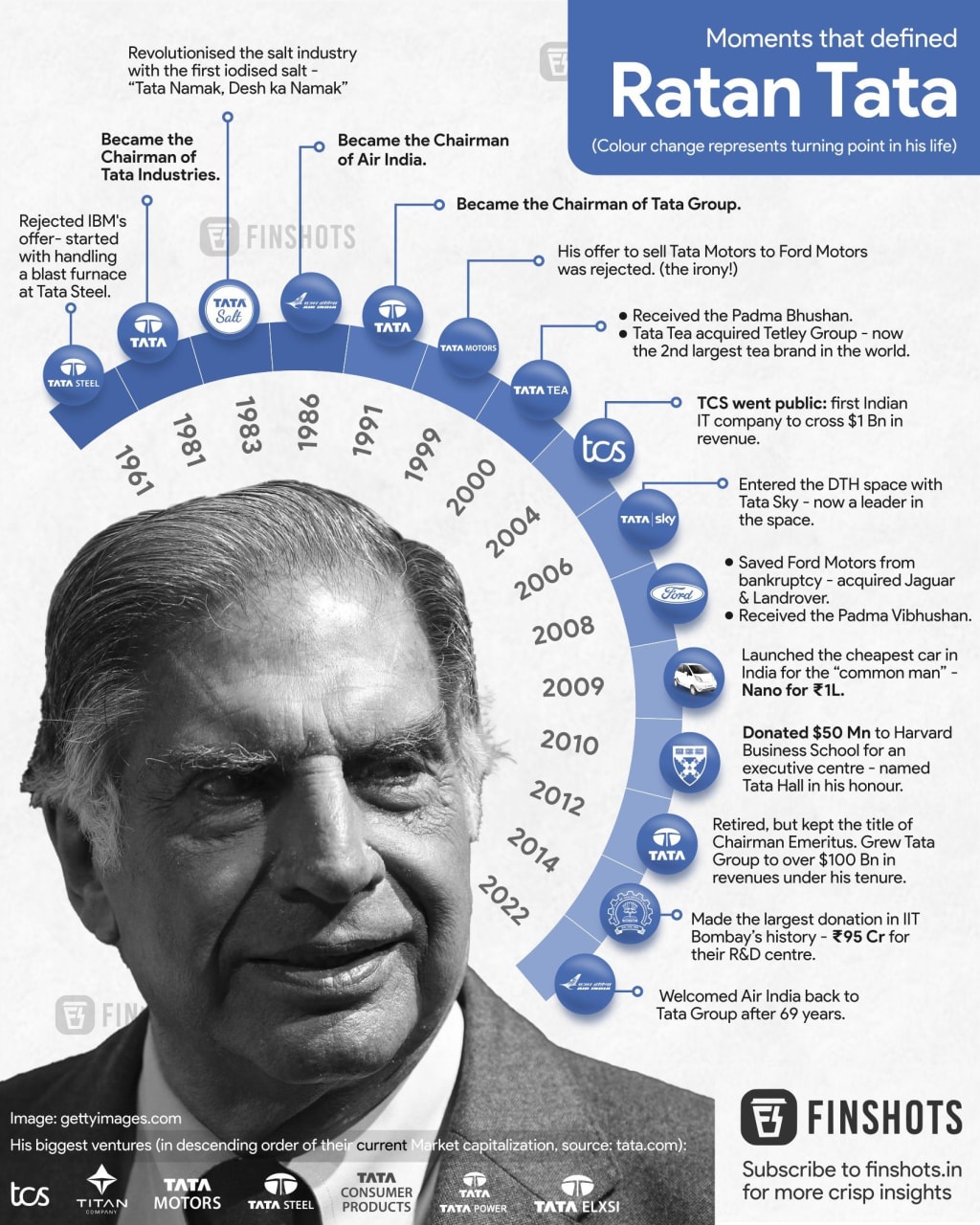
Start writin..it is impossible to talk about the Indian business scene without mentioning Ratan Tata. From his early days working at Tata Steel to his transformational leadership as the chairman of Tata Sons, Ratan Tata has consistently been one of India’s most respected and admired business leaders. His incredible success, however, is not just a result of his shrewd business acumen; Ratan Tata is also known for his great heart and generosity. In this article, we will explore Ratan Tata’s life, career, and philanthropy, in an attempt to understand how he became the richest man in India with a great heart.
Early Life and Education
Ratan Tata was born in Mumbai on December 28, 1937, into one of India’s most prominent families. His grandfather, Jamsetji Tata, was the founder of the Tata Group, a multinational conglomerate with interests in steel, automobiles, telecommunications, and more. Ratan’s father, Naval Tata, was a well-known businessman in his own right, and his mother, Sooni Tata, was a social worker.
Ratan Tata spent his early years in Mumbai before moving to the United States for his education. He attended Cornell University, where he earned a degree in architecture and structural engineering. After Cornell, he went to Harvard Business School, earning an advanced management degree.
Early Career
In 1962, Ratan Tata started his career working at Tata Steel, one of the flagship companies of the Tata Group. He worked his way up the ranks, eventually becoming the director of the company in 1979. Under his leadership, Tata Steel saw significant growth and expansion.
In 1991, Ratan Tata was appointed chairman of Tata Sons, the holding company of the Tata Group. This was a transformative time for India, with the country undergoing significant economic liberalization and opening up to foreign investment. Ratan Tata saw this as an opportunity to expand the Tata Group’s reach and influence, and he set about transforming the group into a truly global corporation.
Transforming the Tata Group
Under Ratan Tata’s leadership, the Tata Group underwent a significant transformation, expanding into new industries and markets. One of the key acquisitions during his tenure was the purchase of Tetley Tea, a British company, for $430 million in 2000. This was followed by acquisitions of Corus, a British steel company, and Jaguar Land Rover, the British luxury car manufacturer.
Ratan Tata also oversaw the creation of Tata Consultancy Services, which has become one of the world’s largest IT services companies. Additionally, he initiated the development of the Tata Nano, the world’s cheapest car, designed to provide a safe and affordable means of transportation for millions of Indians.
All of these initiatives required significant investment, and Ratan Tata was able to secure financing through a variety of means. He restructured the Tata Group’s finances to raise capital for these initiatives, and he also reached out to international investors, including private equity firms and sovereign wealth funds. In 2008, when the global financial crisis hit, Ratan Tata was able to maintain the group’s stability and growth, while many other companies were struggling.
Philanthropy and Social Responsibility
While Ratan Tata certainly achieved incredible success as a businessman, he is also known for his philanthropy and social responsibility. Throughout his career, he has shown a great commitment to giving back to society and helping those in need.
One of the most significant examples of Ratan Tata’s philanthropy is the Tata Trusts, a group of charitable organizations that he oversees. The Tata Trusts are focused on a variety of causes, including education, healthcare, and rural development. Ratan Tata has personally donated over $50 million to the Tata Trusts over the years.
In addition to his work with the Tata Trusts, Ratan Tata has also been a vocal advocate for social responsibility in business. He has criticized companies that focus solely on profits at the expense of social and environmental impacts. He has also spoken out against corruption and unethical business practices, calling for greater transparency and accountability in the corporate world.
Personal Life and Legacy
Ratan Tata has never been one to seek the limelight, preferring to let his work and his deeds speak for themselves. Despite this, he is widely admired and respected, both in India and around the world. His personal life has been relatively private, although he has been known to enjoy classic cars and has a passion for aviation.
Ratan Tata retired as the chairman of Tata Sons in 2012, but he continues to serve as the chairman of the Tata Trusts. He is also involved in a variety of other business and philanthropic ventures.
In terms of his legacy, Ratan Tata will undoubtedly be remembered as one of India’s greatest business leaders. He transformed the Tata Group into a global powerhouse, while always maintaining a commitment to social responsibility and philanthropy. Although his business acumen is impressive, it is his great heart and generosity that truly set him apart.
Conclusion
Ratan Tata’s journey to becoming the richest man in India with a great heart has been a remarkable one. He has led the Tata Group through a period of significant change and growth, expanding the company’s reach and influence in ways that few thought possible. At the same time, he has never lost sight of the importance of giving back to society and working to make a positive impact on the world.
As we look to the future, Ratan Tata’s legacy is a reminder of the power of business to create change and make a difference. It is not enough to simply pursue profits; businesses must also take into account their social and environmental impacts, and work to create a better world for all. Ratan Tata’s example is a shining one, and his great heart will continue to inspire generations to come.
About the Creator
Keep reading
More stories from Sakshi Verma and writers in Journal and other communities.
Why women enpowerment is compulsory
St writing...Gender equality is a basic human right, and it is also fundamental to having a peaceful, prosperous world. But girls and women continue to face significant challenges all around the world. Women are typically underrepresented in power and decision-making roles. They receive unequal pay for equal work, and they often face legal and other barriers that affect their opportunities at work.
By Sakshi Verma3 years ago in Education
The goals I did not achieve
Every writing goal I made for the year is a wash. It has been this way for a while, but I think it's important to be open about my failures and the reality of how life can get in the way. This is especially true considering the several times I have posted on Vocal about my writing goals, how I was changing my approach, and where I was hoping to be for the upcoming year. I will probably do that again in a couple months, but for now, it is time to acknowledge where I am today.
By Kay Husnick23 days ago in Journal
The Hour the World Went Quiet
It began with a flicker. Not of light, but of absence. The hum of my devices—the soft chime of messages, the buzz of updates, the endless scroll of curated lives—simply stopped. At first, I thought it was a glitch. I tapped screens. Checked cords. Restarted everything twice. But the silence held.
By KAMRAN AHMAD4 days ago in Journal
The Devil's Cut
“Comrade, finally you’re awake.” The voice was smooth, sensual. A flickering incandescent bar was all that lit the white, sterile room. All Vladimir remembered was everything going black. He tried to move his arms and found them strapped to the gurney.
By Matthew J. Fromm4 days ago in Fiction


Comments
There are no comments for this story
Be the first to respond and start the conversation.