
How QR Codes Enhance the Shopping Experience in Retail Stores?
Revolutionizing Retail with QR Code Technology


Embracing QR codes into daily operations is nothing new for retailers. Small grocery shops and departmental stores use the technology mainly for seamless transactions, facilitating easy, cashless customer checkout. However, QR codes have so much more to offer.
Considering the current consumer trends and the rising number of smartphone users worldwide, this pixelated square technology has become an indispensable tool in today’s market. According to a Statista survey, 83% of retailers in the US and UK believed that their customers would choose other merchants if they stopped providing barcode and QR code options to the shoppers.
That’s something every retailer must be aware of.
How QR Codes Enrich Retail Shopping Experiences?
As a versatile tool, QR codes enhance customer experience by allowing contactless payments, omnichannel experience, virtual try-ons, discounts & deal offers, and more. Let’s explore more on this.
Contactless payments: QR code payments help customers simplify transactions by scanning their smartphones. They can make cashless and contactless payments through UPI and digital wallets. This allows shoppers to maintain hygiene during transactions and speed up checkout by reducing the need for cash or cards.
Detailed product information: QR codes on packaging allow customers to scan and access product specifications and ingredients. This allows customers to quickly read reviews, watch video tutorials, and make informed decisions before purchasing. Upon scanning, shoppers can also quickly complete product warranty registration after purchase.
Virtual try-on: Integrating Augmented Reality applications in QR codes, customers can virtually try on products before buying. This application suits retailers selling makeup and beauty items, furniture, decorative items, and clothes. With the virtual experience, customers can make better decisions about their purchases.
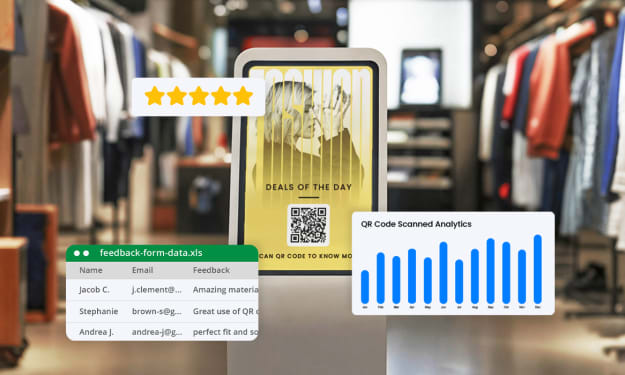
Instant customer feedback: Retailers can place a QR code at the exit door for instant customer feedback. Shoppers can share their experiences, good or bad, with the retail store just by scanning. This helps stores understand their weak spots and can improve on them for better customer service.
Omnichannel experiences: By implementing QR codes, retailers can offer offline and online shopping experiences through one platform. If some limited products are out of stock in physical stores, customers can check the product availability on the brand’s website with a smartphone scan. This helps increase customer satisfaction and shopping experiences.
Discounts and offers: Retail stores can attract customers by offering special discounts, sales offers, and coupons using QR codes in flyers, social media posts, and TV ads. Shoppers can claim those discounts and offers when visiting the store. Customers with good experiences are most likely to repeat purchases.
Self-service: In big retail stores, such as departmental stores, customers can scan a QR code and locate their preferred products in the store without the help of staff. This helps shoppers pick up their items quickly in the crowded store. For example, by scanning QR codes, shoppers can find the food outlets or navigate a menu before visiting the physical stores in a mall.
Best practice to use QR codes for retailers
Retailers should follow certain steps to use the QR code effectively—catching customer attention.
Clear call-to-action: Provide a clear and concise CTA next to the QR code. Let customers know well before scanning it. For discounts and offers, you can use CTAs like “Scan to avail yourself of 15% offers” or “Scan to explore product details” for product information.
Placement at high visibility: Position your QR codes where most customers can easily see them and display them in the correct location. For example, place your discount offer QR codes outside your store’s door and product QR codes next to the product.
Tracking QR code engagement: Continuously track customer interaction with the QR code to learn about their choices and preferences. Improve the CTA or placement of QR codes that receive less engagement.
Future of QR Codes in the retail industry
Without a doubt, QR codes have a bright future in the retail industry as these versatile tools have become an integral part of retail operations—payment to self-services for customer convenience. Another key aspect of QR codes is their significant contribution toward a sustainable environment, reducing paper use for storing information.
QR codes are cost-effective and easy-to-use tools for retailers that have unlocked smarter customer shopping experiences and improved satisfaction. Building trust and loyalty with consumers becomes easy when you provide convenience and high-value customer propositions.
About the Creator
Akrati Raina
Passionate about bridging the gap between technology and user engagement, I aim to share insights, strategies, and innovations that empower brands to thrive in the evolving digital landscape.
Keep reading
More stories from Akrati Raina and writers in Journal and other communities.
Revolutionizing Marketing with QR Codes: Bridging the Physical & Digital World
Incorporating QR codes into marketing strategies isn’t just a trend—but a key force revolutionizing how businesses engage with their audiences. One primary reason for the rising popularity of QR codes is they transform static marketing materials into interactive digital experiences, effectively linking the physical and digital worlds.
By Akrati Rainaabout a year ago in Journal
Why Ancient Goldsmithing Still Outperforms Modern Machines
In an age defined by automation and digital precision, it is easy to assume that machines have replaced traditional craftsmanship in nearly every industry. Jewellery, however, tells a different story. While 3D printers and computer-guided tools dominate headlines, one of the oldest techniques in metalworking continues to hold its ground: the lost-wax casting method.
By Md Mehedi Hasan Rifad5 days ago in Journal


Comments
There are no comments for this story
Be the first to respond and start the conversation.