
How People Get Rich Without a Normal Job
The many ways to get rich


The Meme Coin Millionaire
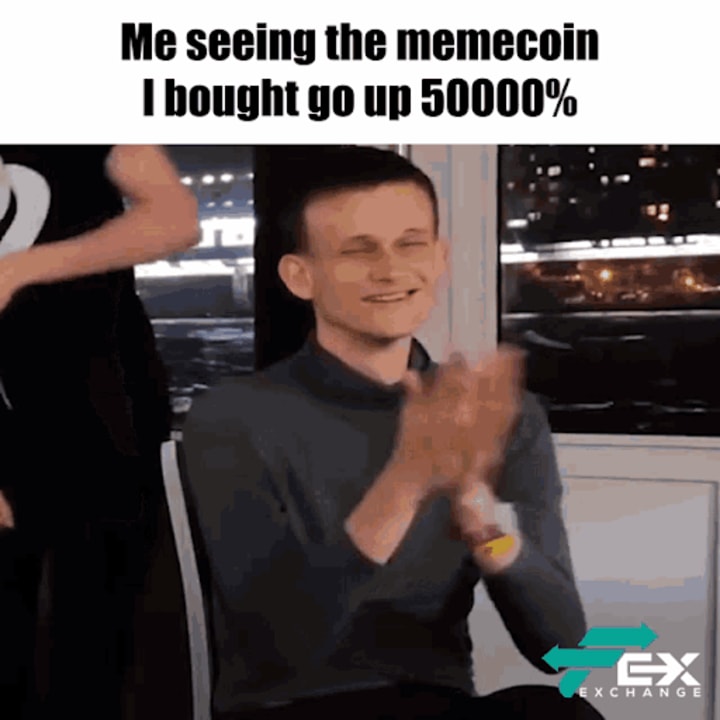
You're 16. It's late — the kind of late where you know you'll regret it tomorrow during the first period. You're already in bed, lights off, phone glowing in the dark, when the notification comes through.
Your friend: "buy this coin now."
You squint at the screen through half-closed eyes and tap the link. The name loads: ElonSperm. You actually laugh out loud into your pillow. Of course it's called ElonSperm. Every one of these coins has some unhinged name, and that's exactly what makes it feel legitimate.
You think about it for maybe two seconds, shrug in the darkness, and drop $100 on it. This same friend tipped you off about DogeButt a few weeks back and you actually made enough for lunch money. So why not?
You tap confirm, plug in your phone, and pass out.
A month goes by, You're mindlessly scrolling when a video thumbnail catches your eye — some finance bro in a tank top announcing, "Not financial advice, but ElonSperm just surged 89% overnight. We're going to the moon — literally swimming in gains."
You stop scrolling. ElonSperm? That sounds familiar. Wait. Did I buy that?
You open your crypto app and start digging through your neglected portfolio of forgotten garbage coins. And there it is. ElonSperm.
You tap the chart. It's not just up — it's practically vertical. Green candles stacked like Manhattan skyscrapers. You refresh three times just to confirm it's actually real.
Your $100 isn't worth $120. It's not even a few thousand. It's $3 million.
You just sit there, mouth hanging open, Then the reality settles in — you're actually a multimillionaire because you impulsively threw money at a coin with possibly the most deranged name imaginable.
So like most people, you immediately go buy a Lamborghini.
The Entrepreneur

You've tried everything. Ecommerce store collapsed after four months of fulfillment nightmares. A clothing brand launched with actual hype — sold exactly three hoodies, two of them to your wife. A Social media growth agency never even made it past the landing page.
But through every failure, every cringe-worthy pitch deck, and every time you opened your banking app to see a balance with fewer digits than your age, you kept going. You knew something would eventually work — not because you were delusionally optimistic, but because the alternative was terrifying.
Student debt. Cubicles. lighting humming above your head for eight hours straight. Forty years of slow, soul-crushing decline. No thanks, not for you.
So you sacrifice the safe route. You walk away from the guaranteed paycheck, slash expenses everywhere possible, subsist entirely on instant ramen and gas station coffee.
You work from a beat-up laptop in your childhood bedroom, teaching yourself to code through YouTube tutorials at 2 a.m., iterating through startup ideas until something finally gains traction.
And then — it happens. You launch an app that generates AI-powered horoscopes based on your Spotify listening habits. Does it make any logical sense? Absolutely not. But you are a marketing genius. Downloads start climbing.
A major tech company takes notice. An acquisition offer arrives in your inbox — $2 million. Just like that.
After all those sleepless nights and sodium-heavy dinners, you actually made it. You're financially free.
You could stop now. But you won't. Because the real win was never the money — it's the Grind.
The Quiet Rich
You show up to school, keep your head down, do exactly what's expected — not because you're chasing some grand vision, but because it's simply what people do. You graduate, step directly into a job, and from that moment forward it's go time.
You work every single day. Sometimes juggling two jobs. Sometimes grinding through seven-day weeks. You don't complain about it. You don't party it away. You don't chase dopamine hits or blow money trying to impress people who wouldn't notice if you disappeared tomorrow.
You just work, relentlessly. Like a machine that forgot how to turn off.
Your entire life runs on routine. You never eat out unless there's a coupon involved. Every piece of clothing comes from Temu or the clearance rack at Target. You survive on rice, frozen vegetables, and whatever meat got marked down because it's expiring tomorrow.
You're not trying to live your best life in your twenties. You're trying to purchase actual freedom.
After 15, maybe 20 years of this monastic existence, you actually pull it off. You do it.
By 40, you're completely debt-free, own your home outright, and your investment portfolio quietly generates enough passive income each year to fund your simple lifestyle.
You don't live in some sprawling mansion. You don't drive a Bugatti with custom plates. But you also don't answer to a boss anymore.
You live in a decent size, paid-off house. Your days belong entirely to you. You read books for hours. You play video games guilt-free. You take long walks without ever checking the time.
Wait. You're actually rich.
The Gambler
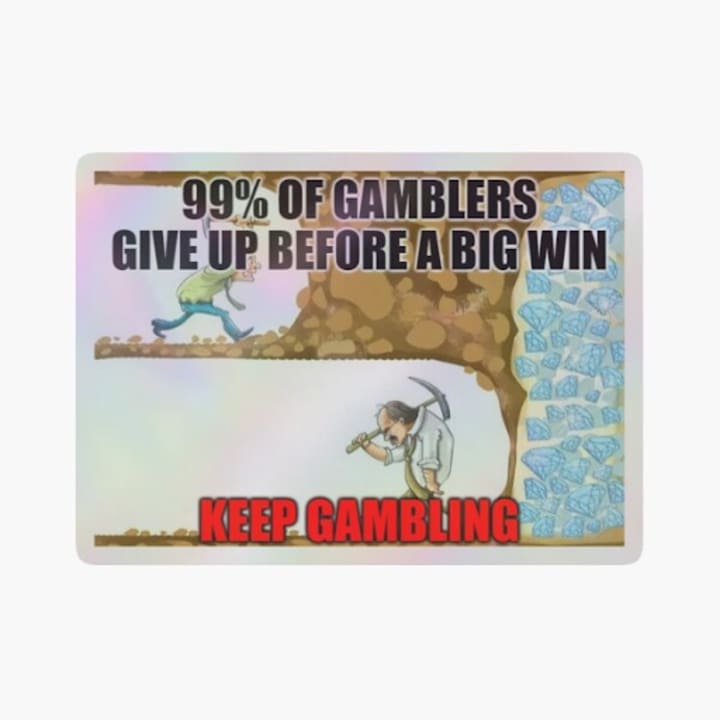
You walk into the casino with your nerves buzzing, palms damp, fully aware the odds are designed to destroy you. But you hear it — the hypnotic click of your favorite game. Roulette.
You slap down your entire $1,000 and pick black. The wheel spins. The ball bounvces and clacks around the rim. Everyone within earshot watches. It lands. Boom. Black. You're sitting at $2,000.
Most people would collect the win. Most people would walk away happy. But you're not most people, You let it ride. Black again. $2,000 becomes $4,000. Your hands start trembling now. Again. And again. $4,000 to $8,000. $8,000 to $16,000.
A small crowd starts forming around your table. You're not just gambling anymore — you're performing an act of financial insanity.
$1,000 becomes $32,000. Then $64,000. Then $128,000. Then $256,000. Thirteen consecutive blacks. Statistically absurd. Borderline supernatural. The entire table falls silent. The dealer stares at you like you've made a pact with something unholy.
You're at over $800,000 now. You take a breath, then push your entire mountain of chips forward. One final spin. Everyone around you stops breathing.
The ball bounces. Clinks. Rattles. Drops.
Black again.
You just turned $1,000 into over $1.6 million dollars.
This time, you walk. You cash out immediately. Your entire life has changed.
The Influencer
You start posting cringe Instagram Reels from your bedroom. Lip-sync trends. Fabricated story times. Whatever algorithm bait gets you views.
At first, your entire audience is literally your cousin and what appears to be several bot accounts. But you keep posting anyway. Slowly, the numbers start climbing.
Then one day, brands start sliding into your DMs. Your first actual deal? A print-on-demand T-shirt company hawking motivational quotes in Comic Sans. The shirts are objectively terrible — tissue-paper thin, shrink two sizes in the wash, feel like wearing cardboard.
You hype them up anyway. "Limited edition drop. Premium streetwear quality."
It works. You clear $10,000 from a single Reel.
From there, it becomes easy. Smart glasses that probably do nothing. Sketchy supplements with unpronounceable ingredients. You smile for the camera. You sell the dream. You collect the check.
If people actually buy it? That's on them. You're just playing the game everyone else is playing — you're just better at it.
The Streamer

The Freelancer
I tell people I'm a freelancer.
It started small and slightly desperate. A blog post for $50. A logo that took four hours and paid for groceries. The kind of work you do while your college roommate climbs the corporate ladder and sends you LinkedIn articles about "building your personal brand."
But then the gigs got bigger. The rates got real. And one day I realized I was making actual money while wearing pants I'd technically slept in.
Now my morning commute is eight feet. My boss is a vague sense of dread about invoices. And my office is wherever I can steal decent Wi-Fi — a coffee shop in Lisbon, my kitchen table, that one beach in Mexico where the internet somehow worked.
I set my own rates, which means I've Googled "how much should I charge for this" approximately 600 times. I pick my own clients and I never ask permission for time off, because there's no one to ask. There's just me, my calendar, and the creeping anxiety that I should probably be working right now.
Sure, I'm sometimes answering emails at 1 a.m. But that's only because I spent the entire afternoon watching YouTube videos about sourdough starters and convinced myself it was "research”.
Course Seller
I Sell Courses on How to Sell Courses
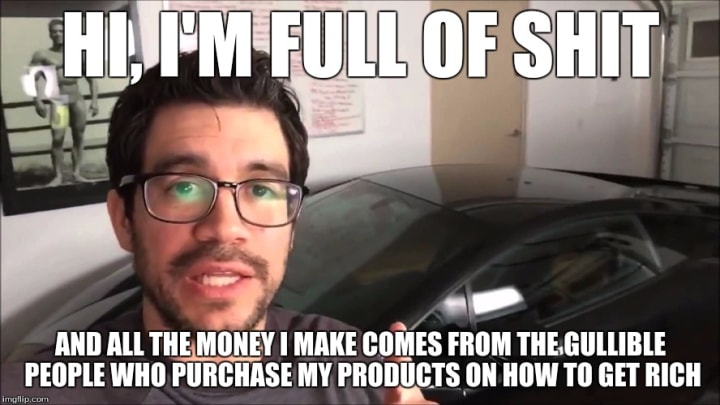
At some point, you realize the real product isn't a product at all. It's the idea of making money online.
I figured this out around month three of my "entrepreneurial journey," which is what we're calling unemployment now. I'd been trying to build an actual business—dropshipping, affiliate marketing, all the stuff people with ring lights told me would work. It didn't. But you know what worked? Talking about it.
So I did what any rational person spiraling through their savings account would do: I packaged my mediocre results into a "proven system," borrowed some phrases from people more successful than me, and declared myself a business coach.
The content strategy was to Film myself in front of cars I don't own. Take laptop-on-the-beach photos that suggest I work three hours a week. Use words like "scale," "leverage," and "passive income" until they lose all meaning. Promise freedom from the 9-to-5 grind to people who are so tired they'll believe anything.
The course costs $499. But there's always a "limited-time" discount, because apparently it's always 72 hours before the price goes up forever. It's been 72 hours for nine months now.
And people buy it. Not some people—a lot of people. They wire me money for information that absolutely exists on Reddit and YouTube, organized slightly worse and with more stock photos of sunsets. I'm making more selling the fantasy of escape than I ever made trying to actually escape.
Most of them won't make their money back. The math doesn't math. If everyone who bought my course started selling courses, we'd just be a pyramid scheme with better branding and a Kajabi subscription.
But every person who fails becomes a better customer. They're not disillusioned; they're almost there. They just need the next program. Advanced training. The inner-circle mastermind at $2,997.
I know what this makes me. I know what you're thinking. But I also know my conversion rate, my email open rate, and exactly how much I'll make this quarter.
And honestly? That's the only system that's ever actually worked.
Politician
How to Get Rich in Politics

There's a moment in every aspiring politician's career when you realize the path to wealth isn't building a business or climbing the corporate ladder—it's getting elected and then just... staying elected.
I started like they all do: at city council meetings that smelled like old carpet and broken dreams. Shaking hands at diners. Kissing exactly one baby, which was honestly enough. Making promises that sounded specific enough to be inspiring but vague enough to be unfalsifiable. "I'll fight for working families." Which families? Doing what? Don't worry about it.
I won by 18 points.
Suddenly, I had a government salary for showing up to meetings where people argued about zoning codes for 90 minutes. The pay was fine—not embarrassing, not impressive. Comfortable. The kind of money that makes your parents proud but your college roommate who went into finance smirk a little.
But the salary is just the base layer. The appetizer. The real entrée comes later, delivered through channels that are technically legal and definitely hard to explain at dinner parties.
Campaign donations that somehow never quite get spent. Consulting gigs that pay $40,000 for three phone calls with people who just happen to need legislative favors. Book deals for memoirs nobody reads but everyone buys in bulk. Speaking fees that cost more than most people's annual salary for an hour of recycled talking points.
And then there's real estate. Always real estate. Properties purchased by LLCs with names like "Prosperity Holdings" or "Freedom Ventures," which are definitely not connected to your brother-in-law, except they are, but proving it would require subpoenas nobody wants to file.
I perfected the art of the 20-minute speech that says absolutely nothing. It's a skill, honestly. You hit the inspirational notes—"opportunity," "future," "our children"—you pause for applause, you make a callback to the opening anecdote, and you exit before anyone can ask what any of it actually means.
It works. It works so well. I've been reelected five times using basically the same stump speech with updated statistics I don't verify.
Thirty years later, I'm worth $8 million on a salary that never topped $180,000. My financial disclosures are a creative writing exercise. My memoir is called "A Life of Service," which is technically true if you count serving yourself.
Half the people back home still think I changed their lives. The other half suspect something but can't quite articulate what. And I'm sitting by a pool that cost more than my childhood home, drinking something with an umbrella in it, thinking about my legacy.
About the Creator
Arsalan Haroon
Writer┃Speculator
Keep reading
More stories from Arsalan Haroon and writers in Journal and other communities.
What Hedge Funds are Shorting Right now
The vibes in the stock market are getting weird. Oracle's credit default swaps - basically insurance against the company going bust - are going bonkers. Even people who work in AI are starting to mutter that maybe, just maybe, things have gotten a little overheated. So naturally, investors are starting to wonder: Is it time to short something?
By Arsalan Haroon3 months ago in Journal
Eddie Gravalese: Navigating Business Strategy, Finance, and Real Estate With Long-Term Thinking
In an era where quick gains and rapid scaling often dominate business headlines, a growing number of professionals advocate for a different way of working—one rooted in thoughtful planning, disciplined decision-making, and sustainable outcomes. One such figure in this space is Eddie Gravalese, whose work spans business consulting, financial strategy, and real estate. Rather than promoting a singular success story or self-help narrative, his approach reflects broader principles that can be informative for anyone interested in strategic growth and responsible investment.
By Adria Hargrave4 days ago in Journal
This Is What I Do When People Throw Rocks At Me
Rocks have been thrown at me for a greater part of my life. Some have been small and missed hitting me. When people don't get a reaction from me, they throw bigger rocks with a better aim. Many have been hurled at me with precision over the years. For a long time, I thought my only options were to dodge them or be crushed by them.
By Margaret Minnicks5 days ago in Confessions



Comments
There are no comments for this story
Be the first to respond and start the conversation.