
How modern articulated trailed sprayers are good for vineyards and for the environment
And why is it suitable to you
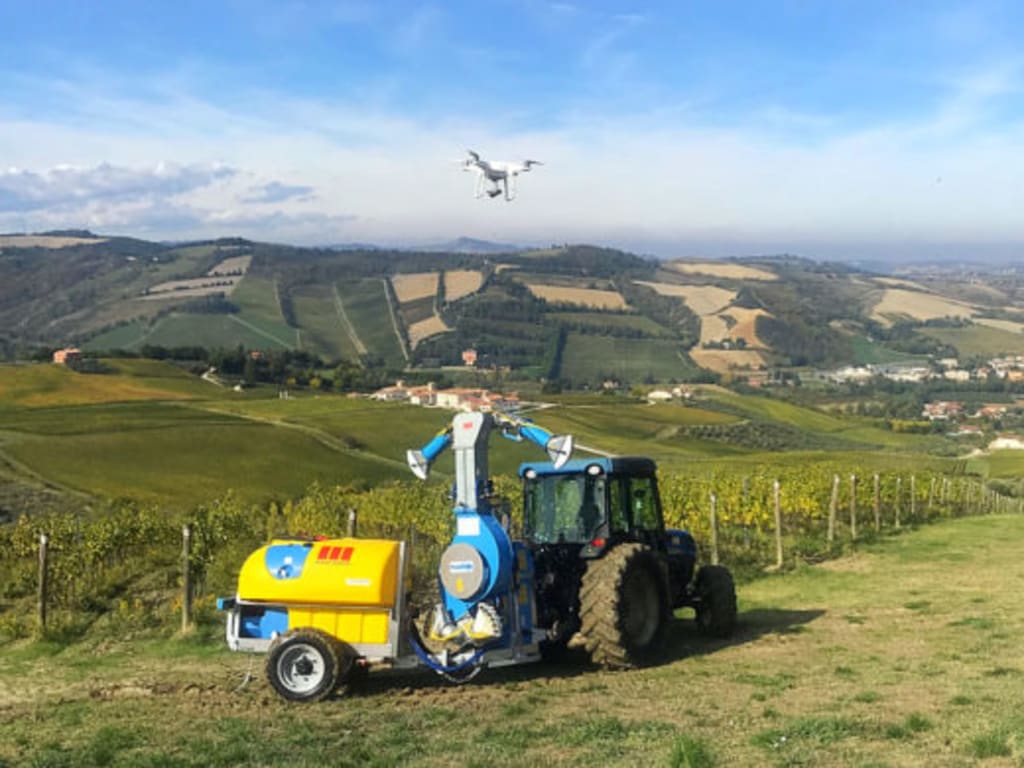
Articulated trailed sprayers have been around since the 1960s. They are efficient and adaptable to any type of crops, that's what allows trailed sprayers to have maximum performance with minimal maintenance costs.
SUITABLE LANDS FOR TRAILED SPRAYER
They are particularly suitable for the treatment of alternate rows of hilly vineyards with narrow passages because, thanks to the separate tank connected via a joint system, it allows great manoeuvrability without the use of homokinetic cardan shafts and or hydraulic articulated drawbars.
Articulated trailed sprayer often have steering radio of less than 6 meters and can articulate up to 90° (drive 6/90).
These sprayers can treat 4 vineyards walls simultaneously as the two lower diffusers treat the row in which the tractor passes, while the upper ones treat the rows alongside. This means a considerable time saving for producers because the steps in the vineyard are reduced exactly in half.
ADVANTAGES OF THE ARTICULATED TRAILED SPRAYER
• Water savings up to 90%
• Sustainable use of agro-chemicals: product savings up to 40%
• Electrostatic charge: reduction in drift losses + ZERO residues on fruit and wine
• Faster working speed: 50% time saving
• Reduced power consumption thanks to fan design (tractors required starting from only 40 HP in plain): fuel savings of an extra 20%
• Integrated pump-fan system
Capacity is another critical element: 1000 Lt (for up to 10 hectares of vineyards with a single tank refill) is recommended in the slope vineyards and 1500 Lt (up to 15 hectares of vineyards with a single tank refill) is recommended in the plains. It is suitable for road traffic and has a simple and easy maintenance system.
Accessories can include a retractable / reclining rear flap for product loading and tank inspection, and has better ergonomics too. For example, it can be used as a trolley for accessories / products, etc....
These revolutionary sprayers are ideal for crops in particularly difficult soils. Effective in treatments, fast and with great savings for the growers.
DIFFERENCES BETWEEN ELECTROSTATIC MIST BLOWER AND AIR BLAST SPRAYER
Images of fluorescent dye electrostatic mist blowing (200 l/ha) show impressive coverage:
Images of Air Blast fluorescent dye high volume spraying (1500 l/ha) show big droplets (run off) and uneven coverage:
ELECTROSTATIC MIST BLOWER (1) VS. AIR BLAST SPRAYER (2)
1. All the air sucked in by the dual intake blower is used
2. Only 2/3rds of the axial fan produces air: 1/3rd of the fan is not used although it requires power
1. Uniform air flow on all of the outlet section and perfectly directed air stream
2. The air turns round the impeller shaft, causing turbulence and non-uniform air stream at the outlet (the stream in mainly upwards on one side and downwards on the other)
1. The special streamlined design of the spray-heads directs the air almost with no loss of power
2. The air must suddenly turn through 90° causing a loss of speed and power of 20%
1. Continuous air stream of high speed and penetrative power, but without violence and turbulence
2. Heavy turbulence in the air stream causing great loss of speed and power
1. The two outlets can be turned through 90°, thus for every shape of tree the air stream can be directed individually to the most important parts of the tree
2. No adjustment or adaptation to the tree shape possible
1. Both heads can be directed in one direction: this doubles penetration so that perfect coverage is possible also under windy conditions
2. When working one sided, the liquid output on one side must be closed, the air capacity of this side will remain unused though power is absorbed
1. Straight flow air stream and the absence of turbulence gives a high output. Add to this the advantages of the many adjustments possible for single and double sided spraying the electrostatic mist blower can be considered as using 100% of the power required
2. It has a loss of power of 20% and 33% (see points 1, 2, 3) leaving only less than 50% which on the other hand is used inefficiently
1. DOUBLE AIR ACTION: uniform droplet production and transport of liquid (PNEUMATIC SYSTEM)
2. SINGLE AIR ACTION: only transport of the liquid divided into droplets of different size by the pressure nozzles (AIR CONVENYANCE)
About the Creator
Keep reading
More stories from writers in Journal and other communities.
The Early Church Fathers and Why Their Writings Matter Today
The Early Church Fathers are some of the most important figures in the history of Christianity. Their writings, letters, sermons, and theological reflections helped define the beliefs, practices, and structure of the Church in the centuries following Christ. Understanding who the Church Fathers were and why their works matter today is essential for anyone seeking to understand Catholic teaching, tradition, and the roots of Christian faith.
By Sound and Spirit7 days ago in Journal
The Devil's Cut
“Comrade, finally you’re awake.” The voice was smooth, sensual. A flickering incandescent bar was all that lit the white, sterile room. All Vladimir remembered was everything going black. He tried to move his arms and found them strapped to the gurney.
By Matthew J. Fromm7 days ago in Fiction
My New Book is Finally Here
My poetry collection Beautiful and Brutal Things is done. It's actually done and finally published over 270 pages. Over a year of my life went into this book. More than a year, really. Long days at my computer, sometimes seven days a week because I couldn't stop even when I probably should have. Then two months of editing that felt harder than the writing itself. But it's finished, and I'm still standing, and the book is real.
By Tim Carmichael4 days ago in BookClub



Comments
There are no comments for this story
Be the first to respond and start the conversation.