
How Ikea Builds A Winning Strategy
Strategy and The Future of What Ikea Builds

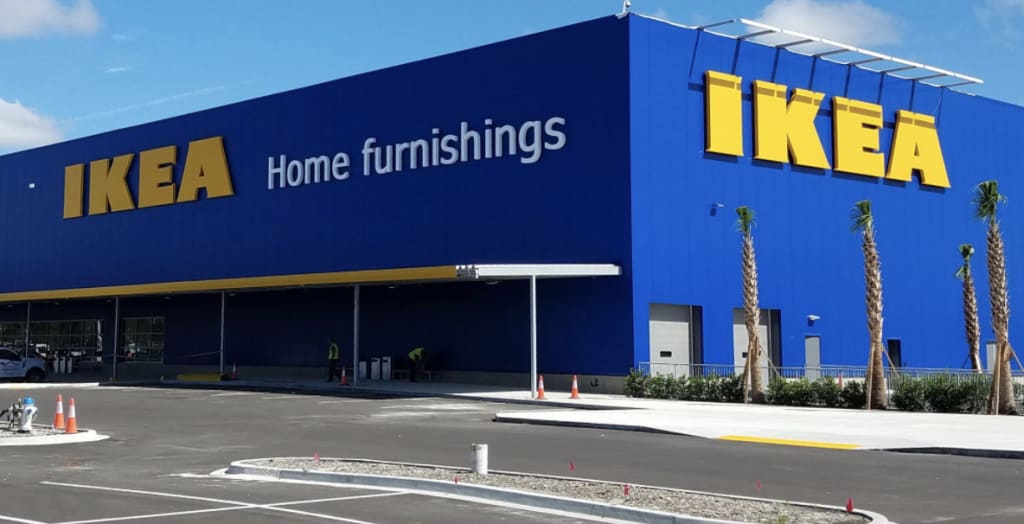
IKEA’s strategy is to sell low-cost, Swedish-inspired home furnishings to young buyers, specifically families who are furnishing their first home. They make products ranging from great ceiling fans to affordable bedding. 67% of their sales are in Europe, with the rest in North America (18%), Asia and Australia (10%), and Russia (5%), and high growth in the U.S., China, and Russia. Multiple internally consistent activities strengthen their strategy.
1. IKEA’s most effective activities strengthen its “low-price” Customer Value Proposition, while also reducing costs in order to bolster its “low-cost” Profit Value Proposition.
2. These cost-reduction activities include maintaining high-volume, fixed contracts from suppliers and keeping extra inventory on-hand to eliminate “expedited delivery” charges; helping their suppliers reduce costs by assisting with factory design, equipment, and quality control; buying from non-traditional suppliers who have excess capacity (e.g. using a shirt factory to supply cushions); exploring backward integration into furniture manufacturing to better understand and negotiate with suppliers; and leveraging cheap labor in Asia. IKEA invests heavily in R&D for the cheapest and most efficient product and packaging design, allowing their prices to drop over time instead of rise with inflation.
For example, repeated redesigns of the Billy bookcase over almost 30 years dropped the price from $98 in 1979 ($342 in 2016 dollars) to $69 in 2016. All of IKEA’s cost-savings measures, and their subsequently low prices, attract its price-conscious target customer and increase quantities sold. Despite being “low-price,” IKEA’s R&D and marketing activities produce a medium-quality, differentiated product and experience.
It creates this value through staunch adherence to its proven brand of Swedish minimalism, coupled with rigorous attention to the tastes and needs of its target customer.
While IKEA’s corporate structure lets the Inter IKEA group enforce the brand across franchises globally, IKEA also appeals to local tastes using calculated changes to the marketing, products, and in-store experience; for example, dressers sold in the U.S are made with larger drawers because Americans prefer to fold most of their clothes.
IKEA uses cross-functional design teams and human-centered design techniques to create stylish furniture that functions in its target customers’ homes. For example, its design teams visit homes thousands of times to see how each new product will be used, and each new product takes 3-5 years to perfect.
Lastly, in order to differentiate its in-store experience and encourage families to stay longer, IKEA offers a restaurant, children’s play area, and ample parking.
When IKEA opened its second store, it had few competitive advantages. It had long-term fixed contracts with suppliers and had a stock of goods in large warehouses. Competitive advantage stemmed from preemption, i.e. the sunk costs of the supply contracts and warehouses would deter new entrants. These supplier contracts also translated into bargaining power, meaning IKEA was able to secure furniture at cheaper prices than smaller competitors. By the end of the time period of the case, IKEA’s competitive advantage stems from economies of scale, economies of scope, accumulated investments and pre-emptive investments. IKEA is able to spread out the large fixed costs of R&D and design over many units. It also spreads out the fixed costs of building and running its service trading offices and highly automated distribution centers. By buying production capacity, it has moved the variable costs of buying from furniture suppliers to the fixed cost of capacity. These activities increase the Minimum Efficient Scale any competitor needs to match IKEA’s cost.
By selling a vast range of home furniture in a single location and offering matching furniture, IKEA creates economies of scope: a customer is willing to pay more for a bundle of items than for the items separately. The vast product range also reduces IKEA’s cost as the knowledge gained from building one type of furniture improves another type of furniture. These economies of scope also enable IKEA to spread marketing costs (like catalog costs) over 9,500 products.
IKEA blocked off key resources from competitors by copyrighting its catalog. By suing STOR, IKEA established a credible threat to its competitors that it would take legal action against companies copying its store layout and experience. IKEA has also incurred large sunk costs in long-term supplier contracts, production capacity and branding/advertising.
This means that competitors and potential entrants know that IKEA has incurred fixed costs for remaining in business, and would be incentivised to retaliate if competitors competed with IKEA directly.
IKEA’s accumulated investments in human-centered design, reduction of costs through iterative design, and advertising approach mean that it has spent many years accumulating and reaping the benefits of lower costs and a higher customer willingness to pay. Any new entrant would not have these experiences and the resulting cost and WTP gains, and thus, would be deterred from entering the industry.
About the Creator
Adam Naor
Senior Partner Manager — Startups @ Amazon. Helping WFHAdviser.com. Previously Cornell Tech, BRV Fund, Google.
Author’s Advice
If you would’ve asked me 20 years ago did I know I’d become a writer and an author, I would’ve said “nope, ain’t happening”. As fate would have it I did become an author and I can honestly say I’m loving it so far. It really does feel good to be a writer. I’ve learned a lot on this journey and I feel like with even me being as new to this world as I am, there’s some wisdom I need to share with every other aspiring author.
By Joe Patterson3 days ago in Journal
Top tipple tricks
Been thinking a lot about drinking, lately. Not least because of a recent episode of over-indulgence and the inevitable after effects. Some readers may recall the earlier articles I wrote about beating the booze. Here I set out an experiment in techniques for cutting down on my alcohol intake. The experiment was successful, the techniques worked, and I have armed myself with an arsenal of weapons in the war against the demon drink. I have yet to fire the first round however. It's all a question of timing (perhaps procrastination).
By Raymond G. Taylor5 days ago in Psyche




Comments
There are no comments for this story
Be the first to respond and start the conversation.