
How I.C.E. Shoots Renee Good and the Moment Minneapolis Broke
Inside the Shooting of Renee Good and the Moment Minneapolis Broke


Sometimes a single bullet does more than tear through glass.
Sometimes it shatters trust.
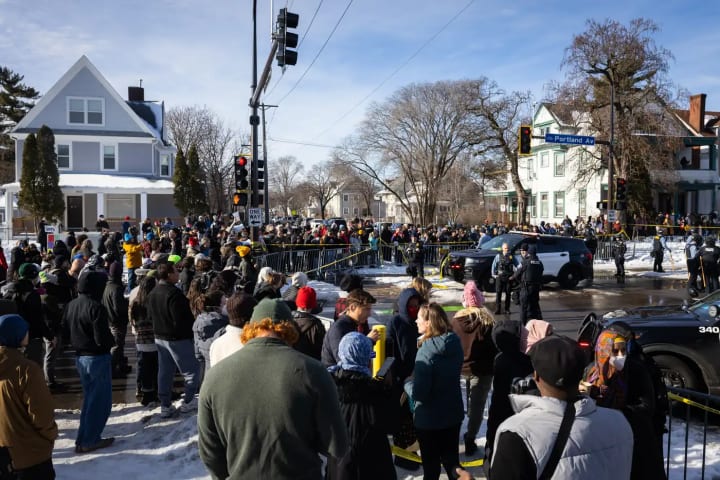
On a cold Wednesday morning in south Minneapolis, a maroon SUV sat awkwardly on Portland Avenue. Horns echoed. Whistles pierced the air. Federal vehicles clogged the street like stones dropped into a river. Then came the gunshots — sharp, final, irreversible.
By nightfall, the woman behind the wheel had a name: Renee Good, 37 years old. By then, Minnesota was already divided between two competing realities — one told by federal authorities, and another told by the people who stood feet away when her life ended.
This is the story of that rupture.
A Street Becomes a Stage
The shooting happened amid a dramatic escalation of federal immigration enforcement in Minnesota. Just one day earlier, the Department of Homeland Security announced what it called “the largest DHS operation ever” in the state, deploying thousands of federal officers across the Twin Cities.
For many residents, especially in immigrant communities, the surge felt less like public safety and more like occupation.
Neighbors had learned to recognize the signs: tinted windows, unmarked SUVs, out-of-state plates. When federal vehicles became stuck in a snowbank on Portland Avenue, people showed up — not with weapons, but with phones, whistles, and voices.
Among them was Renee Good.
“She Was Trying to Leave”
Federal officials say Renee Good attempted to ram ICE agents with her vehicle — a claim used to justify lethal force. But eyewitnesses interviewed by MPR News paint a dramatically different picture.
Betsy, a neighborhood resident who had just returned from walking her dog, said what she saw haunts her.
“She posed absolutely no threat,” Betsy said. “It looked like she was trying to leave.”
According to her account, federal agents surrounded the SUV. One agent stood near the driver’s side window, shouting. As Renee tried to move south on Portland Avenue — apparently attempting to get out of the chaos — the agent reached into the vehicle and fired multiple shots.
The SUV lurched forward and crashed into parked cars.
What followed, witnesses say, was silence — and then grief.
Neighbors wanted to help. A man identifying himself as a doctor asked to render aid. They were told to stand back. Witnesses say no immediate medical assistance was offered by federal officers.
To many watching, it felt less like law enforcement and more like abandonment.
Conflicting Orders, Fatal Seconds
Another eyewitness, Caitlin Callenson, described a moment of deadly confusion.
She said ICE agents gave Renee conflicting commands — one ordering her to drive away, another demanding she exit the vehicle while reaching for the door handle.
An agent stood in front of the car. Another was at the side. The margin for error — the human margin — collapsed to zero.
Shots were fired at close range.
Video of the incident quickly spread online, intensifying public outrage and undermining the official narrative of self-defense.
“You can see what happened in that video was not self-defense,” Callenson said.
Leaders Push Back: “A Garbage Narrative”
The response from Minnesota leaders was swift and unusually blunt.
Minneapolis Mayor Jacob Frey rejected ICE’s claim outright.
“The narrative that this was self-defense is a garbage narrative,” he said. “This was an agent recklessly using power — and someone died.”
Governor Tim Walz, who confirmed he had seen video footage of the shooting, echoed that assessment. He called the death “predictable and avoidable,” arguing that the aggressive federal presence itself created the conditions for tragedy.
“I’ve seen the video,” Walz wrote. “Don’t believe this propaganda machine.”
The Minnesota Bureau of Criminal Apprehension and the FBI have both confirmed investigations are underway.

A State in Mourning
As night fell, vigils spread across Minnesota — Duluth, Mankato, Rochester, Minneapolis. Candles flickered beneath winter skies. Voices trembled through bullhorns.
In Duluth, faith leaders urged peace without silence.
In Mankato, protesters demanded their city draw clearer lines against federal immigration enforcement.
In Rochester, strangers gathered simply to grieve together.
“What happens to one of us happens to all of us,” one mourner said.
The death of Renee Good became more than a single incident. It became a symbol — of fear, of power unchecked, of a system cracking under its own weight.
Schools Close, Tensions Rise
The shockwaves rippled outward.
Minneapolis Public Schools canceled classes for two days “out of an abundance of caution.” Border Patrol agents later appeared at Roosevelt High School, where witnesses reported aggressive confrontations, chemical irritants, and staff being handcuffed during dismissal.
For many parents, the question became painfully simple:
If this can happen on a neighborhood street, can it happen outside a school?
The Question That Remains
ICE says the shooting was justified. Witnesses say it was not. Video exists. Investigations are ongoing.
But beyond the legal outcome lies a deeper wound — one that cannot be cauterized by press releases or policy language.
When armed agents fire into a car on a city street…
When bystanders are barred from helping a dying woman…
When leaders openly contradict federal accounts…
Trust erodes.
And when trust erodes, the social contract fractures.
Renee Good’s death forces a question Minnesota — and the nation — cannot avoid:
At what point does enforcement become endangerment?
Until that question is answered with honesty, accountability, and humanity, the echoes of Portland Avenue will not fade.
They will linger — like a bullet hole in glass — reminding us that safety is not measured by force, but by restraint.
About the Creator
Omasanjuwa Ogharandukun
I'm a passionate writer & blogger crafting inspiring stories from everyday life. Through vivid words and thoughtful insights, I spark conversations and ignite change—one post at a time.
Keep reading
More stories from Omasanjuwa Ogharandukun and writers in Journal and other communities.
Charlotte Rose Harper Autobiography
My name is Charlotte Rose Harper, and every life has a beginning—but not every beginning is loud. Mine unfolded like a slow sunrise over brick buildings and narrow sidewalks, shaped by patience, observation, and the quiet insistence of becoming. If you are reading this, then you are stepping into the story of Charlotte Rose Harper, a woman whose life has been defined not by spectacle, but by substance.
By Omasanjuwa Ogharandukun2 months ago in Journal
The Quiet Comeback of Men's Gold Jewellery
For years, men’s fashion leaned heavily toward minimalism. Clean lines, neutral tones, and understated accessories dominated wardrobes across the globe. Gold jewellery, once associated with bold statements or specific cultural aesthetics, seemed to fade into the background. But recently, something has shifted. Men’s gold jewellery is making a quiet yet confident comeback.
By Md Mehedi Hasan Rifad3 days ago in Journal


Comments
There are no comments for this story
Be the first to respond and start the conversation.