
How Does Experiential BTL Marketing Shape Consumer Memory?
The Power of BTL: Turning Retail Moments into Lasting Memories

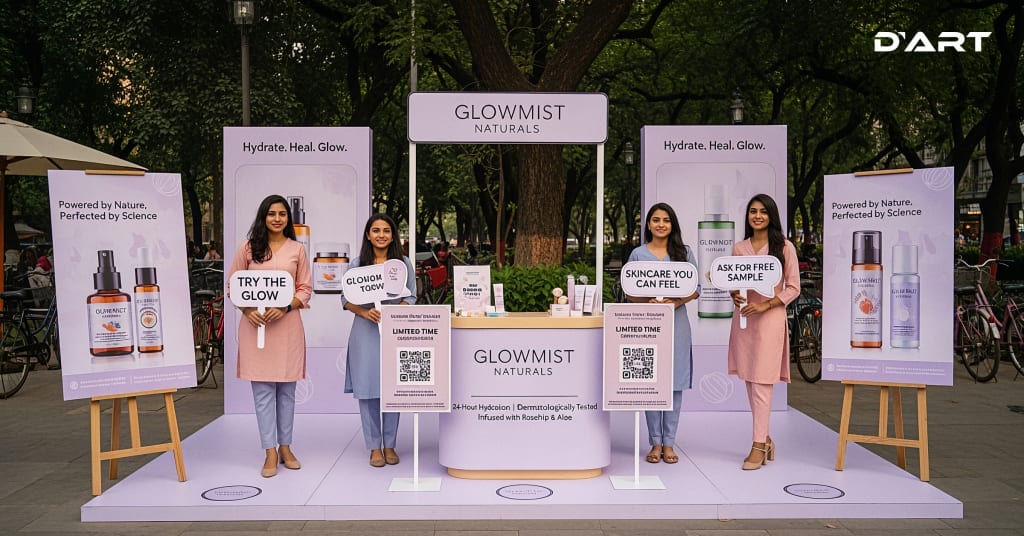
In today’s overstimulated world of advertising fatigue and content saturation, it has become a challenging task for retailers to promote brand recall through traditional branding. But clearly, when the logos fade, it is the experience that stays. This is exactly where the concept of experiential marketing steps in. It is not just a creative retail strategy but a psychological aspect that shapes customers’ perception, memory, feelings, and actions towards a brand.
Well, most of us assume below the line marketing services to be all about setting up booths, events, or sampling counters. However, the respective concept goes way beyond this. It is more about creating experiences that stick with the customers. And when done right, BTL does not just create footfall, but instead, it creates brand recall that outperforms various other media campaigns.
This insightful topic will explore how experiential below the line marketing tactics help brands shape customers’ perception and memory. Hence, let us begin with it.
Memory is Emotional, Not Just Informational!
According to Gerald Zaltman, a renowned professor at Harvard University, more than 95 percent of purchasing decisions happen subconsciously. Well, this clearly underlines the fact that logic often takes a back seat when emotion enters the car. Human brains encode memories better when the person is tied to emotionally charged moments like surprise, delight, nostalgia, curiosity, etc.
According to a 2022 study by Neuro Insight, it was found that retail experiences that trigger high emotional intensity deliver more than 3.5X long term memory encoding in comparison to traditional ads. Understand this with an example: a person is obviously more likely to remember a perfume brand from a scent infused pop up lounge than from a television commercial or radio ad.
The Role of Sensory Immersion
The concept of memory and senses go hand in hand as they are deeply connected with each other. According to research by neuroscience, the human brain can actually recall smell linked memories with more than 65% accuracy, even after a year, and just 50% of the visual memories after a few months.
Well, this is the reason why BTL marketing campaigns that engage multiple senses have a higher chance of developing long term emotional and personal connections with customers.
The Principle of Presence: Why Physical Interaction Matters?
The concept of presence goes way beyond just being there. It is more about developing a micro environment where the brand is completely embodied. When a customer steps into immersive setups, they actually become a part of the brand universe and live in that moment.
The field of embodied cognition explains this well. A human being’s physical actions, like holding, touching, interacting, etc., significantly influence the way he or she thinks and remembers.
A study published in the Journal of Consumer Psychology revealed that people who touched a product were 22% more likely to remember the brand in comparison to those who only saw it.
Why Does BTL Works Better in the Attention Economy?
In this rapidly evolving era, the rate of customer attention is decreasing day by day. Modern customers, due to their tight schedule, are always in a hurry. Instead, a study revealed that in 2024, the average attention span during digital scrolling is just 2.5 seconds. As a result, brands are competing for just milliseconds of attention. On the contrary, BTL marketing activities can actually hold customer attention for minutes or even hours in physical spaces.
Well, things are not just about attention. Instead, they are more about attentional depth. That’s exactly where interactivity wins. Any person who spends 10 minutes playing a virtual reality game about sustainability will remember it in a better way than someone who scrolled past a 15 second Instagram ad with the same message.
The Memory Blueprint: Key Levers for Experiential BTL Impact!
So, the question that remains unanswered is: how should brands intentionally design BTL advertising campaigns that leave a long lasting impression on the minds of the viewers? Well, mentioned below are five main psychology backed levers that drive impact.
1. Novelty: Believe it or not, human brains are developed in a manner that they often remember the unfamiliar. Unexpected formats like pop up spas, invisible museums, etc. create immediate curiosity in comparison to the boring, traditional store designs.
2. Multi sensory Engagement: Brands need to implement BTL strategies that appeal to different senses of their customers. Apart from using immersive visual elements, they can integrate texture, texture, temperature, soundscapes, and even curated smells.
3. Narrative Flow: Brands should create unique retail experiences that are similar to a story. For example, they can start with curiosity, build with interaction, and finish with a reward or takeaway.
4. Participation: This point is all about co creation. Interactivity is equal to memory. Clearly, customers always remember things that they were also a part of.
5. Closure Moments: Finishing strong is a must. Presenting the customer with a surprise gift, photo, or personal note will leave a long lasting emotional mark on their mind, further boosting brand recall.
Future Forward: What’s Next for BTL Memory Building?
We all are aware of the fact that there are constant technological updates happening in the world of retail and marketing. Considering this scenario, we can expect that the future of experiential BTL advertising will likely blend AI personalization with immersive technology.
According to a 2023 report by WARC, it was predicted that 60% of the leading retail brands will shift more than 25% of their experiential budgets to tech augmented BTL initiatives by 2027 in order to boost brand recall and enhance their loyal customer base.
Winding Up: Building Brands by Building Memories
It is very clear that experiential BTL marketing is not just about scaling. Instead, it is actually about developing emotional depth. The whole concept is based on a simple truth: people might forget what you say but will also remember how you made them feel.
When retail brands don't just relate their presence with location but instead embrace it as emotion, they allow the customers to remember, relive, and return. This is because the battle of mindshare is not about the loudest voice but about the most memorable presence.
About the Creator
D'Art Design
D’Art Design is a leading global retail design agency. We integrate tactic to provide outstanding experiences, through brand communication and activation, brand design, promotion, and interior design.
Keep reading
More stories from D'Art Design and writers in Journal and other communities.
How Effective Retail Store Deployment Reinforces Brand Identity?
It is often assumed that with the advent of online retail, physical outlets will no longer be operational. However, this isn’t the truth. In this highly competitive retail landscape, where people prefer online shopping and quick commerce platforms, physical stores are still a very powerful tool to express a brand’s identity. Online presence is undoubtedly essential, but brick and mortar spaces continue to offer something that digital channels can never: a tangible, long lasting, and immersive brand experience.
By D'Art Design7 months ago in Journal
~ Fired ~
— Ai Intrusion ~ Are you Next ~ Is Ai Evolution after your job? — Few workplaces haven't been affected. Ai is in supermarkets, at doctors' offices, and even monitoring farms. I just can't think of anything this machine is not getting into, can you? For instance: Education ~ Law and Tech jobs will one day have a major influence or be taken over by these inanimate machines, with accuracy and vigor. From mechanics' diagnoses to a wide variety of everyday jobs, including fast food workers, with this input having the ability to cut their unnecessary work hours. I'm certain all of us have been touched by this with our short stories and colorful headings, have you? Even comments are very questionable 'Non-Robot' insertions.
By Jay Kantor28 days ago in Journal
Hiring Qualified Therapists for Partial Hospitalization Programming Programs
Understanding Partial Hospitalization Programs Partial Hospitalization Programs (PHPs) provide intensive, structured mental health treatment while allowing patients to return home daily. Unlike residential programs, PHPs strike a balance between rigorous clinical intervention and community integration. The nuanced nature of these programs demands not only therapeutic expertise but also a deep understanding of patient monitoring, crisis management, and individualized care planning. PHPs often address complex psychiatric conditions, necessitating a blend of psychotherapy, behavioral interventions, and pharmacological oversight. Recognizing this unique operational framework underscores the necessity for highly skilled professionals who can navigate the delicate interplay between clinical intensity and patient autonomy.
By Fida Hassain4 days ago in Journal




Comments
There are no comments for this story
Be the first to respond and start the conversation.