
Holocaust (1975)
A Review of the Made-For-Television Film of 1978

The planned genocide of ALL the world's Jewish people by the Nazi regime during World War 2 has come to be known as "the Holocaust," which is a Greek word that derives from the concept of "destruction by fire." It began with the racist Nuremberg Laws when Hitler came to power; it ended with millions upon millions dead at concentration death and slave labor camps such as Auschwitz, Treblinka, Bergen-Belsen, Buchenwald, and Sobibor. Millions of beautiful, innocent, and valuable human beings were killed for no other reason than they were Jewish; other victim's groups included Roma ("Gypsies"), homosexuals, communists and socialists, the mentally or physically disabled, and members of pacifist and "uncooperative" religious groups, such as the Jehova's Witnesses. To be a dissident in Nazi Germany, or show ANY resistance to them or their plan for world domination and mass murder on an unimaginable scale, meant death.
I first read the book Holocaust by Gerald Green, a novelization of this mini-series, decades before I ever saw the series. Watching that seven-hour epic was both pain and pleasure, a kind of revelatory masochism almost. It made me feel the deep tragedy and guilt for the human condition, and it also raised the specter of sheer, brutal, deep anger in myself, both at the Germans, who, so many of them, let themselves be beguiled by the Svengali-like influence of the tyrant Hitler; and who, likewise, totally subsumed themselves in an ideology of genocidal hatred, one where, in the words of actor Michael Moriarty (who plays a young, lawyer, Erik Dorf, who becomes an S.S. officer and a total "true believer") "We had to kill the children[...]those same children would have one day grown up and destroyed Germany."
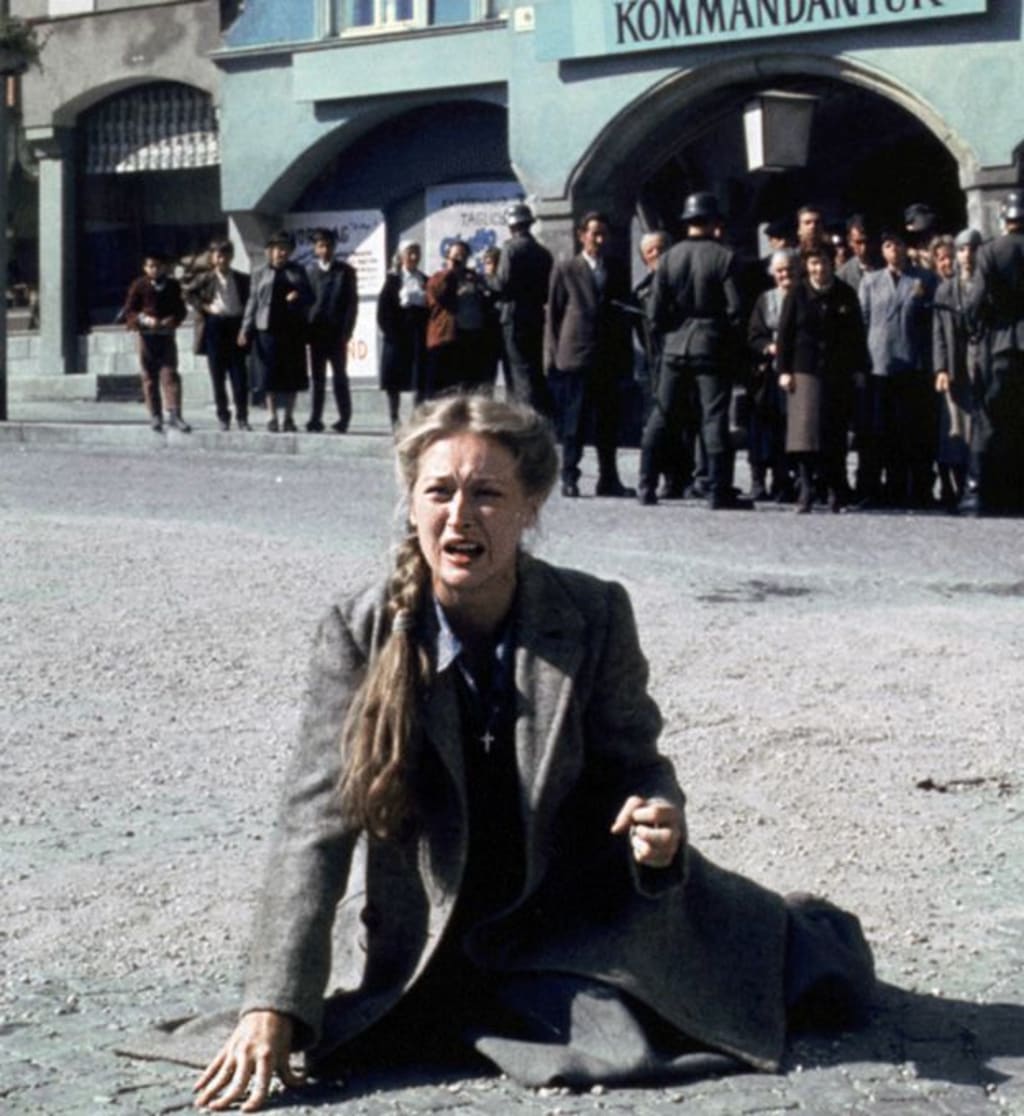
Holocaust is the sage of the family of Dr. Weiss (Fritz Weaver), whose son, the artist Karl (James Woods), is an out-of-work Jewish artist, but whose new bride, Inga, played by Meryl Streep, is a gentile. At the wedding, what is about to happen, historically, is foreshadowed at the reception by the attendance of a young relative in his shiny new Nazi uniform, and his colleague, who, likewise, becomes an S.S. officer.
Scenes from Holocaust (1978)
The essentials of the film, and the way it places each family member in a crucial aspect of history as it unfolds, is a kind of quick foreshortening of history. But it misses NO points. Slowly, the net of discrimination, dehumanization, and "race laws" tightens around the Jewish people. They are subject to tighter and tighter control, and the grandparents are beaten during Kristallnacht. The young son, Rudi (Joseph Bottoms), who is an eager and good football player, is kicked off the team for being Jewish. His sister (Deborah Norton) is raped by S.S. officers, and she is taken to an asylum, where she is gassed under Hitler's T4 program. Rudi runs away, and his father is deported to Poland, now forbidden to treat "Aryan" patients. He becomes a doctor in the Warsaw Ghetto.
Karl is arrested by the Gestapo and ends up breaking rocks at Buchenwald, before his artistic skills see him transferred to the Nazi, phony "model" camp at Thieresenstadt. Inga smuggles letters through to Karl by sleeping with the toad-like S.S. man in charge, but, eventually, Karl, because of the sale to a guard (by another artist) of grim depictions of camp life in certain hidden drawings, ends up at Auschwitz (after having his hands broken so he can no longer work).
Meanwhile, another plotline sees Erik, a young lawyer (portrayed by Michael Moriarty), join Reinhard Heydrich's S.S. and become his chief adjutant. Heidrich, portrayed by the late David Warner, is a lethal, emotional iceberg, but with a seeming undercurrent of psychological dissonance. He is actually less repellent though than Moriarty's character, who progresses into a cyborg-like brainwashed Nazi militant, one who does not blanch at the "righteous" nature of their work, killing millions of innocent men, women, and children; because she puts it, "We'll be able to make our case[....] as a necessity, for protecting Western Civilization." He later says, "Don't you see? We can't quit killing them. Because to quit, is to admit[...] we were wrong."
Himmler (as portrayed by the late Ian Holm) likewise comes off as bland, civil, yet paradoxically monstrous, as he congratulates his underlings for all remaining "loving men," as they stack up a mountain of corpses, every single day.
Rudi escapes to Ukraine, where he falls in love with a young girl (Tovah Feldshuh) after being rescued, and they both join a Jewish partisan group led by "Uncle Sasha" (Lee Montague). After commencing a series of raids (and witnessing the infamous Baba Yar Massacre, a mass murder in which the Nazis actually exhumed the bodies of their victims to burn, to try and hide the evidence of their crimes from the advancing Soviet Army), his wife is killed, and he ends up in the famous escape from Sobibor, following the lead of Leon, a Red Army lieutenant.
Dr. Weiss ends up being deported to Auschwitz. Before, he has been operating a 'clinic" to try and divert inmates from being transported via cattle cart to Auschwitz, by claiming they are ill with typhus. His wife (portrayed by Deborah Harris, who has been living with Inga's hostile parents), is likewise sent to Auschwitz, where she is gassed (this is shown).
After grueling, inhuman slave labor on a road crew, he likewise is murdered. (A somewhat sympathetic civil engineer who is the boss, and a relative of Moriaty's S.S. man, inflames the Nazi militant by using Jews instead of Russians and Poles on his work crew, thus, leading to Dr. Weiss's eventual killing.)
Karl, also taken by train to Auschwitz, arrives and rejoins Inga, who informs him she is pregnant. He dies, leaning over his final drawings, but Inga survives to liberation, and meets Rudi afterward. We also have a recreation of the Warsaw Ghetto Uprising, in which it is first learned, by disbelieving people, that the Nazis have been GASSING Jews. They began to smuggle in weapons from Polish resistance fighters, making one heroic, noble last stand, before they are overwhelmed by the S.S., marched in front of a wall, and, in a moving scene, one says the "Shma Yisrael" before they are shot.
Rudi, after the war, is recruited to smuggle Jewish children to Palestine. Which, in three years will become modern Israel. He ends the film as he began it, playing soccer. Yet, his entire family, save for sister-in-law Inga and his little nephew, is now dead.
The loathsome Erik ends up an Allied prisoner and commits suicide by taking a hidden cyanide caplet. No one in the audience will be saddened by this. (Note: Erik is accused of having distant Jewish ancestry, and of having attended "communist" meetings. This is in an anonymous letter to Heydrich.)
This film was a firebrand of controversy, with Holocaust survivor and Nobel Laureate Elie Wiesel calling it, "Cheap, untrue, offensive." However, it was a huge success in, of all places, Germany, where after each segment, according to Wikipedia, historians were impaneled to answer calls from outraged viewers who called in asking how such events could ever have happened. It was both excoriated and praised, but, regardless was one of the first full-length films to be presented to American audiences about the Holocaust.
The film uses its fictional characters and puts them in shortened historical frameworks or events that seem 'truncated", but this is a result of the constraints of time and the limitations of the television format. This is in NO WAY to suggest that the film lacks emotional impact, or that it is simply a series of historical recreations; the viewer will follow the tragedy unfolding in the characters' lives, and will be impacted by it on a deep, visceral level, and will learn that man, that most righteous and noble and intelligent of all the animals, the "upright beast," is capable of evil so lethal and poisonous it is unimaginable to the average mind.
Young viewers, especially, should see this film. It simplifies history and dramatizes it in a way that may educate them as no simple classroom lecture could. They will identify with Karl, with Rudi, with Marta, and with the struggle of a people to survive when, seemingly, every demon of hell had been belched forth at them for six long years.
And it may teach them an important lesson: about remaining human, resisting the lure of evil, and why "we keep them standing" (the vacant concentration death camps). As a reminder, as Rod Serling once said, in an outro to an episode of "The Twilight Zone" that dealt with just this subject. That we must, in the face of great evil, not remain idle, "wherever men walk God's Earth."
About the Creator
Tom Baker
Author of Haunted Indianapolis, Indiana Ghost Folklore, Midwest Maniacs, Midwest UFOs and Beyond, Scary Urban Legends, 50 Famous Fables and Folk Tales, and Notorious Crimes of the Upper Midwest.: http://tombakerbooks.weebly.com
Scary Movie 6 Leaks Ands All You Need To Know
The horror-comedy genre is officially back in the spotlight, and this time it arrives with a self-aware twist worthy of its legacy. Scary Movie 6 is already generating massive buzz — not only because it marks the long-awaited return of the Wayans creative force, but because Marlon Wayans decided to “bootleg” his own trailer before its official wide release.
By Omasanjuwa Ogharandukun8 days ago in Journal



Comments
There are no comments for this story
Be the first to respond and start the conversation.