
Hindus Crazy beliefs
A Critical Reflection on Certain Hindu Beliefs and Practices
By: Fawad Khan
Introduction
Hinduism, regarded as one of the oldest living religions, is a complex amalgamation of spiritual traditions, philosophies, rituals, and societal values. Rooted in the Indian subcontinent, it has evolved over thousands of years, influenced by various cultural, historical, and philosophical streams. However, due to its vast diversity and regional variations, many of its practices remain controversial, misunderstood, or subjected to criticism, both internally and externally. This journal aims to critically explore certain Hindu beliefs and rituals that are often questioned or misrepresented, with the goal of understanding their origins, symbolic meanings, and impact on society today. The goal is not to mock or belittle but to engage with a spirit of respectful inquiry and reasoned critique.
1. Sacred Cow: Symbol of Purity or Superstition?
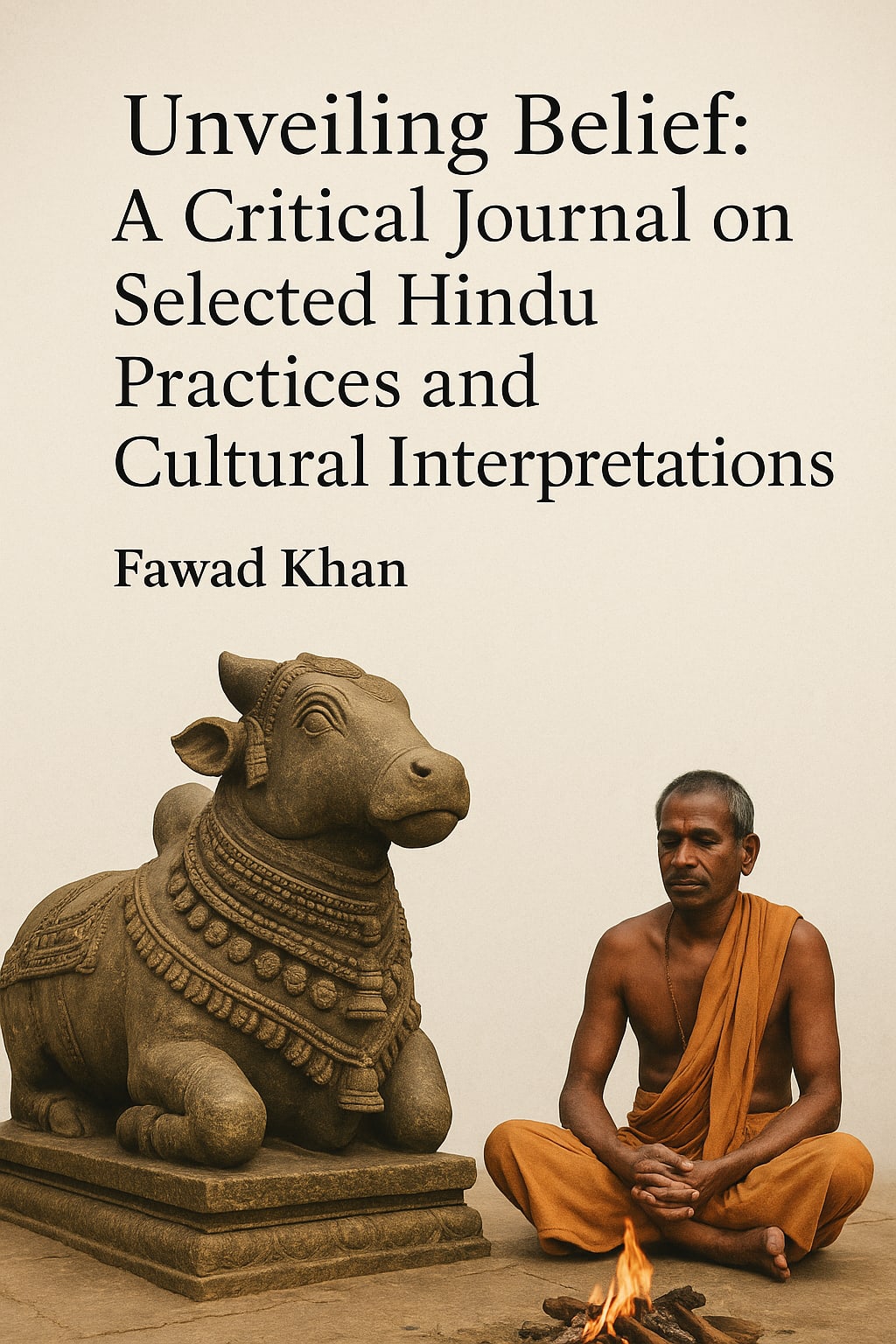
Among the most iconic symbols of Hinduism is the cow, revered as a sacred animal. In many Hindu communities, the cow is considered a maternal figure ("Gau Mata") and a symbol of selfless giving, as it provides milk and other resources. This reverence has led to a wide range of practices, including the prohibition of beef consumption, the establishment of cow shelters (gaushalas), and the use of cow urine and dung in rituals and Ayurvedic medicine.
Some sects even advocate for the ingestion of cow urine or the application of cow dung as a form of spiritual or physical healing. While certain compounds in cow products may have antiseptic properties, the scientific community does not support the claim that these substances cure serious diseases like cancer or COVID-19, as was claimed by some Hindu fringe groups during the pandemic.
Critics argue that such beliefs, when elevated to the level of unquestionable truth, can lead to superstition and health hazards. The veneration of the cow has also become a politically charged issue, particularly in modern India, where cow protection laws have been used to justify violence against minority communities accused of cow slaughter.
From a rational standpoint, the respect for animals and sustainable living is admirable. However, blind belief in the miraculous power of cow waste without scientific validation risks turning a cultural tradition into dogma.
2. Vegetarianism: Spiritual Discipline or Cultural Mandate?
Vegetarianism is widely practiced among Hindus, especially among upper castes like Brahmins and Vaishnavites. This dietary choice is often associated with the principle of ahimsa (non-violence) and spiritual purity. However, the history of Hinduism reveals a more nuanced picture. Ancient Hindu scriptures, including parts of the Vedas and epics like the Mahabharata, mention animal sacrifices and meat consumption by sages and warriors.
The strict vegetarianism followed today in many Hindu households appears to be a later development, influenced by Jainism and Buddhist teachings, as well as caste-based notions of purity and pollution. While vegetarianism can offer health and ethical benefits, turning it into a rigid religious obligation can create moral hierarchies that stigmatize meat-eaters, often those from lower castes or minority groups.
The idea that eating meat inherently defiles a person is not universally supported even within Hindu philosophy. The Bhagavad Gita emphasizes the intent and attitude of the individual over specific dietary practices. Therefore, while vegetarianism can be a meaningful personal choice, its enforcement as a religious mandate may reflect social control more than spiritual elevation.
3. Idol Worship: Symbolic Devotion or Literal Stone Worship?
One of the most debated aspects of Hinduism is murti puja, the practice of worshipping deities in the form of idols. To the devout Hindu, these idols are not just pieces of stone or metal; they are embodiments of divine energy, consecrated through rituals and devotion.
However, to outsiders—and even to some reformist Hindus—this practice can appear as literal idol worship, a form of superstition. Critics argue that praying to a statue contradicts the philosophical teachings of Hinduism that describe God as formless, omnipresent, and beyond human comprehension (nirguna Brahman).
Defenders of idol worship argue that humans often need a tangible form to focus their minds and hearts during prayer, and that idols serve as symbolic tools for devotion, not as gods themselves. Still, when rituals become mechanized or when people believe that mere acts of offering food or flowers to a statue will solve their problems, the practice risks degenerating into ritualism devoid of inner spiritual growth.
4. Rebirth and Karma: Philosophical Insight or Fatalistic Trap?
The concepts of reincarnation (samsara) and karma form the backbone of Hindu metaphysics. According to this worldview, every soul passes through multiple lives based on its past actions, and the ultimate goal is liberation (moksha) from this cycle. Hindu texts speak of seven or more cycles of rebirth, depending on one's karma and level of spiritual progress.
While this belief can offer comfort—especially in explaining suffering or injustice—it also has potential drawbacks. When misinterpreted, karma can be used to justify social inequalities, such as the caste system, by suggesting that one's present condition is the result of past-life deeds. This can discourage social reform and personal accountability.
Furthermore, the focus on otherworldly liberation may distract believers from engaging fully with the realities and responsibilities of the present life. A balanced understanding of karma should empower ethical action and compassion, not promote passivity or victim-blaming.
5. Death Rituals: Burning Bodies and Journey to the Next Life
Hindu funeral rites typically involve the cremation of the dead, followed by rituals intended to guide the soul toward its next destination. Fire is considered a purifier, and cremation is seen as a way to release the soul from its earthly bondage.
While this practice has deep symbolic meaning, environmentalists have raised concerns about the ecological impact of traditional open-air cremations, which consume large amounts of wood and release pollutants. In recent years, electric crematoriums and eco-friendly alternatives have been introduced, but traditionalists often resist these innovations.
Additionally, the elaborate rituals associated with death can be financially burdensome for poor families. The emphasis on ritual correctness sometimes overshadows the emotional and spiritual needs of the grieving. Reformers argue for a more compassionate and sustainable approach that retains the spiritual essence without rigid formalism.
6. The Role of Astrology, Superstition, and Ritualism
Astrology (Jyotish Shastra) plays a significant role in the daily lives of many Hindus. From marriage compatibility to business ventures, celestial charts often dictate important decisions. While astrology is rooted in ancient mathematical and observational traditions, it lacks empirical validation and is often exploited by unscrupulous practitioners.
Similarly, a strong belief in omens, rituals, and taboos—such as not starting a journey on certain days, or the belief that sneezing before a task is unlucky—reflects a cultural mindset that may hinder rational thinking and decision-making. These superstitions, while part of cultural heritage, need to be questioned when they interfere with progress or promote fear-based behavior.
7. Caste and Religious Orthodoxy: A Legacy of Inequality
Although the caste system is not a belief exclusive to Hinduism, it has been historically justified using Hindu scriptures like Manusmriti. The belief that a person’s worth and role in society are determined by birth rather than merit contradicts modern ideals of equality and justice.
The caste system has led to widespread discrimination, particularly against Dalits (formerly known as untouchables), who are often denied temple entry, education, and basic human rights in some parts of India. While many reform movements within Hinduism, such as the Bhakti and Arya Samaj movements, have challenged caste orthodoxy, the problem persists.
The religious justification of social hierarchy is a distortion of spiritual principles. The core Hindu teaching that "the divine resides in all beings" should inspire inclusion and compassion, not exclusion and privilege.
Conclusion: Seeking Truth Beyond Tradition
Religious beliefs and practices, when rooted in deep insight and ethical values, can uplift individuals and societies. However, when rituals become mechanical, when symbols are mistaken for substance, and when dogma overrides reason, even the most ancient traditions can become obstacles to growth.
Hinduism is a vast and multifaceted tradition, and its strength lies in its ability to adapt and evolve. By critically examining certain practices—like cow veneration, idol worship, reincarnation, death rituals, and dietary laws—we open the door to a more informed, inclusive, and spiritually grounded understanding of the faith.
True spirituality transcends ritual and identity. It calls for inner transformation, compassion, and truth. As seekers of knowledge and truth, we must respect traditions while having the courage to question and reform them in the light of reason and humanity.
In the end, the goal is not to reject belief but to purify it—so that religion becomes a source of wisdom, not superstition; a force for unity, not division; and a path toward enlightenment, not ignorance.
About the Creator
Fawad Khan
I’m Fawad Khan a passionate speaker and researcher sharing journals, fiction, history, education, current affairs, and English literature. With deep research and clear voice, I bring knowledge to life. Learn,grow, and stay informed with me.
Keep reading
More stories from Fawad Khan and writers in Journal and other communities.
Love or Money
In the grand journey of life, two forces often seem to tug us in opposite directions: love and money. One is the heartbeat of emotion, connection, and purpose; the other is the fuel for survival, security, and ambition. While both are undeniably essential in today’s world, the question remains: if you had to choose between love or money, what would you choose?
By Fawad Khan11 months ago in Journal




Comments (1)
I agreed with you