
GOP Senator Helps Police Remove Anti-War Protester From Capitol Hill Hearing
Republican Senator Tim Sheehy assisted Capitol Police in removing an anti-war protester from a Senate Armed Services hearing on Capitol Hill. The protester claims his arm was broken during the incident.

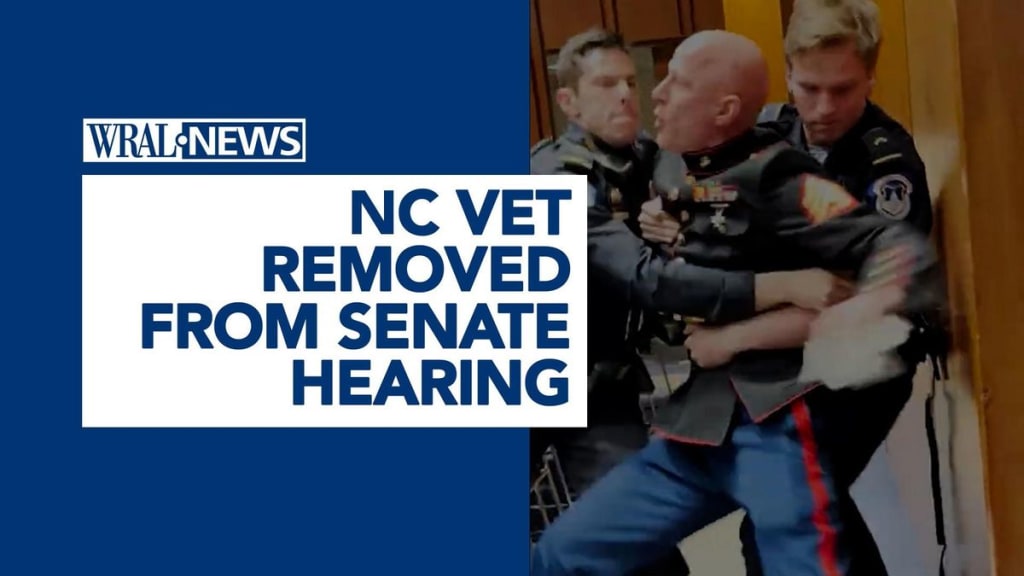
A tense moment unfolded on Capitol Hill when Tim Sheehy, a Republican senator from Montana, joined law enforcement officers to physically remove an anti-war protester who interrupted a congressional hearing.
The incident occurred Wednesday during a session of the United States Senate Armed Services Committee, where military leaders were testifying about national defense readiness. What began as a routine hearing quickly escalated into a dramatic confrontation involving police, a political protester, and a sitting U.S. senator.
The protester—identified as Brian McGinnis—is a Marine veteran and Green Party candidate running for the U.S. Senate in North Carolina.
Protest Disrupts Senate Hearing
Roughly 30 minutes into the hearing, McGinnis suddenly stood up and began shouting objections related to U.S. foreign policy.
Witnesses say he loudly criticized American involvement in the conflict between Israel and Iran, declaring that the United States should not send soldiers into war on behalf of foreign interests.
His interruption quickly drew the attention of officers from the United States Capitol Police, who moved in to remove him from the hearing room.
Protests are not permitted inside congressional buildings, and Capitol Police are responsible for maintaining order during legislative proceedings.
Senator Steps In to Help Officers
Video from the hearing shows officers attempting to escort McGinnis out of the room as he resisted their efforts.
During the struggle, Senator Sheehy left his seat at the dais and moved toward the doorway where officers were attempting to remove the protester.
According to footage shared by activists, Sheehy appeared to help officers lift McGinnis and guide him out of the hearing chamber.
At one point during the confrontation, McGinnis’ hand appeared to become trapped between the door and its frame.
Observers in the room could be heard asking whether his hand had been injured.
McGinnis later responded that it was.
Protester Claims His Arm Was Broken
Following the incident, McGinnis told people nearby that his left arm had been broken during the confrontation.
His campaign manager, Mark Elbourno, later confirmed that McGinnis was taken into custody and transported to a hospital—identified as George Washington University Hospital—for treatment.
Elbourno strongly disputed police claims that McGinnis assaulted officers.
“He wasn’t assaulting anybody,” Elbourno said. “He just wanted to be heard.”
According to the campaign manager, McGinnis attended the hearing with the intention of confronting lawmakers about continued funding for military operations related to the Middle East conflict.
Capitol Police Offer a Different Account
Authorities, however, presented a much different version of events.
In a statement, Capitol Police said McGinnis violently resisted officers attempting to remove him and created a dangerous situation inside the hearing room.
Police also claimed the protester intentionally wedged his arm in the doorway while trying to push back into the hearing chamber.
According to the department, three officers suffered injuries during the struggle and were treated by emergency medical personnel.
As a result, McGinnis now faces multiple criminal charges, including:
Three counts of assaulting a police officer
Three counts of resisting arrest
One count of crowding, obstructing, and incommoding—a charge often used when individuals block entrances or passageways in government buildings
Authorities emphasized that while public demonstrations are allowed on Capitol grounds, protests inside congressional buildings are prohibited.
Senator Sheehy Defends His Actions
After the confrontation, Senator Sheehy addressed the incident in a post on social media platform X.
He said he stepped in to assist officers because the protester was physically resisting removal.
According to Sheehy, his goal was to help de-escalate the situation and ensure officers could safely remove the individual from the hearing room.
“This gentleman came to the Capitol looking for a confrontation, and he got one,” Sheehy wrote.
He added that he hoped the protester would receive help without creating further violence.
Sheehy’s office has not released additional comments about the incident.
A Broader Debate About Protest and Free Speech
The dramatic scene has already sparked debate about the limits of protest inside government institutions.
Supporters of McGinnis argue the incident highlights the frustration many Americans feel about U.S. involvement in overseas conflicts.
Critics, however, say congressional hearings must remain orderly and that disruptions undermine the democratic process.
Security rules inside the U.S. Capitol are strict, especially after years of heightened concerns about safety within federal buildings.
For that reason, Capitol Police are authorized to immediately remove individuals who interrupt official proceedings.
What Happens Next
McGinnis’ medical condition has not been publicly confirmed beyond his claim of a broken arm.
If prosecutors move forward with the charges outlined by Capitol Police, the case could lead to court proceedings in Washington, D.C.
Meanwhile, the viral footage of the incident continues to circulate online, fueling ongoing political debate.
For many observers, the episode illustrates the increasingly tense intersection of protest, politics, and national security in Washington.
Whether viewed as an act of civil disobedience or a violation of congressional rules, the confrontation has already become one of the most talked-about moments on Capitol Hill this week.
About the Creator
Omasanjuwa Ogharandukun
I'm a passionate writer & blogger crafting inspiring stories from everyday life. Through vivid words and thoughtful insights, I spark conversations and ignite change—one post at a time.
Keep reading
More stories from Omasanjuwa Ogharandukun and writers in Journal and other communities.
FBI Probes Possible Terrorism Link in Deadly Austin Bar Shooting
The FBI and Joint Terrorism Task Force are investigating a deadly bar shooting in Austin, Texas, that left two dead and 14 injured. Authorities are examining possible terrorism links, the suspect’s background, and the broader implications for public safety.
By Omasanjuwa Ogharandukun4 days ago in Journal
Why Ethical SEO Practices Are Essential for Long-Term Drug Rehab Marketing Success
Understanding Ethical SEO in the Context of Drug Rehab Marketing Ethical SEO, in the realm of drug rehab marketing, is the deliberate application of strategies that prioritize transparency, integrity, and compliance with search engine guidelines. Unlike manipulative tactics, ethical SEO seeks to enhance visibility without compromising credibility. For drug rehabilitation centers, where trust and reliability are paramount, employing ethical SEO ensures that prospective clients encounter accurate, supportive information rather than misleading promises. This approach fosters both immediate engagement and sustained growth, establishing a reputation grounded in authenticity. The use of ethically optimized meta descriptions, accurate schema markup, and precise keyword integration exemplifies how a methodical, principled approach can elevate search engine performance without courting risk.
By Fida Hassain3 days ago in Journal




Comments
There are no comments for this story
Be the first to respond and start the conversation.